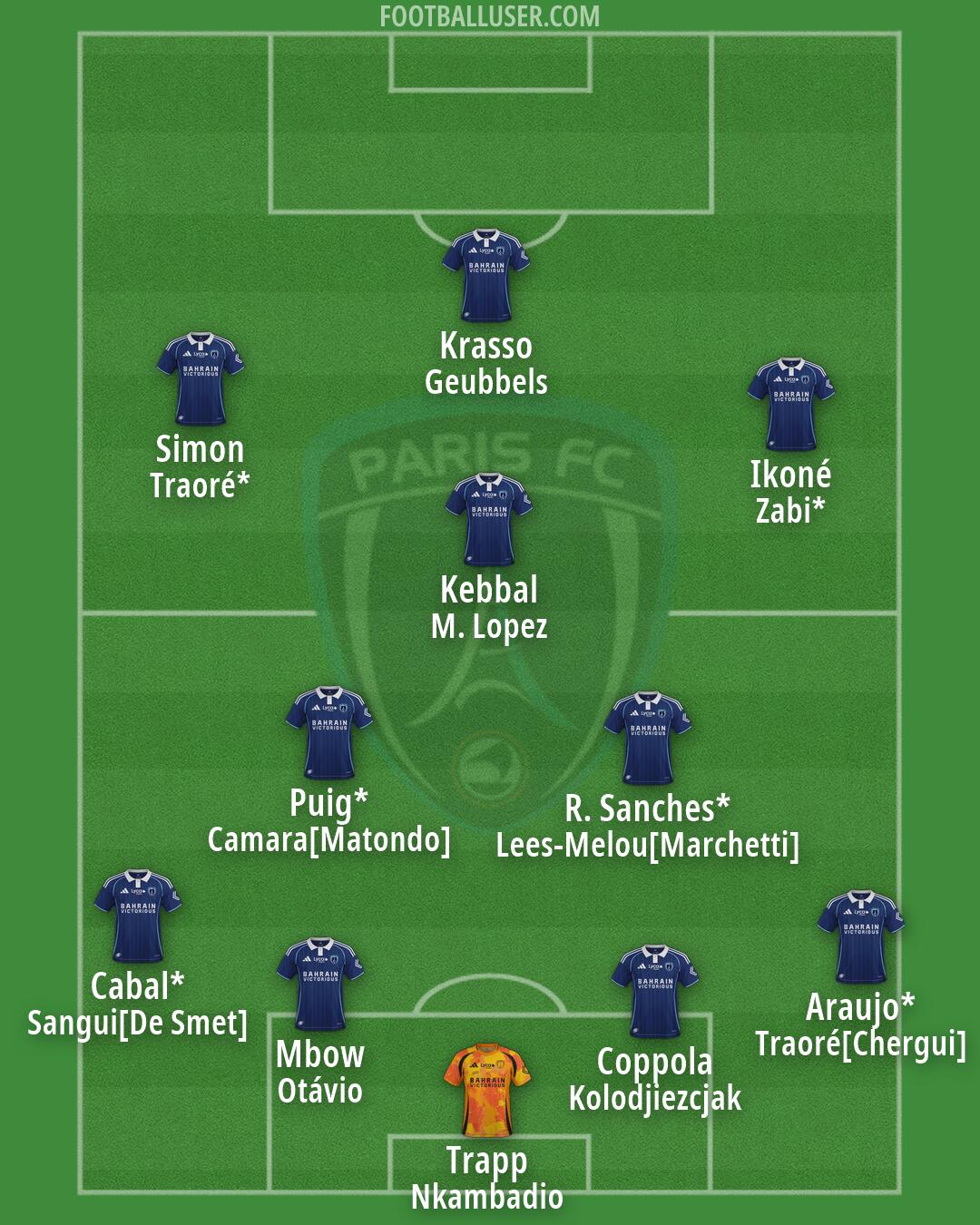

Paris FC Football Formation
 May 16, 2026
 Rebuild Master


Starting Lineup
Trapp (Nkambadio) · Cabal* (Sangui[De Smet]) · Mbow (Otávio) · Coppola (Kolodjiezcjak) · Araujo* (Traoré[Chergui]) · Puig* (Camara[Matondo]) · R. Sanches* (Lees-Melou[Marchetti]) · Kebbal (M. Lopez) · Simon (Traoré*) · Krasso (Geubbels) · Ikoné (Zabi*)Paris FC uses a 4-3-3 formation to play a direct and vertical style of football. This lineup aims to control the tempo through a strong midfield presence while looking to exploit spaces behind the opposition defense. The goal is to use quick transitions to catch opponents out of position.
Trapp acts as the last line of defense in goal. The back line operates as a flat back four with Araujo and Cabal playing as full backs. Araujo is expected to push up the flank to provide width while Cabal offers support from the opposite side. In the center, Coppola and Mbow form the defensive pairing, with Mbow providing aerial strength and Coppola covering the space behind the full backs. The unit works together to keep a high line and push the opposition back.
The midfield functions with a mix of roles to link the defense to the attack. R. Sanches and Puig operate in the central areas, where they look to control the ball and break the line with vertical passes. R. Sanches provides energy to drive forward, while Puig works to connect the play. Kebbal plays as the attacking ten ahead of them, looking to create chances in the final third. This midfield group is responsible for shielding the back four and making sure the ball moves quickly toward the front line.
In the attacking third, Paris FC employs three attackers. Krasso acts as the lone striker to hold up the ball and provide a central target. On the wings, Ikoné and Simon operate as wide attackers who look to cut inside or beat their markers to deliver crosses. The attackers are tasked to press high and force turnovers near the opponent's goal. This movement creates space in the middle for Kebbal to operate.
This formation offers several tactical advantages for Paris FC. The presence of three central midfielders allows for numerical superiority in the middle of the pitch, making it hard for opponents to control the game. The ability to use the full backs to overlap creates wide overloads that pull defenders out of position. Additionally, the quick transitions from the midfield to Ikoné and Simon allow the team to strike fast when they win the ball back.
The 4-3-3 formation provides a balanced way to control the game through central dominance and wide attacking threats. It is best suited for matches against teams that play with a high line or leave gaps between their midfield and defense.