
PSG Football Formation
 May 17, 2026


Starting Lineup
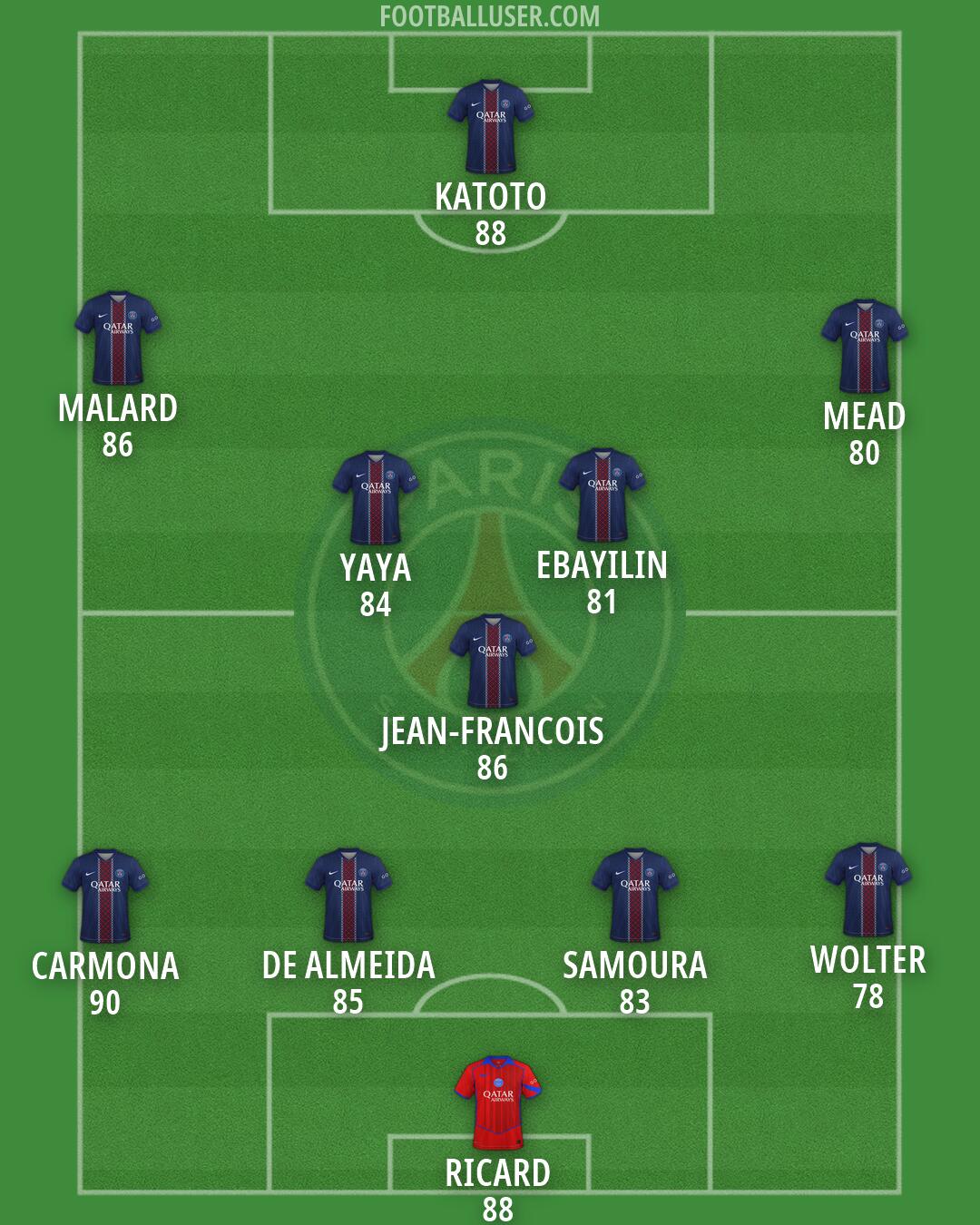
RICARD (88) · CARMONA (90) · DE ALMEIDA (85) · SAMOURA (83) · WOLTER (78) · JEAN-FRANCOIS (86) · MALARD (86) · YAYA (84) · EBAYILIN (81) · MEAD (80) · KATOTO (88)PSG uses a 4-5-1 formation that leans heavily on a high press and quick transitions. This lineup is built to control the central zones of the pitch while forcing the opposition into mistakes through intense pressure. The goal is to win the ball in the middle third and immediately look for ways to break the line to reach the final third.
RICARD stays between the posts to organize the back four. A flat back four consists of WOLTER at right back and CARMONA at left back, who both need to overlap to provide width. In the center, DE ALMEIDA and SAMOURA hold the line, with SAMOURA acting as a cover defender if the line steps up. This defensive unit must stay compact to prevent gaps between the defenders and the midfield.
The midfield functions as a five man block containing a single pivot and four attacking midfielders. JEAN-FRANCOIS sits in front of the defense to shield the back line and intercept passes. Ahead of him, YAYA and EBAYILIN work to connect the play, with EBAYILIN driving forward to support the attack. MALARD and MEAD operate in the half spaces, looking to cut inside and create chances while tracking back to help when the team loses possession.
PSG operates with a lone striker in KATOTO, who must hold up the ball to bring the midfielders into the game. The wide players, MALARD and MEAD, push high to act as wingers, creating width that stretches the opposing defense. When the team attacks, the movement of the midfielders into central pockets allows KATOTO to find space. The forwards press in unison to prevent the opposition from building play from the back.
One major advantage of this formation is the numerical superiority in the central midfield area. By packing the middle with JEAN-FRANCOIS, YAYA, and EBAYILIN, the team can dominate possession and disrupt the opponent's passing lanes. Another strength is the ability to press high in coordinated waves, using the front five to squeeze the space available to the opposing defenders.
This 4-5-1 formation relies on intense work rates and quick ball movement to dominate games. It is best suited for matches against teams that try to play out from the back or those that struggle with high pressure in the middle of the pitch.