
St. Pauli Football Formation
 May 20, 2026


Starting Lineup
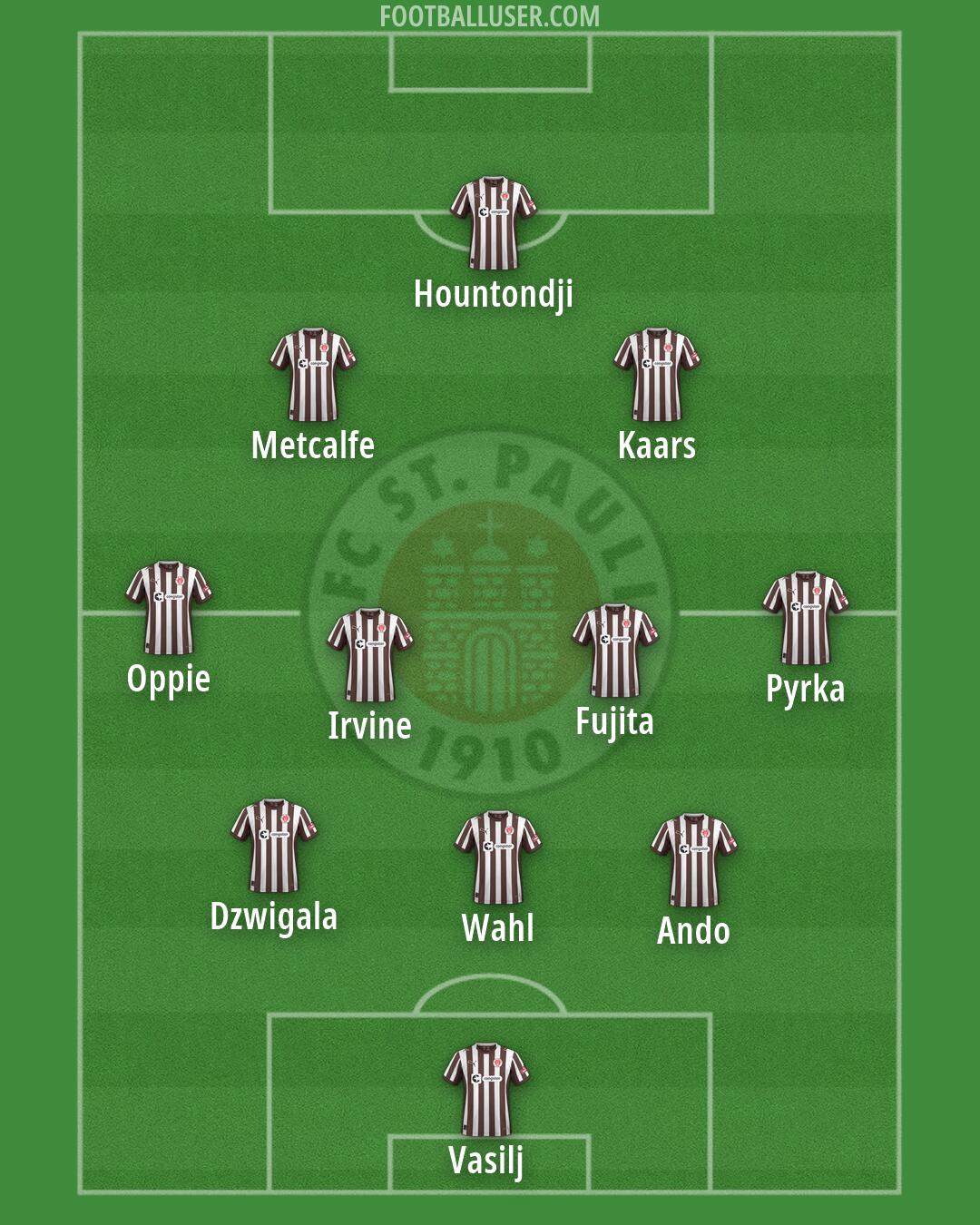
Vasilj · Ando · Wahl · Oppie · Pyrka · Irvine · Fujita · Metcalfe · Dzwigala · Hountondji · KaarsA high pressing identity defines St. Pauli as they operate within a 3-4-3 formation. This lineup focuses on aggressive ball recovery and rapid transitions to catch the opposition out of position. The team aims to dominate much of the game through intense pressure and vertical movements in the final third.
Vasilj acts as the last line of defense within the back three. The defensive unit consists of Ando, Wahl, and Dzwigala, who form a compact block to protect the central area. Ando and Dzwigala sit on the flanks of the back three to cover wide areas and intercept long balls, while Wahl holds the center to dominate in the air and organize the line. This defensive trio works closely to ensure the team can step up and squeeze the space in front of them.
The midfield relies on a central pairing of Irvine and Fujita to control the tempo and connect the defense to the attack. Irvine works to shield the back three and break the lines with his passing, while Fujita drives forward to link the play. On the flanks, Pyrka and Oppie act as wide midfielders who provide the necessary width. These players must track back to support the defenders and shift across the pitch to maintain a solid block when the team does not have the ball.
Attacking movements are driven by a front three of Metcalfe, Kaars, and Hountondji. Metcalfe and Kaars operate as wide attackers who look to cut inside and create chances for the central striker. Hountondji leads the line as a lone striker, tasked to hold up the ball and press the opposition defenders high up the pitch. This attacking unit is designed to create overloads in the channels and force the defense to spread thin.
Several tactical advantages emerge from this St. Pauli formation. The wide midfielders, Pyrka and Oppie, allow for wide overloads when they push high to support the wingers. By using a back three, the team maintains compactness when defending deep, making it difficult for opponents to play through the middle. The coordination between the press and the quick transitions allows the team to isolate wide players in one on one situations frequently.
This 3-4-3 formation prioritizes heavy pressure and verticality to disrupt the rhythm of the game. It is a system best suited for facing teams that struggle to play out from the back under high intensity.