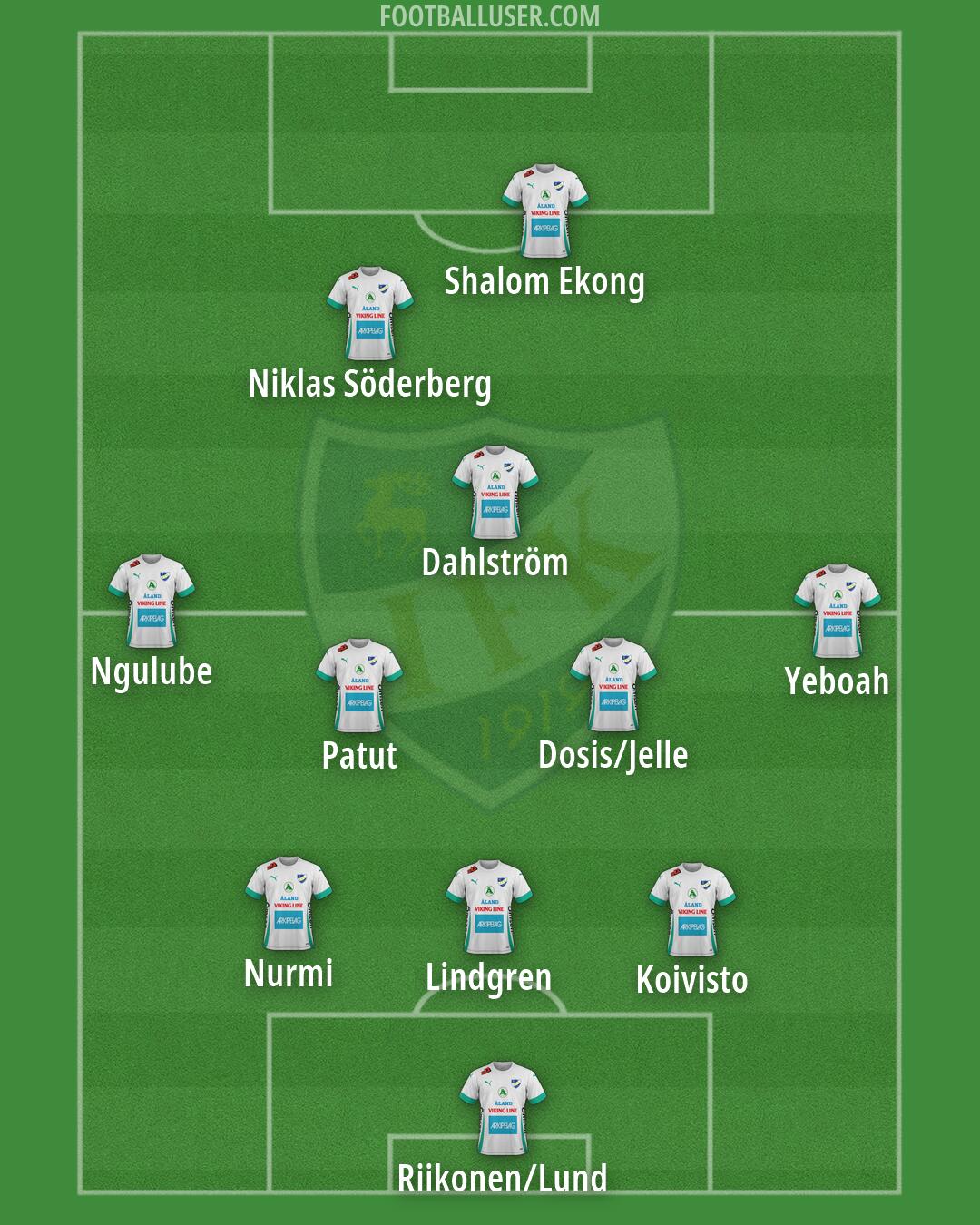

IFK Mariehamn Football Formation
 May 20, 2026


Starting Lineup
Shalom Ekong · Niklas Söderberg · Dahlström · Ngulube · Yeboah · Nurmi · Lindgren · Koivisto · Patut · Dosis/Jelle · Riikonen/LundHeavy central congestion defines the tactical identity of IFK Mariehamn in this 3-6-1 formation. This lineup aims to control the center of the pitch by flooding the middle zones with bodies. The team seeks to dominate ball possession and control the tempo through a dense midfield block. This formation is built to play a game based on possession that stifles opponents in the middle third.
Protecting the goal, Riikonen/Lund acts as the last line of defense. In front, a back three consisting of Koivisto, Lindgren, and Nurmi maintains a tight defensive line. Lindgren sits in the center to command the area and win aerial duels, while Koivisto and Nurmi cover the wide channels to prevent crosses. The defensive unit functions as a whole, often dropping deep to form a low block or stepping up to squeeze the space when the team presses.
The midfield operates as a massive engine to connect the defense to the attack. Patut and Dosis/Jelle act as a double pivot to shield the back three and intercept passes. Moving ahead of them, Yeboah and Ngulube occupy the central spaces to drive the ball forward and break the line. Niklas Söderberg and Dahlström push into the half spaces to link the midfield to the front, creating a crowded central area that makes it hard for opponents to play through.
The attack relies on a lone striker, Shalom Ekong, who stays high to hold up the ball and press the defenders. Instead of traditional wingers, Niklas Söderberg and Dahlström act as wide attacking midfielders who can cut inside or push wide to provide service. This movement creates space for Yeboah or Ngulube to make late runs into the penalty area. The aim is to use the width of the attacking mids to stretch the opponent before playing a pass into the central zone.
A major advantage for IFK Mariehamn is the numerical superiority in the center of the pitch. By playing six players through the middle, the team can easily win second balls and control the rhythm of the game. This formation also offers great compactness when defending, as the players can quickly shift to block passing lanes and close down space. The ability to quickly transition from a defensive block to an attacking wave makes them dangerous during quick breaks.
This 3-6-1 formation prioritizes midfield control and central dominance. It is best suited for games against opponents that attempt to play through the center and struggle with heavy central pressure.