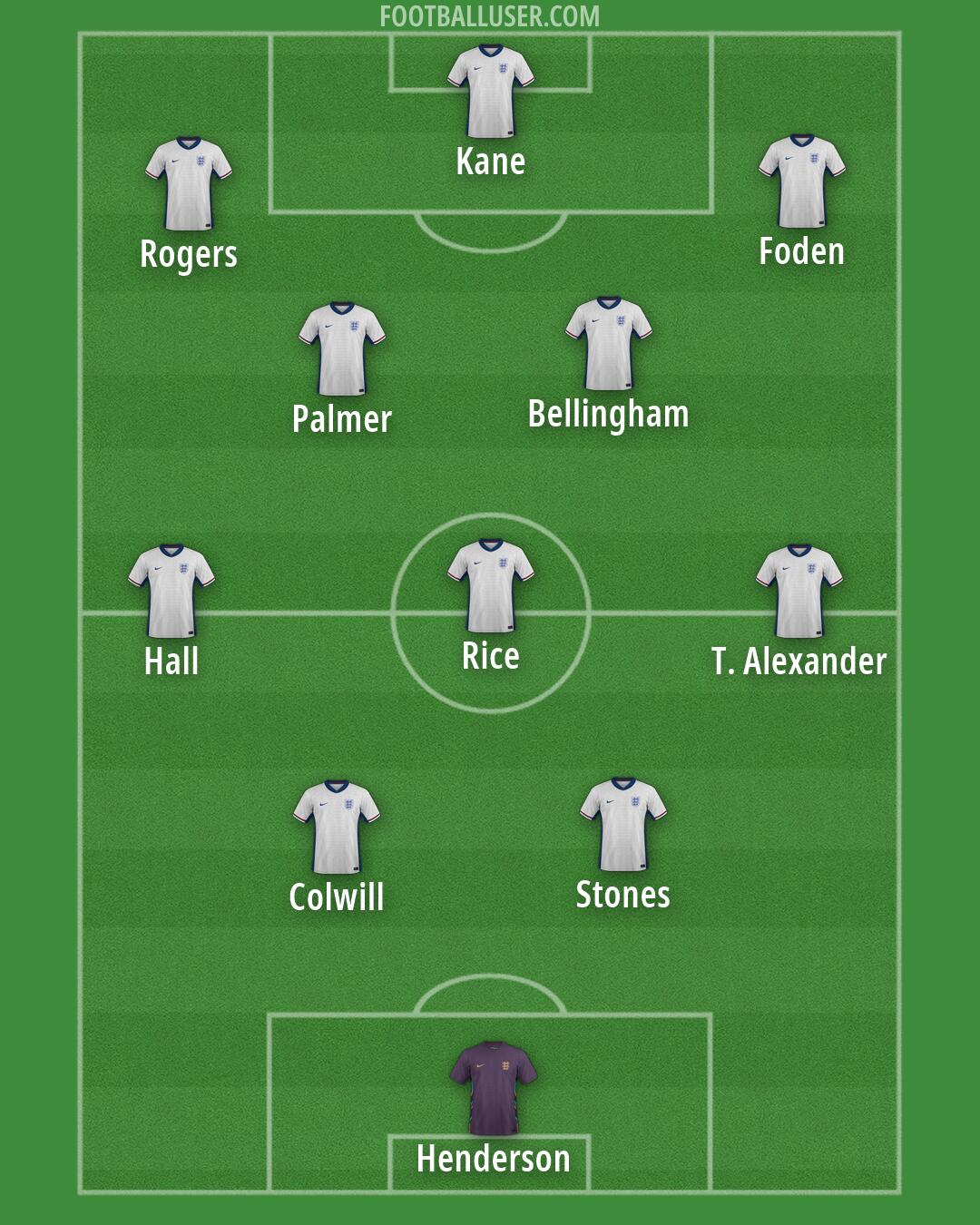
England National Football Team Formation
 May 21, 2026


Starting Lineup
Hall · Colwill · Stones · T. Alexander · Kane · Rogers · Foden · Palmer · Bellingham · Rice · HendersonPrioritizing verticality and high pressure, England operates within a 5-2-3 formation. This lineup aims to dominate territory by pushing players forward quickly to exploit gaps in the opponent defense. The Three Lions look to win the ball high up the pitch and move into the final third with direct passes and rapid movements.
Henderson guards the goal as the last line of defense. A back five sits ahead of him with Rice acting as the central anchor in the defense. Stones provides presence in the middle of that line with his ability to step up into midfield, while Colwill covers the left side of the central defense. T. Alexander operates as the right wing back to provide width, and Hall covers the left flank to ensure the wide areas stay protected. This defensive unit works to maintain compactness and prevent through balls.
The midfield relies on a double pivot to control the center of the pitch. Bellingham drives forward from the right side of this duo, using his ability to carry the ball and break lines. Palmer sits on the left side of the midfield to connect the defense to the attack, often looking to find passing lanes into the forward line. These two players must work hard to track back when possession is lost to prevent counter attacks.
In the attacking phase, England deploys three attackers to stretch the opposition. Kane leads the line as the lone striker, frequently dropping deep to hold up the ball and link play. Foden operates on the right wing as an inverted winger, looking to cut inside and create chances. Rogers stays wide on the left to provide width and deliver crosses, while the movement of the front three forces defenders to stay deep and narrow.
One major advantage for England is the ability to create wide overloads when T. Alexander and Hall push forward to support the wingers. The team can also press high in coordinated waves, using the front three to force mistakes in the opponent half. This setup allows the side to transition from a defensive block to a dangerous attacking unit in seconds.
This formation provides a robust defensive base while allowing for heavy attacking pressure. It is best suited for matches against teams that sit deep and require breaking down a compact low block.