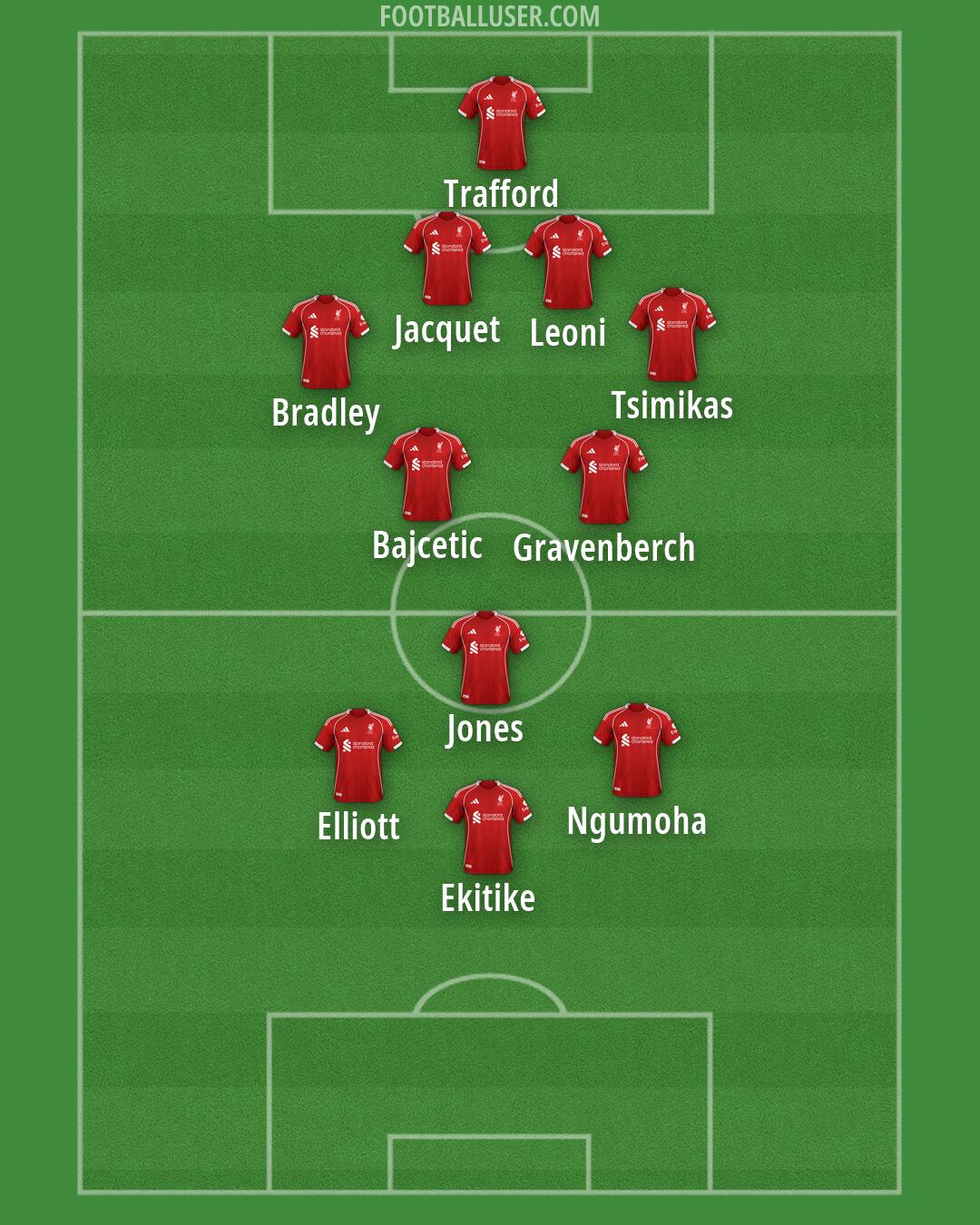
Liverpool Football Formation
 May 24, 2026


Starting Lineup
Ekitike · Elliott · Ngumoha · Bradley · Tsimikas · Leoni · Jacquet · Gravenberch · Bajcetic · Jones · TraffordHigh pressing and rapid transitions define the Liverpool lineup in a 4-3-3 formation. This system seeks to win the ball high up the pitch and quickly push into the final third to catch opponents off guard. By playing with a high line and aggressive intent, the team aims to control the tempo through territorial dominance rather than just holding the ball.
Trafford stays between the posts to organize the back line as the defense pushes high. Jacquet and Leoni act as the central pair, with Jacquet covering the right side and Leoni guarding the left. Bradley pushes forward from right back to provide width, while Tsimikas overlaps on the left to create extra passing lanes. The defenders must step up together to catch attackers offside and keep the unit compact when the ball is on the opposite flank.
A midfield trio manages the center of the pitch to link the defense to the attack. Gravenberch operates in the right central role, using his ability to drive forward and carry the ball through the middle. Bajcetic sits in the left central position to shield the back four and intercept passes. Jones acts as the attacking midfielder, finding pockets of space between the lines to create chances and connect the midfield to the front three.
The attacking unit relies on three players to stretch the opposition defense. Ekitike leads the line as the lone striker, tasked to hold up the ball and lead the first line of the press. On the flanks, Ngumoha cuts inside from the left to threaten the goal, while Elliott operates on the right to provide service and link up with the midfield. These wide players move inward to create space for the full backs to overlap and deliver crosses.
Liverpool creates massive advantages through wide overloads when Bradley and Tsimikas join the attack. The coordinated press from Ekitike, Ngumoha, and Elliott allows the team to win the ball in dangerous areas, leading to immediate goal-scoring opportunities. This formation also offers great speed of transition, as the midfield can quickly switch play to the wings once the ball is recovered.
This 4-3-3 formation relies on intense running and high energy to dominate space. It is best suited for matches against teams that struggle to play out from the back under heavy pressure.