Custom Team Football Formation
 May 25, 2026
 jbramley


Starting Lineup
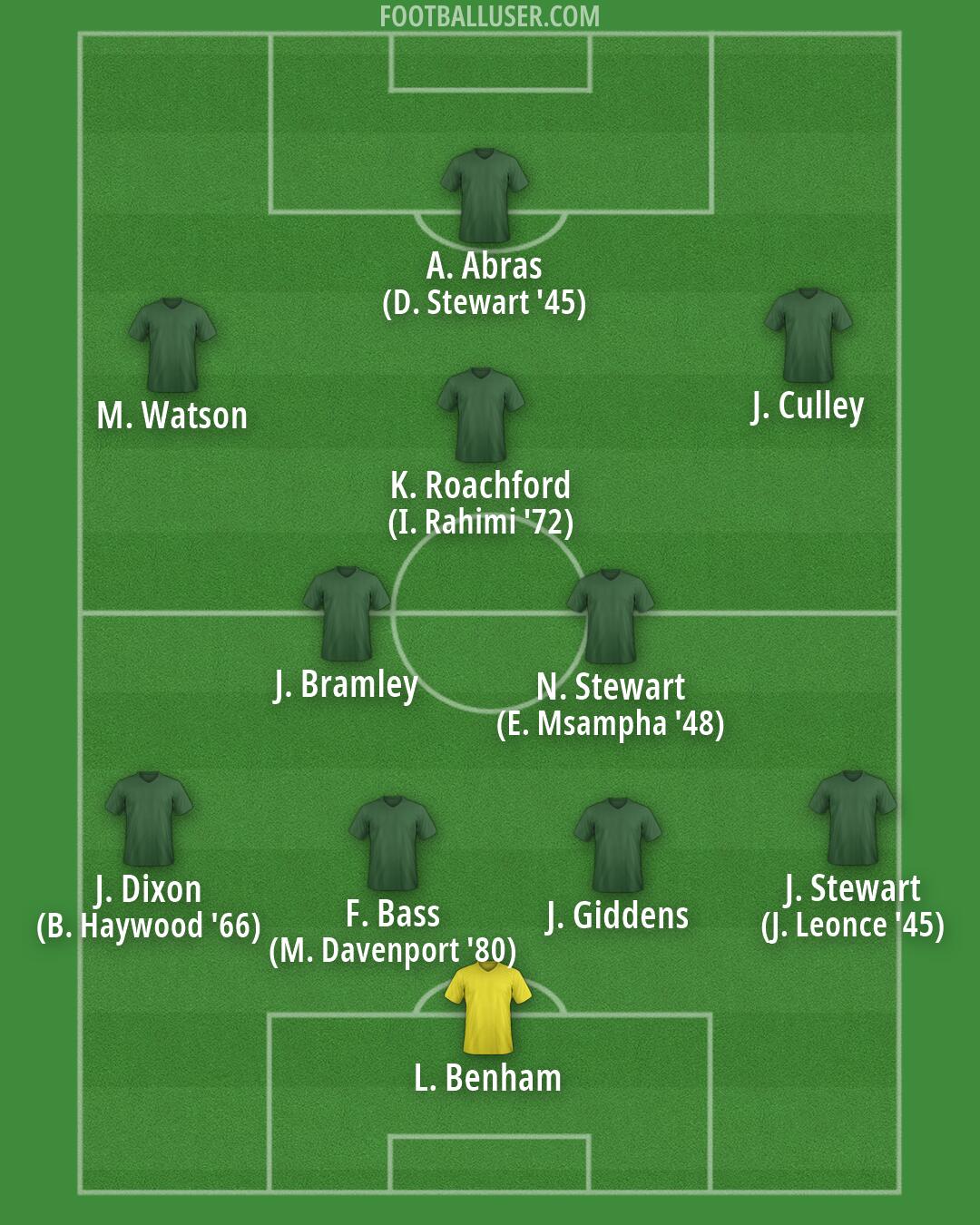
L. Benham · J. Stewart (J. Leonce '45) · F. Bass (M. Davenport '80) · J. Giddens · J. Dixon (B. Haywood '66) · J. Bramley · N. Stewart (E. Msampha '48) · K. Roachford (I. Rahimi '72) · A. Abras (D. Stewart '45) · M. Watson · J. CulleySearching for ways to exploit space behind the opposition is the goal for this team, which operates in a 4-2-4 formation. This lineup is built to play with a high press and a direct attacking style. By pushing many players forward, the team aims to win it back high up the pitch and catch the defense before they can settle.
L. Benham stays between the posts to organize the back line. The defensive unit functions as a flat back four that must stay compact when the ball is on the opposite side. J. Stewart plays as the right back and J. Dixon acts as the left back, both tasked to hold the line when the team sits deep. In the center, J. Giddens and F. Bass form the pairing that must defend zonally and cover for one another. They are required to step up to set the offside trap and clear the lines when under heavy pressure.
The midfield relies on a double pivot to provide stability. N. Stewart and J. Bramley work to shield the defense and win the second ball in the center of the pitch. N. Stewart focuses on driving forward with the ball to transition play, while J. Bramley works to intercept passes and recycle possession. This pair connects the defensive unit to the front four, ensuring the team can move from a mid-block into a quick attack.
An aggressive front line uses four attackers to stretch the defence. K. Roachford and A. Abras operate as two central forwards who focus on running in behind and winning headers. On the flanks, M. Watson and J. Culley act as wide wingers who hug the touchline to create width. This setup allows the team to attack in combinations, with the wingers looking to cut inside or deliver a cross on the run to find the feet of the striker.
The main tactical advantages of this formation include the ability to create wide overloads and the capacity to hit in behind on the transition. Because the team commits so many players forward, they can often isolate wide players in one on one situations. The presence of two central strikers also helps to pin the last defender, allowing the wingers more room to operate in the half spaces.
This high intensity formation is designed to overwhelm opponents through sheer attacking numbers. It is best suited for matches against teams that play a high line and struggle to defend against quick vertical play.