Custom Team Football Formation
 May 26, 2026


Starting Lineup
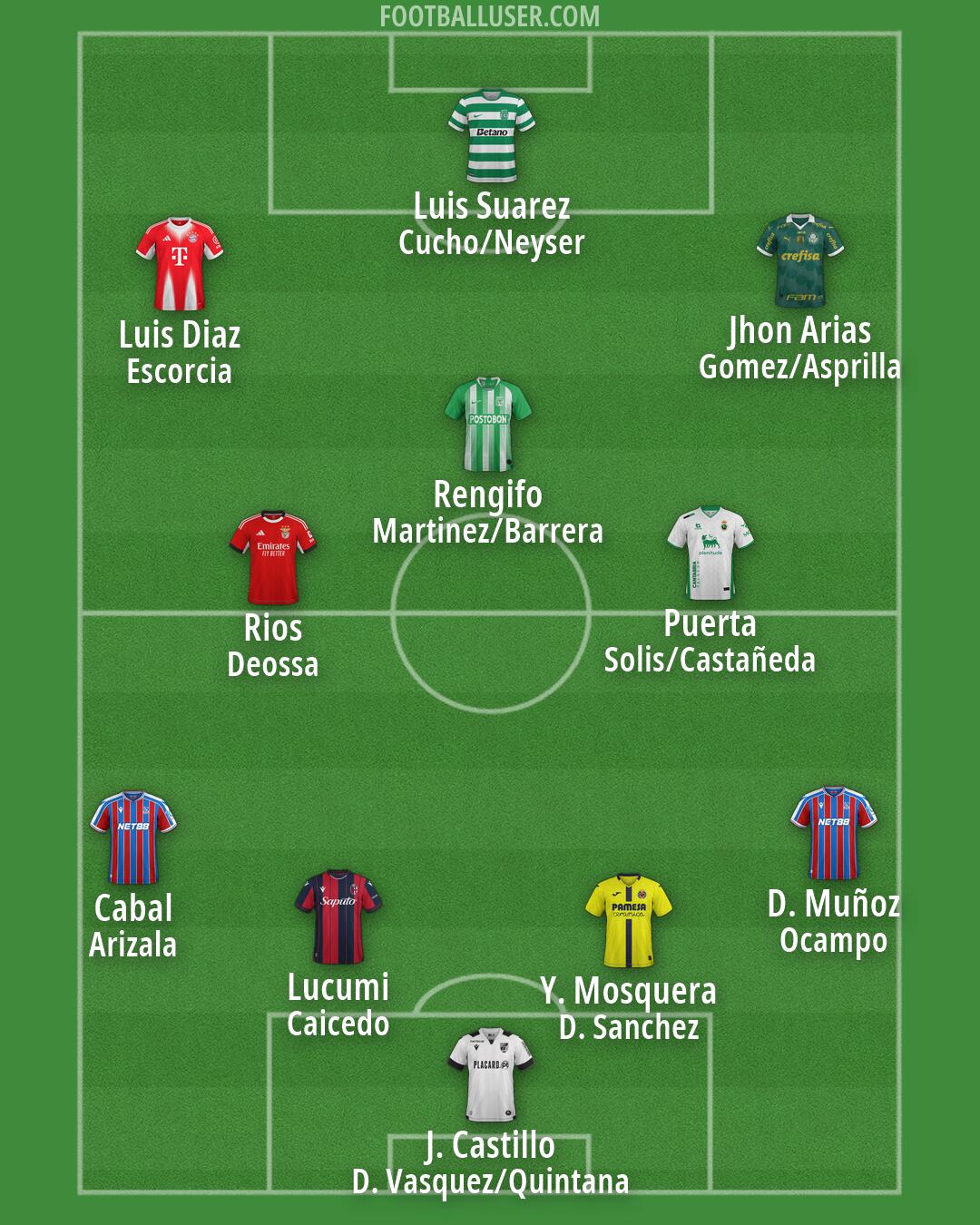
J. Castillo (D. Vasquez/Quintana) (Vit. Guimarães) · Cabal (Arizala) (Crystal Palace) · Lucumi (Caicedo) (Bologna) · Y. Mosquera (D. Sanchez) (Villarreal) · D. Muñoz (Ocampo) (Crystal Palace) · Rios (Deossa) (SL Benfica) · Puerta (Solis/Castañeda) (Racing) · Rengifo (Martinez/Barrera) (Atlético Nacional) · Luis Diaz (Escorcia) (FC Bayern) · Luis Suarez (Cucho/Neyser) (Sporting CP) · Jhon Arias (Gomez/Asprilla) (Palmeiras)Prioritizing a defensive block and quick transitions, this team operates in a 5-4-1 formation. The lineup focuses on staying compact and making it difficult for opponents to play through the middle. This setup is built to sit deep and wait for the moment to hit in behind on the transition.
Luis Suarez sits between the posts to manage the defensive line. The back five consists of Rengifo, Puerta, and Rios acting as central defenders to protect the middle. Rios and Puerta work to win the second ball and clear the lines when under pressure. The wide roles fall to Jhon Arias as the left wing back and Luis Diaz as the right wing back, who both need to track back to defend against wide runners. They must also be ready to push up when the team wins the ball to provide width.
The midfield operates as a flat line of four to maintain horizontal compactness. Lucumi and Y. Mosquera form the central pairing to shield the defence and combat runners in the middle. Y. Mosquera works to intercept passes and break the line of the opposition attack. On the flanks, Cabal and D. Muñoz occupy the wide areas to press in a mid-block and prevent the opponent from spreading wide. This midfield unit works to recycle possession and ensure the team remains hard to break down.
A lone striker, J. Castillo, leads the line as a pressing centre-forward. J. Castillo is tasked to press from the front and pin the last defender to create space for others. The attack relies on the wing backs, Jhon Arias and Luis Diaz, to provide the service once the ball is won. The team looks to play through the thirds using quick vertical passes to find the feet of the striker or exploit the space behind the defence.
One major advantage is the defensive solidity provided by the back five and the narrow midfield block. The team can easily squeeze the space when the opponent enters the final third. Another strength is the potential for speed of transition when the wing backs join the attack. This allows the team to catch opponents out of position before they can recover their defensive positions.
This 5-4-1 formation creates a very difficult block to penetrate through the centre. It is best suited for games against teams that dominate possession where the goal is to absorb pressure and counter at pace.