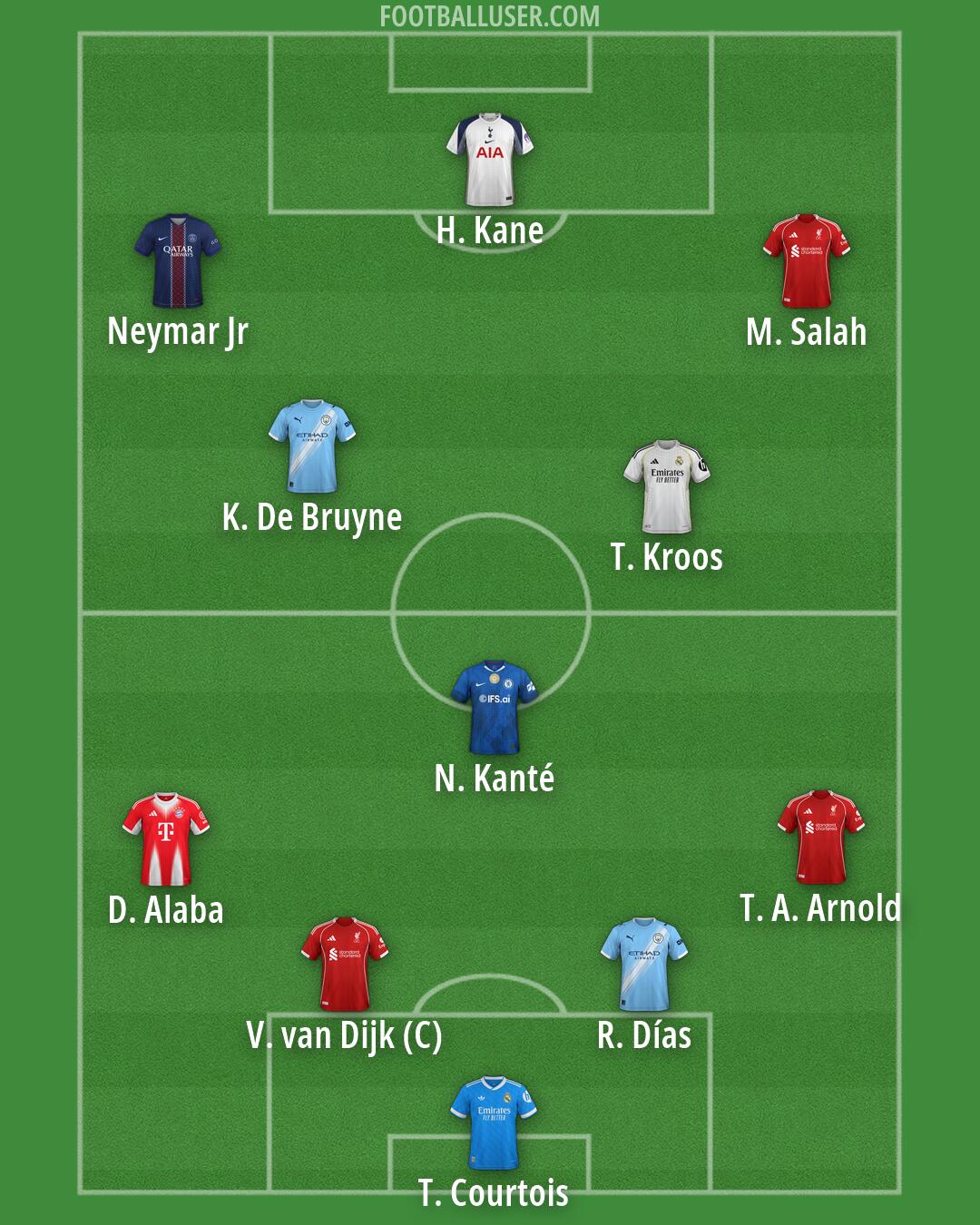
Custom Team Football Formation
 May 26, 2026


Starting Lineup
T. Courtois (Real Madrid) · T. A. Arnold (Liverpool) · D. Alaba (FC Bayern) · V. van Dijk (C) (Liverpool) · R. Días (Man City) · N. Kanté (Chelsea) · T. Kroos (Real Madrid) · K. De Bruyne (Man City) · M. Salah (Liverpool) · Neymar Jr (PSG) · H. Kane (Tottenham)A heavy focus on verticality and rapid transitions defines this lineup in a 5-2-3. The team aims to win the ball high up the pitch and strike quickly before the opponent can settle. This formation relies on power and directness to bypass the midfield and catch defenses off guard.
T. Courtois stands between the posts to command the area. The defensive unit sits in a back five, using a staggered line to protect the center. V. van Dijk (C) acts as the leader of the backline, using his aerial strength and reading of the game to organize the unit. He works alongside R. Días, who is dominant in the air, and N. Kanté, who provides extra cover in the central zone. On the flanks, D. Alaba operates as an attacking wing back to push up the left side, while T. A. Arnold provides width as an attacking wing back on the right. This unit stays compact to deny space between the lines.
The midfield works as a double pivot to control the central zone. T. Kroos operates as a deep lying playmaker, using his immense passing range to recycle possession and find teammates. Beside him, K. De Bruyne drives forward with the ball to link the defense to the attack. He is known for his vision and ability to play through the lines with precision. This pair must work hard to cover the spaces left by the wing backs and ensure they do not get bypassed during transitions.
The attack features three forwards designed to stretch the defense. H. Kane operates as a target man, holding up the ball and finding teammates in tight spaces. On the wings, M. Salah and Neymar Jr act as inverted wingers who cut inside to create goal scoring chances. M. Salah is known for his clinical finishing and speed, while Neymar Jr uses his dribbling style to beat defenders one on one. They often look to receive the ball in the half spaces to pull the opposition back line out of position.
This formation offers significant strength through its ability to press high in coordinated waves. By using five defenders, the team stays compact when defending in a low block, making it hard to break down. Another advantage is the speed of transition, as the wide attackers and central midfielders can quickly move from a defensive stance to an attacking one.
The 5-2-3 formation is built to exploit teams that play with a high line. It is a potent choice for matches where the goal is to sit deep and hit the opposition on the break.