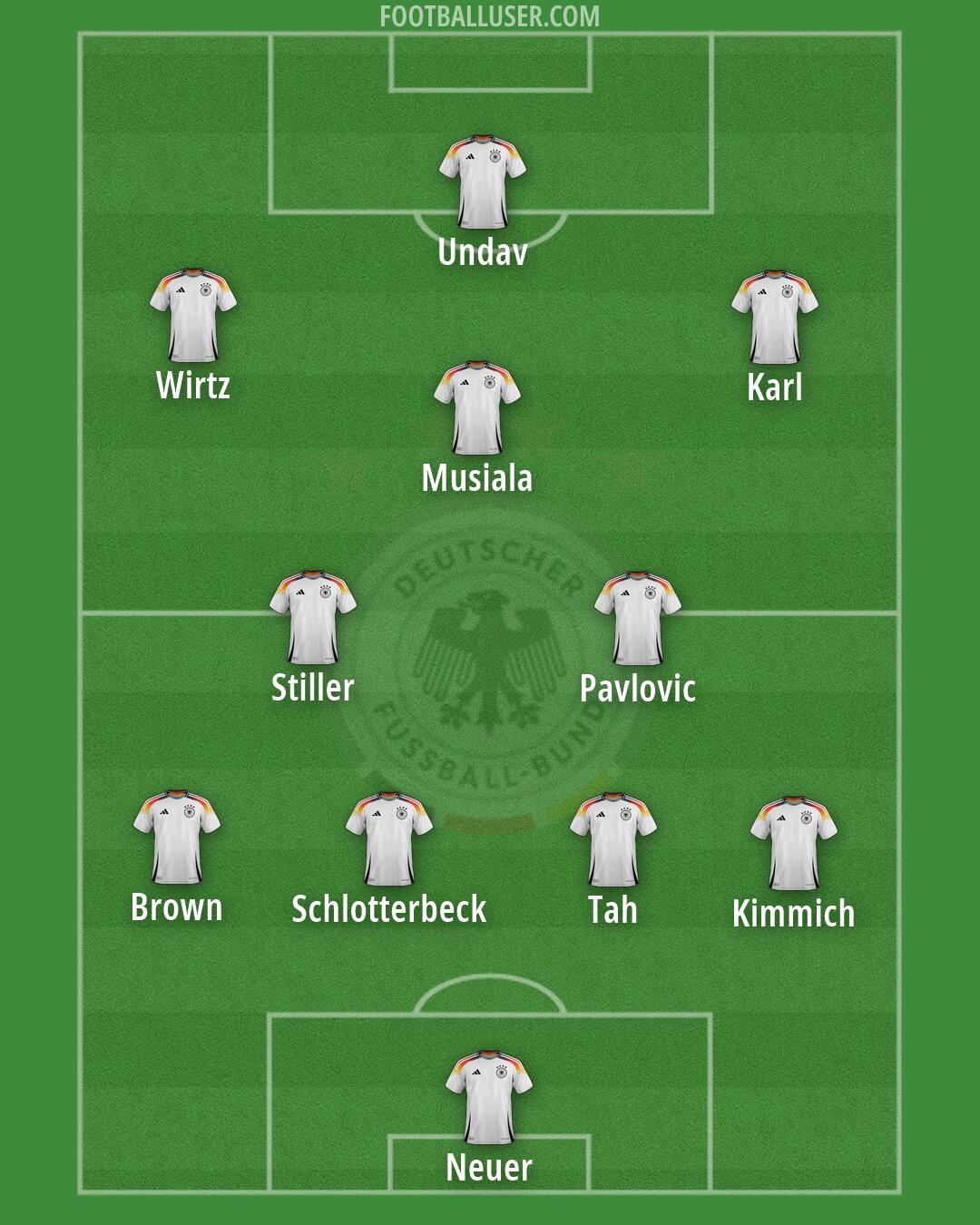

Germany National Football Team Formation
 May 26, 2026


Starting Lineup
Brown · Schlotterbeck · Tah · Kimmich · Stiller · Pavlovic · Musiala · Neuer · Wirtz · Karl · UndavGermany prioritizes high pressing and verticality through a 4-3-3 formation. This lineup seeks to win the ball high up the pitch and quickly move it toward the goal. The team looks to control games by squeezing the opposition in their own half and using quick transitions to exploit spaces.
Manuel Neuer starts in goal, acting as a ball playing goalkeeper who can step up to sweep behind the defense. A flat back four consists of Kimmich at right back and Brown at left back. Kimmich often pushes forward to provide width and cross the ball, while Brown tracks back to cover the flank. In the center, Tah uses his aerial strength to defend against long balls, paired with Schlotterbeck who looks to intercept passes and play out from the back.
The midfield operates with a three man unit designed to connect the lines. Pavlovic and Stiller play as central midfielders who sit deep to shield the defense and break the line with vertical passes. Musiala plays in the attacking midfielder role to drive forward and create chances in the final third. This trio works to press high and ensure the team remains compact when the ball is lost.
Up front, Germany utilizes three attackers to stretch the opposition. Undav leads the line as a lone striker who holds up the ball and makes runs into the channels. Wirtz operates as an inverted winger on the left, cutting inside to find space for shots or through balls. Karl stays wide on the right wing to provide width, while Musiala makes late runs into the box to support the attack.
The team finds success through its ability to press high in coordinated waves. This creates immediate pressure on the opponent's buildup. Another strength is the wide overload potential when Kimmich overlaps to support Karl. The movement of Wirtz and Musiala also allows the team to isolate wide players in one on one situations during transitions.
This 4-3-3 formation relies on intense pressing and quick ball movement to dominate. It is best suited for matches against teams that try to build play from the back under pressure.