Custom Team Football Formation
 May 27, 2026


Starting Lineup
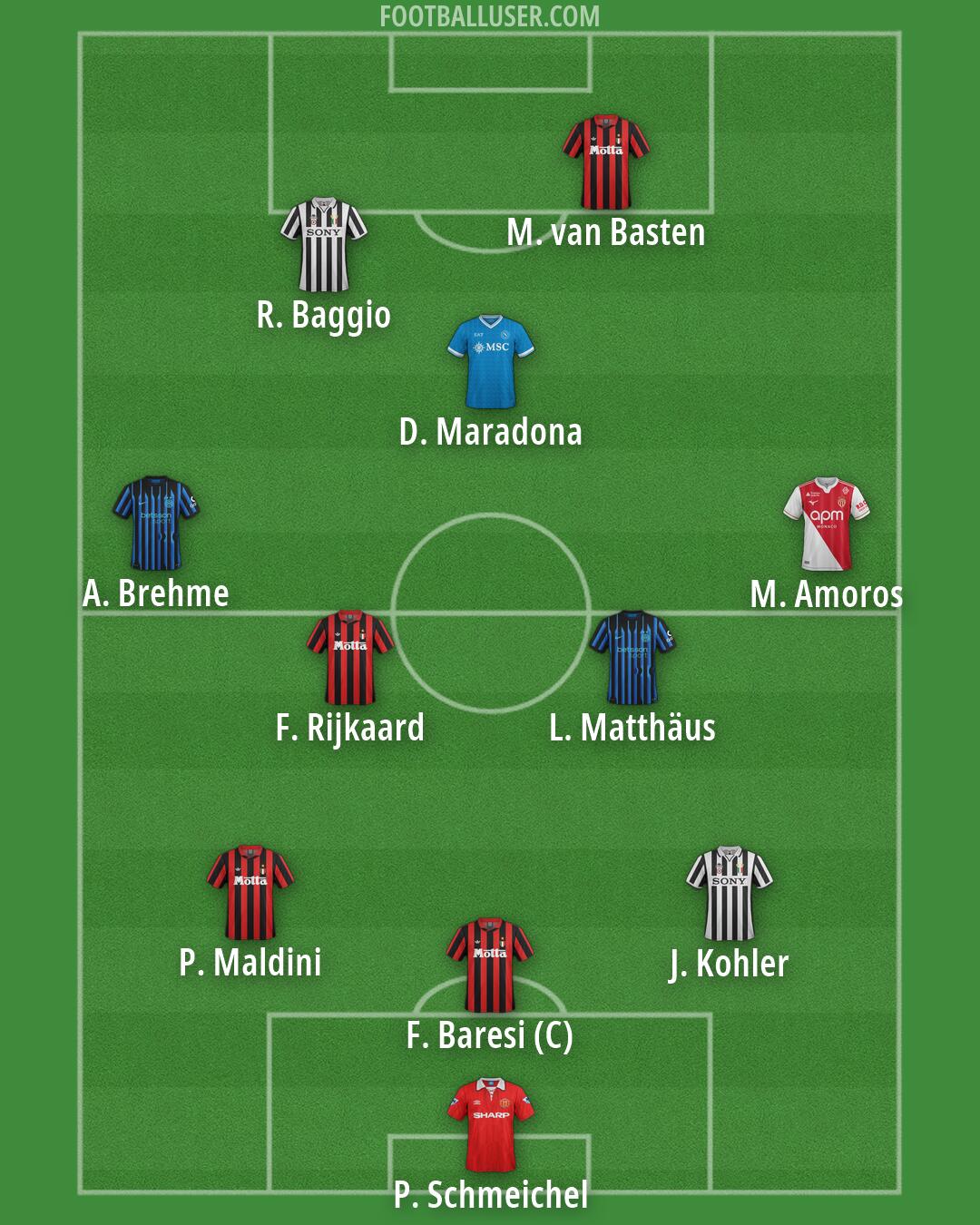
P. Schmeichel (Man Utd) · F. Baresi (C) (Milan) · P. Maldini (Milan) · J. Kohler (Juventus) · A. Brehme (Inter) · M. Amoros (Monaco) · F. Rijkaard (Milan) · L. Matthäus (Inter) · D. Maradona (Napoli) · R. Baggio (Juventus) · M. van Basten (Milan)Focusing on total control and overwhelming numbers in the center, this lineup utilizes a 3-6-1 formation. The team aims to dominate possession and suffocate opponents by flooding the middle of the pitch. This system is built to play a heavy possession based game where the ball is moved through constant short passing to manipulate the opposition.
P. Schmeichel stays between the posts to organize the back line. The defensive unit works as a back three, where F. Baresi (C) acts as the central leader who reads the game to sweep behind the line. F. Baresi (C) uses his reading of the game to intercept passes and manage the space. J. Kohler plays as the right centre back to provide physical presence and win the header, while P. Maldini operates on the left to cover ground and track runners. This unit stays compact to deny space between the lines.
The midfield is a massive engine room designed to control the tempo. It operates with a double pivot of F. Rijkaard and L. Matthäus who sit deep to shield the defense and win the second ball. F. Rijkaard provides strength to intercept play while L. Matthäus drives forward with the ball to link play. Ahead of them, M. Amoros and A. Brehme occupy the left and right channels of the midfield to help recycle possession and provide width. D. Maradona and R. Baggio act as two tens in the half-spaces, working to find pockets of space and play through the lines to find the striker.
In the final third, the team relies on a lone striker in M. van Basten. M. van Basten acts as a target man who can hold up the ball and bring the attacking midfielders into the play. D. Maradona and R. Baggio sit just behind him to create chances through quick combinations. The team builds attacks by moving the ball through the central block before looking to spread wide or find the striker in tight spaces. When the team loses the ball, the forwards press from the front to force a long ball and win it back high up the pitch.
The primary tactical advantage of this formation is the numerical superiority in midfield, which allows the team to control the rhythm of the match. By having six players in the middle, they can easily create overloads to bypass the opponent's pressing triggers. This lineup also allows for high pressing in coordinated waves because the attacking midfielders and central midfielders are so close together.
This 3-6-1 formation is built to dominate ball possession and squeeze the space in the middle of the park. It is best suited for games against teams that sit deep and try to play on the counter.