Custom Team Football Formation
 May 28, 2026


Starting Lineup
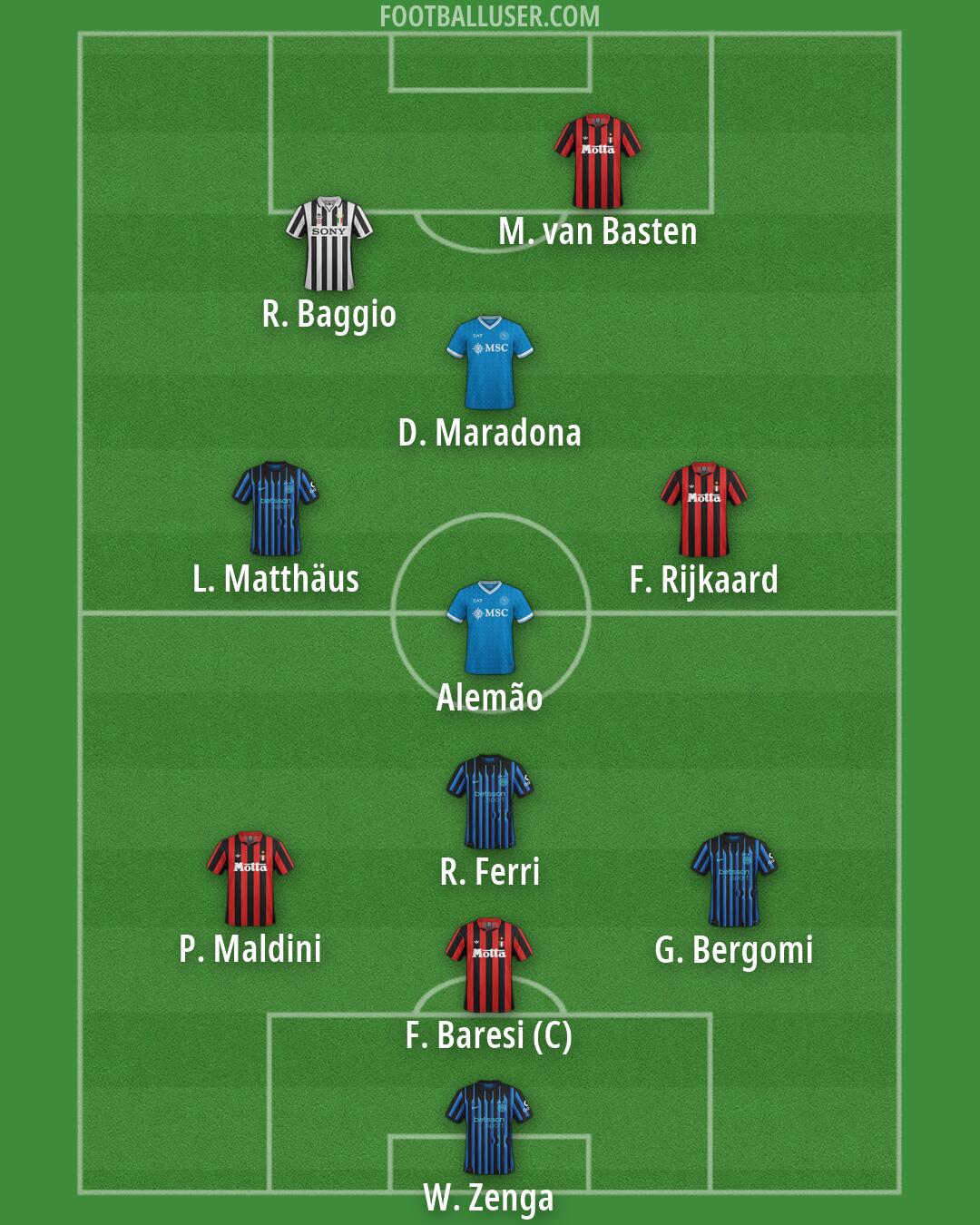
W. Zenga (Inter) · F. Baresi (C) (Milan) · R. Ferri (Inter) · G. Bergomi (Inter) · P. Maldini (Milan) · Alemão (Napoli) · F. Rijkaard (Milan) · L. Matthäus (Inter) · D. Maradona (Napoli) · R. Baggio (Juventus) · M. van Basten (Milan)A heavy emphasis on defensive solidity and rapid transitions defines this team in a 4-5-1. The formation is built to absorb pressure and then hit the opponent quickly through technical players in the middle third. This lineup aims to control the center of the pitch while relying on clinical movements to punish errors.
W. Zenga sits between the posts to organize the defense from the back. The back four functions as a disciplined zonal line where F. Baresi (C) acts as the leader, sweeping behind a high line to intercept long balls. Beside him, R. Ferri provides cover and stays close to the central area. On the flanks, P. Maldini plays as an attacking full back to provide width, while G. Bergomi works as a more defensive full back to ensure the side remains compact. This unit works together to squeeze the space between the lines and protect the goal.
The midfield utilizes a single pivot with two more advanced players to control the rhythm. Alemão sits deep as a single pivot to shield the defense and win the second ball. He connects the back line to the rest of the team. Ahead of him, L. Matthäus and F. Rijkaard act as an inverted eight pairing, where L. Matthäus uses his passing range to drive forward and F. Rijkaard uses his physicality to win duels and carry the ball forward. Both players are vital to help the team transition from a defensive block into attack.
In the final third, the team employs a lone striker supported by two creative players. M. van Basten acts as a pressing centre-forward who can hold up the ball and find the feet of his teammates. Behind him, D. Maradona and R. Baggio operate as two tens in the half-spaces. D. Maradona uses his dribbling style to move through tight spaces, while R. Baggio looks to arrive late into the box to score. These attackers work to stretch the defence and create runs in behind the opposition.
This formation offers significant strength through numerical superiority in midfield. By packing the central areas, the team can easily win the ball back high up the pitch. The combination of technical quality and physical presence allows the team to switch play quickly to the wingers or play through the lines. The defensive compactness makes it very difficult for opponents to find gaps in the middle.
This tactical identity relies on a strong central core to control games. It is best suited for facing teams that play with high lines or rely heavily on possession.