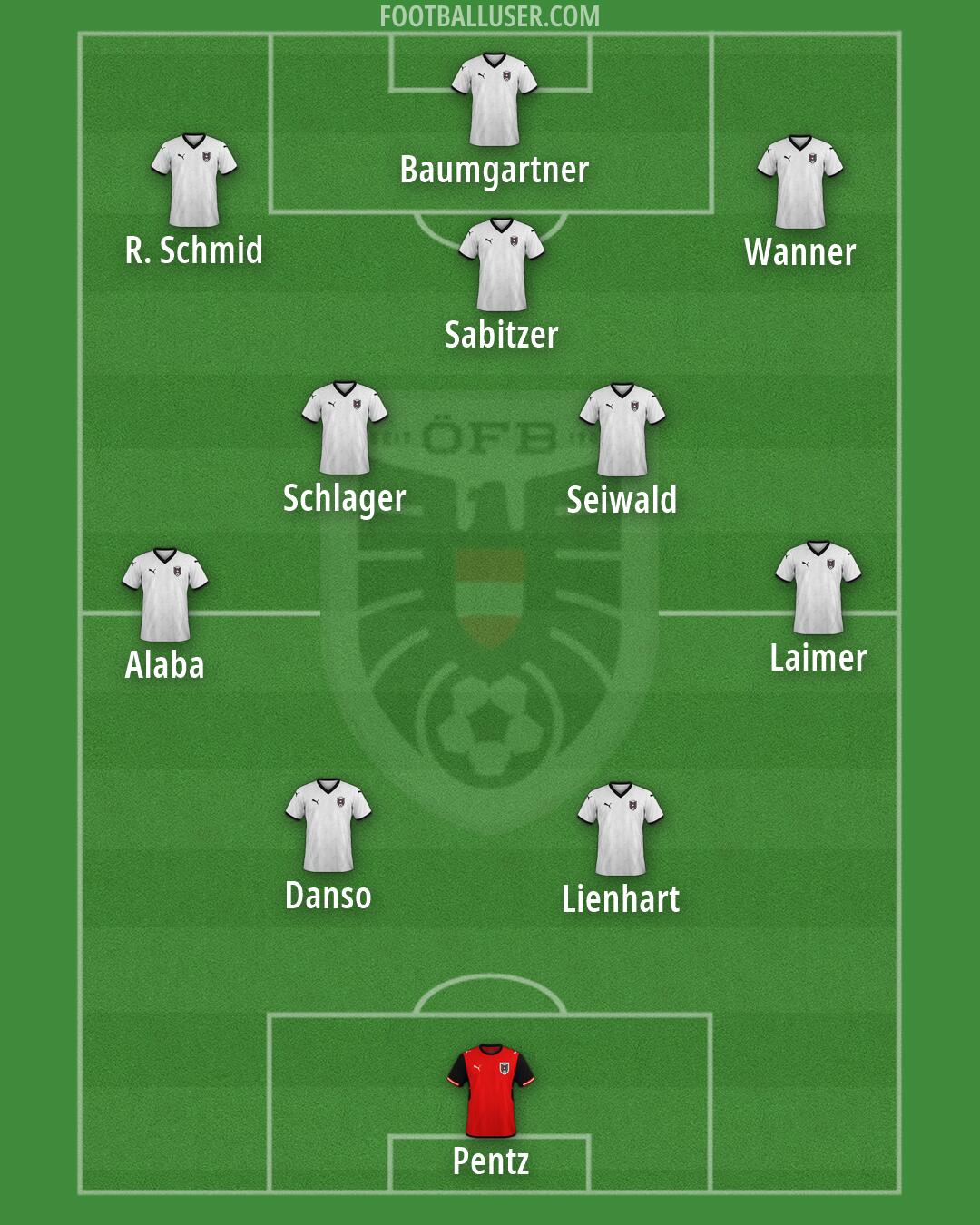

Austria National Football Team Formation
 May 28, 2026


Starting Lineup
Baumgartner · Wanner · R. Schmid · Schlager · Sabitzer · Laimer · Seiwald · Alaba · Lienhart · Danso · PentzAustria prioritizes high intensity pressing and quick vertical transitions through a 2-5-3 formation. This lineup aims to win the ball back high up the pitch and push numbers forward immediately to catch the opposition out of position. By squeezing the space in the middle, the Red Devils look to force turnovers in dangerous areas.
Pentz sits between the two central defenders to act as the first point of distribution. Lienhart and Danso operate as a compact pair in the back, where Danso uses his aerial strength and Lienhart provides cover with his positioning. Since there are no traditional full backs, these two must stay disciplined to prevent long balls from breaking their line. The defensive unit functions by stepping up together to maintain a high line.
The midfield is the engine of this formation, utilizing a crowded central block to control the game. Alaba plays in a deeper role to shield the defense and break the line with his passing range. Laimer works alongside him to press aggressively and cover ground, while Seiwald and Schlager operate in the half spaces to dominate the central zone. Sabitzer operates as the attacking ten, finding pockets of space between the opponent lines to create chances.
A heavy attacking presence is maintained through three front players. Baumgartner leads the line as a lone striker, tasked to hold up the ball and press the opposing defenders. On the flanks, Wanner and R. Schmid act as wide attackers to provide width. Wanner looks to cut inside and drive at the defense, while R. Schmid stretches the play to create space for the central runners.
One major strength is the numerical superiority in the middle of the pitch, which allows Austria to overwhelm opponents during the build up. The ability to press high in coordinated waves makes it very difficult for teams to play out from the back. Additionally, the coordination between Sabitzer and the advanced midfielders allows the team to transition from a defensive block to a direct attack with great speed.
This formation relies on intense physical output to squeeze the pitch and dominate the central areas. It is best suited for matches against teams that struggle to play under pressure or those that leave large gaps between their midfield and defensive lines.