Liverpool Football Formation
 May 29, 2026


Starting Lineup
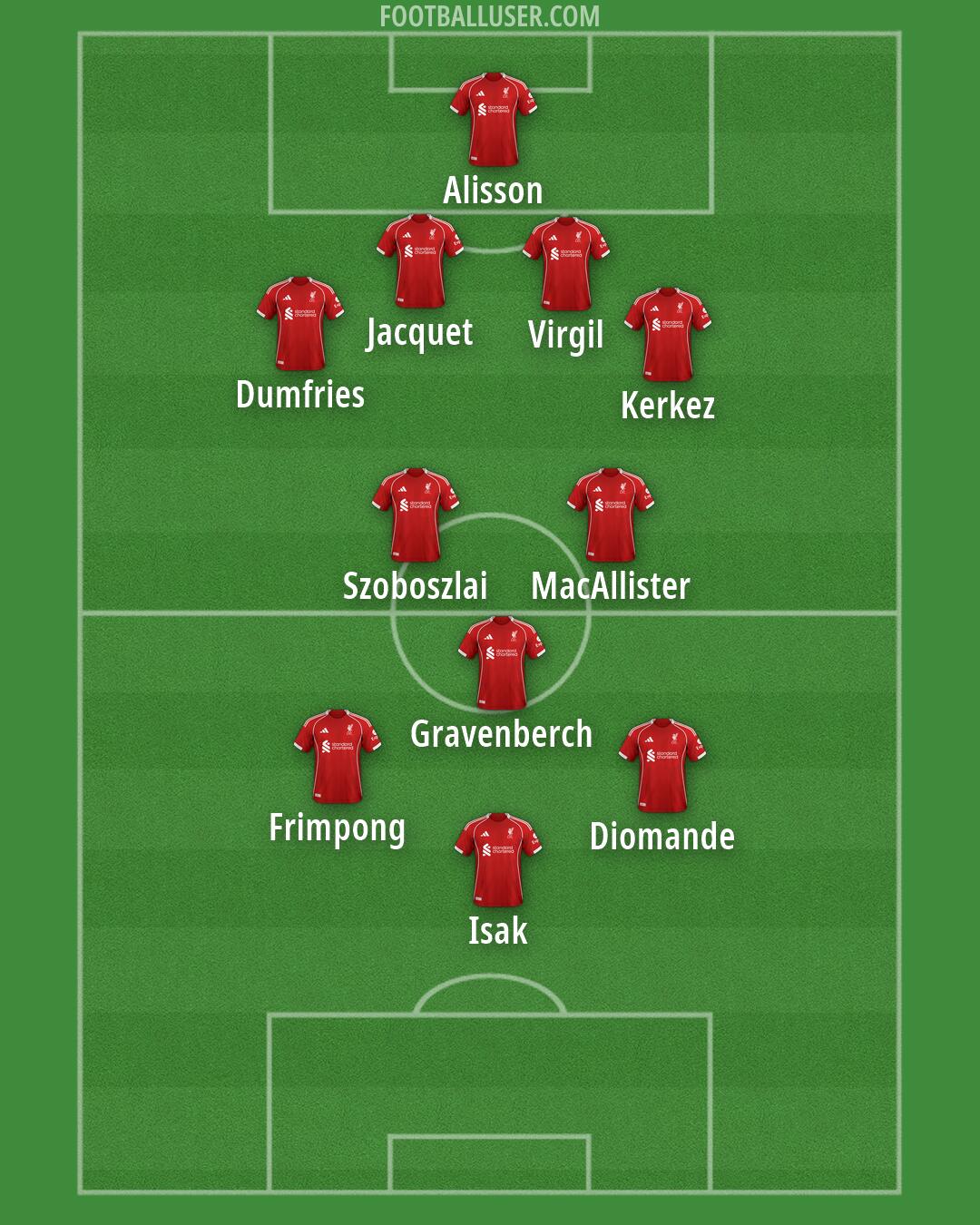
Jacquet · Dumfries · Frimpong · Isak · Szoboszlai · Diomande · Gravenberch · Kerkez · Alisson · Virgil · MacAllisterLiverpool aims to play with a heavy counter attacking identity using a 5-4-1 formation. This lineup is built to sit deep and wait for the opposition to commit players forward before breaking quickly. The team relies on staying compact to frustrate opponents and then using long passes to find the lone striker.
Isak guards the goal as the lone goalkeeper. The defensive unit consists of a back five that can shift wide to cover the flanks. Diomande acts as the right wing back to provide width and track back when needed, while Frimpong plays as the left wing back to push high and cross the ball. In the center, Gravenberch, Szoboszlai, and MacAllister form a trio of central defenders who must hold the line and win aerial duels. This defensive block stays low to deny space behind the back line.
The midfield operates in a flat four to protect the center of the pitch. Virgil and Jacquet sit in the middle as the central midfielders, with Virgil working to break the line with vertical passes and Jacquet acting to intercept play and cover the space in front of the defense. On the edges of this block, Kerkez plays as the right midfielder and Dumfries occupies the left midfield role. These two must help the wing backs and track back to maintain a solid block when the team loses the ball.
Liverpool uses a lone striker in Alisson to lead the attack. Because the formation is narrow, Alisson must hold up the ball and wait for support to arrive from the midfield. The team builds attacks through quick transitions where the wing backs, Diomande and Frimpong, sprint forward to provide width. The attackers press from the front to force turnovers, but the main goal is to move the ball quickly from the midfield to the forward line.
A primary strength of this formation is the compactness when defending in a low block. By having five defenders and four midfielders close together, Liverpool makes it very hard for opponents to play through the middle. Another advantage is the speed of transition, as the wing backs can quickly turn defense into attack. The wide players can also isolate opponents in one on one situations once they carry the ball into the final third.
This 5-4-1 formation provides a solid defensive foundation for a team looking to exploit space on the break. It is best suited for matches against dominant teams that control possession and leave gaps behind their high defensive line.