
Austria National Football Team Formation
 May 29, 2026


Starting Lineup
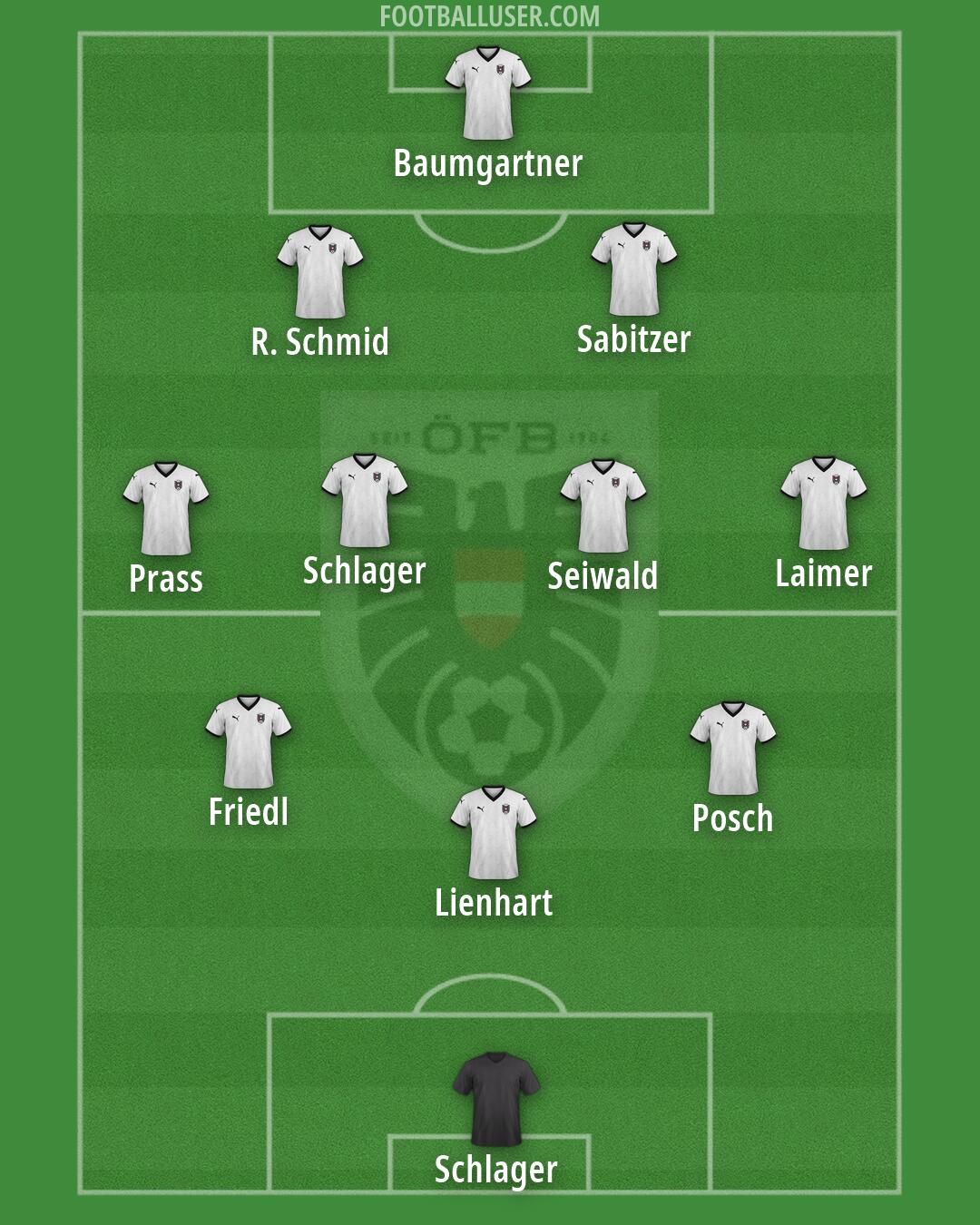
Friedl · Lienhart · Posch · Laimer · Prass · Schlager · Seiwald · Baumgartner · R. Schmid · Sabitzer · SchlagerAustria relies on a high press and quick transitions, operating within a 3-4-3 formation. This lineup is built to suffocate opponents in their own half and strike fast when they lose the ball. By pushing players forward and maintaining a high line, the national team seeks to dominate territory and force mistakes through aggressive pressing.
Schlager starts in goal to organize the defensive unit. Behind the midfield, Lienhart acts as a ball playing defender to help move play from the back, while Posch and Friedl provide physical presence to defend the central zones. The three defenders work to cover space and intercept passes before they reach the penalty area. The back three stays compact to prevent the opposition from playing through the middle.
The midfield uses a central pairing of Seiwald and Schlager to control the center of the pitch. Seiwald acts as a pivot to shield the defense and break the line with vertical passes, while Schlager works to connect the defense to the attack. On the flanks, Prass and Laimer operate as wide midfielders who must track back to help the defense and push up to support the attackers. This midfield block stays close together to prevent opponents from finding space between the lines.
The attack utilizes three forwards to stretch the opposition defense. Baumgartner leads the line as a lone striker to hold up the ball and lead the press, while R. Schmid and Sabitzer occupy the wide channels as wingers. Sabitzer often cuts inside to create chances, while R. Schmid uses his pace to drive at the defense. These three attackers work in unison to pin the opposition back and create space for the midfielders to join the play.
Austria gains tactical advantages through their ability to press high in coordinated waves. The presence of Seiwald and Schlager allows for numerical superiority in the center, which helps the team win second balls. By using Prass and Laimer to provide width, the team creates wide overloads that force opposing full backs into difficult decisions. This allows the wingers to isolate defenders in one on one situations during transitions.
This formation creates a relentless attacking presence that can overwhelm opponents through intensity. It is best suited for matches where the team needs to dictate the tempo and force a high turnover rate against sides that struggle to play out from the back.