Scotland National Football Team Formation
 May 29, 2026


Starting Lineup
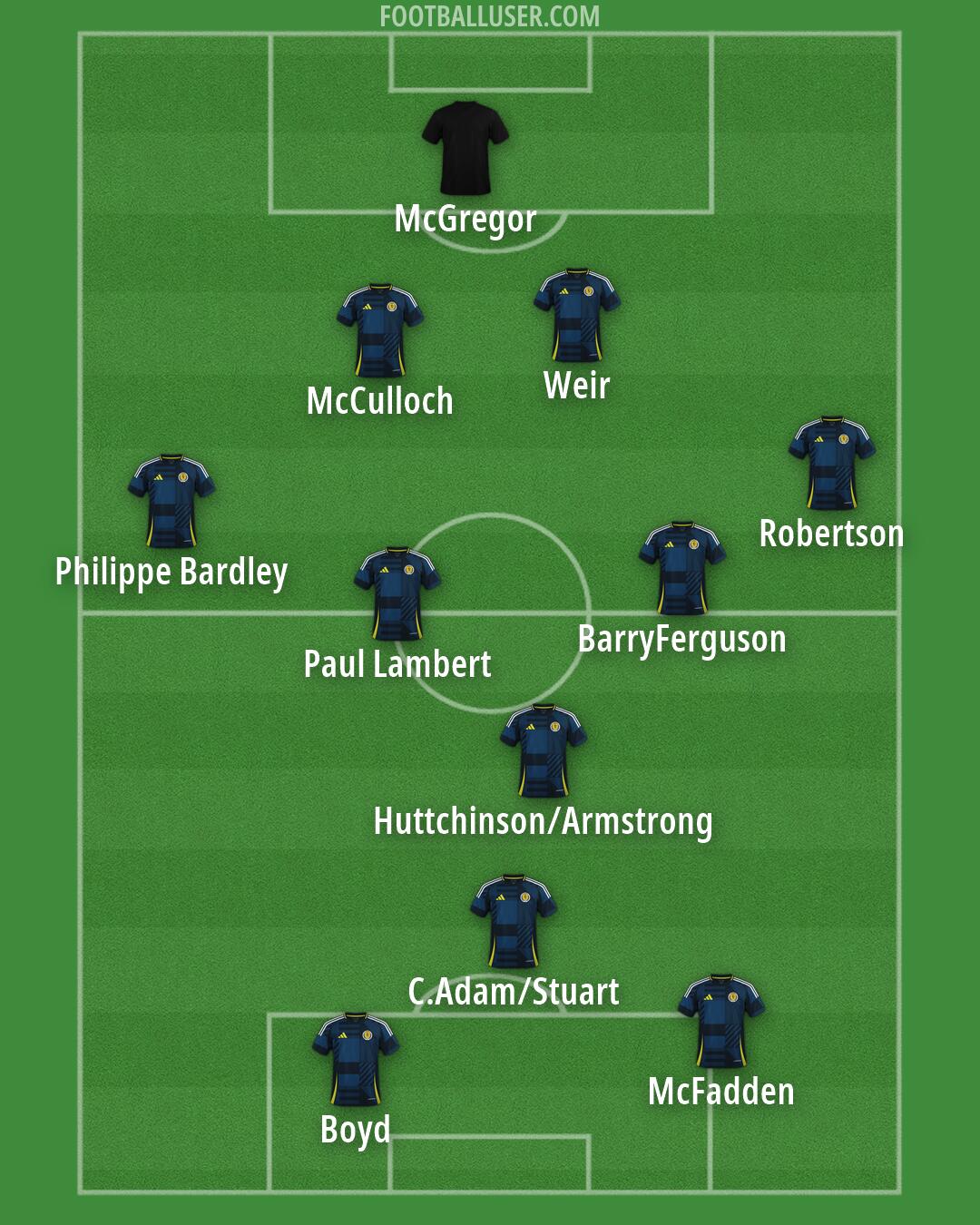
McGregor · Robertson · Weir · McCulloch · Paul Lambert · C.Adam/Stuart · Huttchinson/Armstrong · Boyd · McFadden · BarryFerguson · Philippe BardleyA heavy focus on controlling the center of the pitch and overwhelming opponents in the middle defines this Scotland lineup. The team utilizes a 2-6-2 formation designed to dominate possession and squeeze the space between the lines. This setup builds a wall of players in the center to ensure the ball stays within their reach.
McGregor stays between the posts to command the penalty area. The defensive unit relies on a back two consisting of Weir and McCulloch. These two central defenders must stay compact and cover huge amounts of ground as the rest of the team pushes forward. They act as the final barrier, often forced to step up to intercept long balls or drop deep to protect the space behind them when the midfield is bypassed.
The midfield is the engine room of the Scotland team, utilizing a massive six man block to control every passing lane. Robertson and Philippe Bardley act as the deep pivot to shield the two defenders. Moving further up, BarryFerguson uses his passing range and ability to drive forward to connect the play, while Paul Lambert provides stability in the central area. On the flanks, Huttchinson/Armstrong and C.Adam/Stuart operate in the half spaces to provide width and support the central runners.
In the final third, the team uses two forwards to stretch the opposition. McFadden plays as the left striker to lead the press, while Boyd operates as the right striker to hold up the ball and create space. The attack relies on quick passes from the massive midfield to find these two players in dangerous positions. The wide players in the midfield often cut inside to create numerical superiority around the box.
The main tactical advantage of this formation is the immense numerical superiority in the central zones. By packing the middle, the team can easily intercept passes and win second balls. This creates high pressing waves that can trap opponents in their own half. The midfield block makes it very hard for the other team to find any passing lanes through the center of the pitch.
This formation prioritizes total control of the ball through a crowded central corridor. It is best suited for matches where the team wants to suffocate a less technical opponent by winning every duel in the middle of the park.