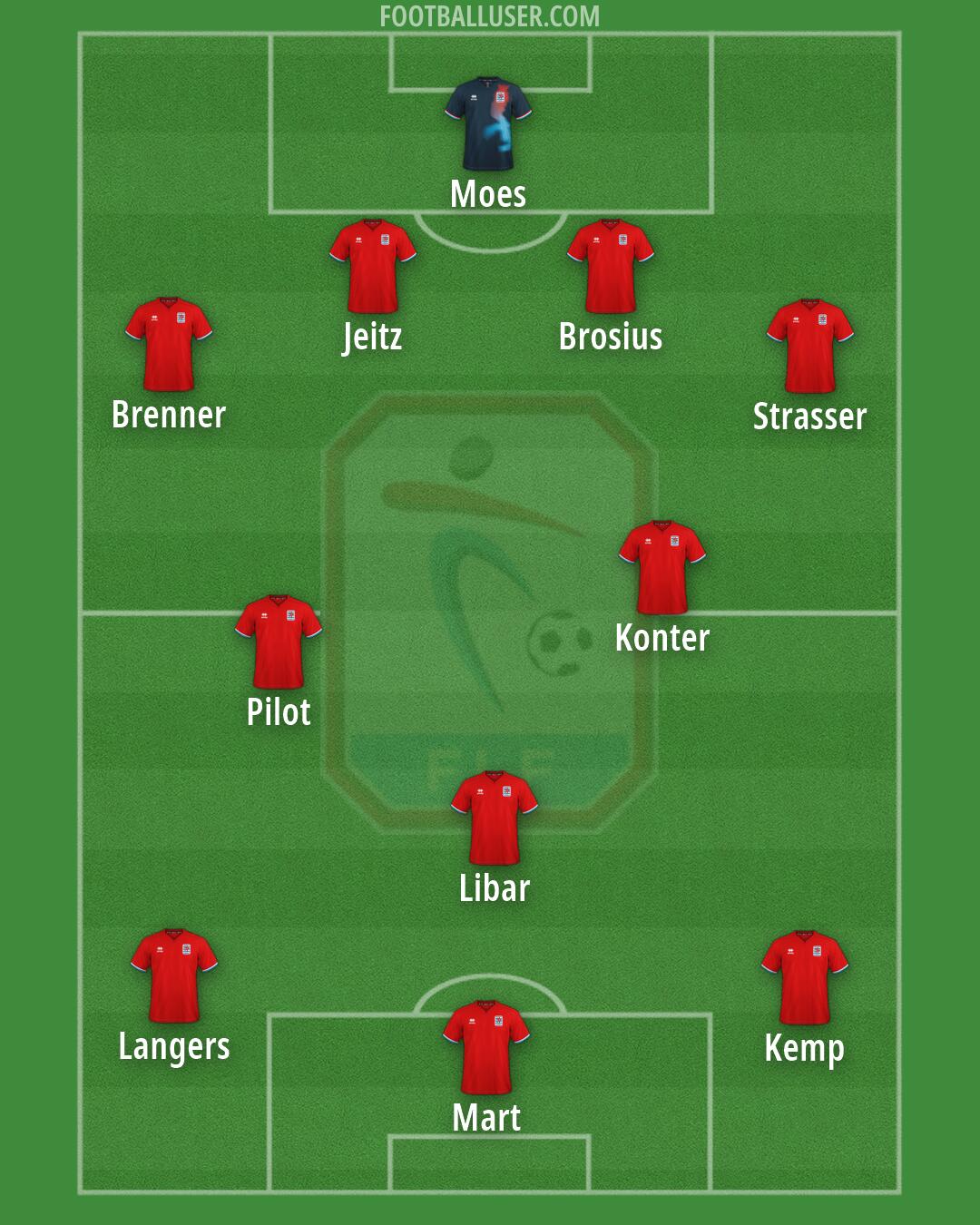

Luxembourg National Football Team Formation
 May 30, 2026


Starting Lineup
Moes · Jeitz · Brosius · Brenner · Strasser · Konter · Pilot · Libar · Langers · Kemp · MartLuxembourg looks to control territory and control the tempo of the match through a 4-3-3. This formation relies on a high press to win the ball back quickly and maintain a heavy presence in the final third. By using this lineup, the team aims to dominate possession and use the width of the pitch to stretch the opposition defense.
Moes stays between the posts to organize the back line and command the penalty area. The defensive unit functions as a flat back four with Jeitz and Brosius acting as the central pairing. Jeitz and Brosius must communicate well to cover the space behind them and stay compact. On the flanks, Brenner acts as a right back who can push up to overlap, while Strasser provides stability on the left side. The defenders must step up to intercept passes and prevent runners from breaking the line.
The midfield functions as a single pivot system that connects the defense to the attack. Konter sits in front of the back four to shield the defense and break up play. Ahead of him, Pilot works to drive the ball forward and connect the phases of play through short passing. Libar plays as the attacking midfielder to create chances and link with the front three. This midfield unit must work hard to track back when losing the ball and move as a unit to close down space.
Luxembourg uses three attackers to stretch the play and press from the front. Mart operates as a lone striker to hold up the ball and bring others into play. On the wings, Kemp and Langers act as wide attackers to provide width and cross the ball into the box. Kemp and Langers can also cut inside to create shooting opportunities or overload the central areas. The front line is tasked to press high and force the opposition into mistakes in their own half.
This formation offers several tactical advantages, such as the ability to create wide overloads when Brenner and Langers push forward. The presence of Libar allows the team to find pockets of space between the opposition lines to play through balls. Additionally, the midfield unit can shift quickly to create compactness when defending a low block. These movements help the team maintain control of the game during transitions.
The Red Devils use this 4-3-3 to dictate the pace and control the ball in the middle of the pitch. This formation is best suited for games against teams that sit deep and require constant pressure to break down.