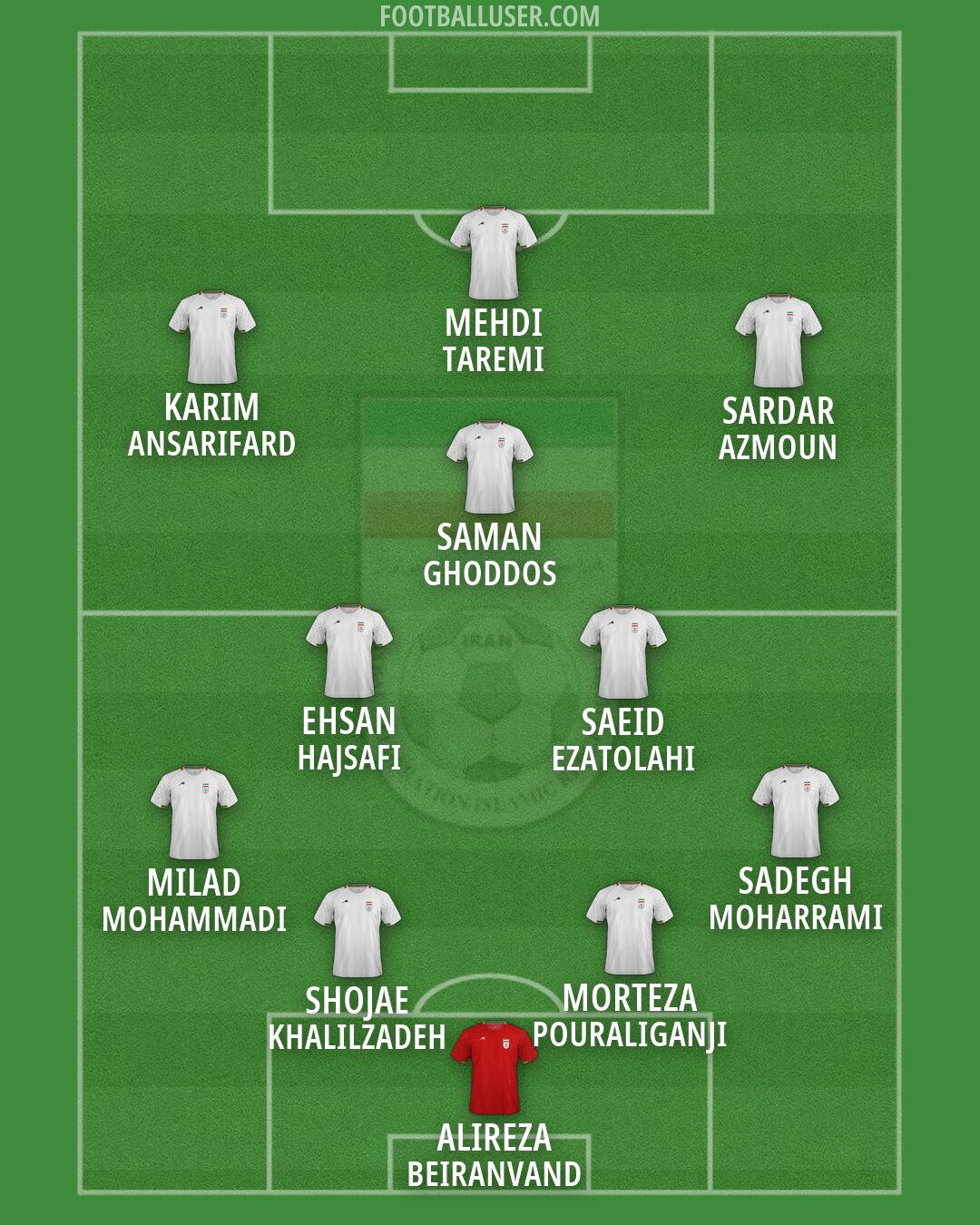

Iran National Football Team Formation
 May 31, 2026
 lucaosantos85


Starting Lineup
ALIREZA (BEIRANVAND) · SADEGH (MOHARRAMI) · MILAD (MOHAMMADI) · MORTEZA (POURALIGANJI) · SHOJAE (KHALILZADEH) · SAEID (EZATOLAHI) · EHSAN (HAJSAFI) · SAMAN (GHODDOS) · SARDAR (AZMOUN) · KARIM (ANSARIFARD) · MEHDI (TAREMI)Prioritizing defensive solidity and rapid transitions, Iran relies on a 4-3-3 formation to remain hard to beat. This lineup seeks to control the tempo through a compact midfield before launching quick attacks when the opposition loses possession. The team is built to sit deep and absorb pressure, making it a difficult unit to break down in organized matches.
Alireza guards the goal, acting as the last line of defense. In front of him, a flat back four remains disciplined to maintain team compactness. Shojae and Morteza act as the central defenders, where Shojae provides cover and Morteza stays dominant in the air. On the flanks, Milad and Sadegh provide width, with Milad often looking to overlap to support the left side while Sadegh holds the line to prevent being caught out on the break.
The midfield works through a combination of roles to link the back four to the attack. Ehsan and Saeid operate in the central areas, where they work to intercept passes and shield the defense. Saman plays as an attacking ten, moving between the lines to connect the play and drive the team forward. This midfield trio must press together to prevent opponents from playing through the center of the pitch.
Up front, the attack uses three players to stretch the opposition. Mehdi leads the line as a lone striker, tasked to hold up the ball and bring others into play. On the wings, Sardar and Karim act as wide attackers who look to cut inside and create goal scoring chances. The movement of Sardar and Karim creates space for Mehdi to run into channels, while the forwards press high to disrupt the opponent's build up.
Iran offers several tactical advantages due to this specific formation. The team can achieve numerical superiority in the middle of the pitch when Saman pushes forward to join the two central midfielders. Another strength is the ability to create wide overloads, as Milad and Sadegh can push high to support the wingers. This allows the team to switch play quickly and isolate opponents in one on one situations on the flanks.
This 4-3-3 formation provides a balanced way for Iran to defend deep and strike on the counter. It is best suited for matches against teams that dominate possession, allowing the side to absorb pressure and use pace in transition.