
PSG Football Formation
 May 31, 2026


Starting Lineup
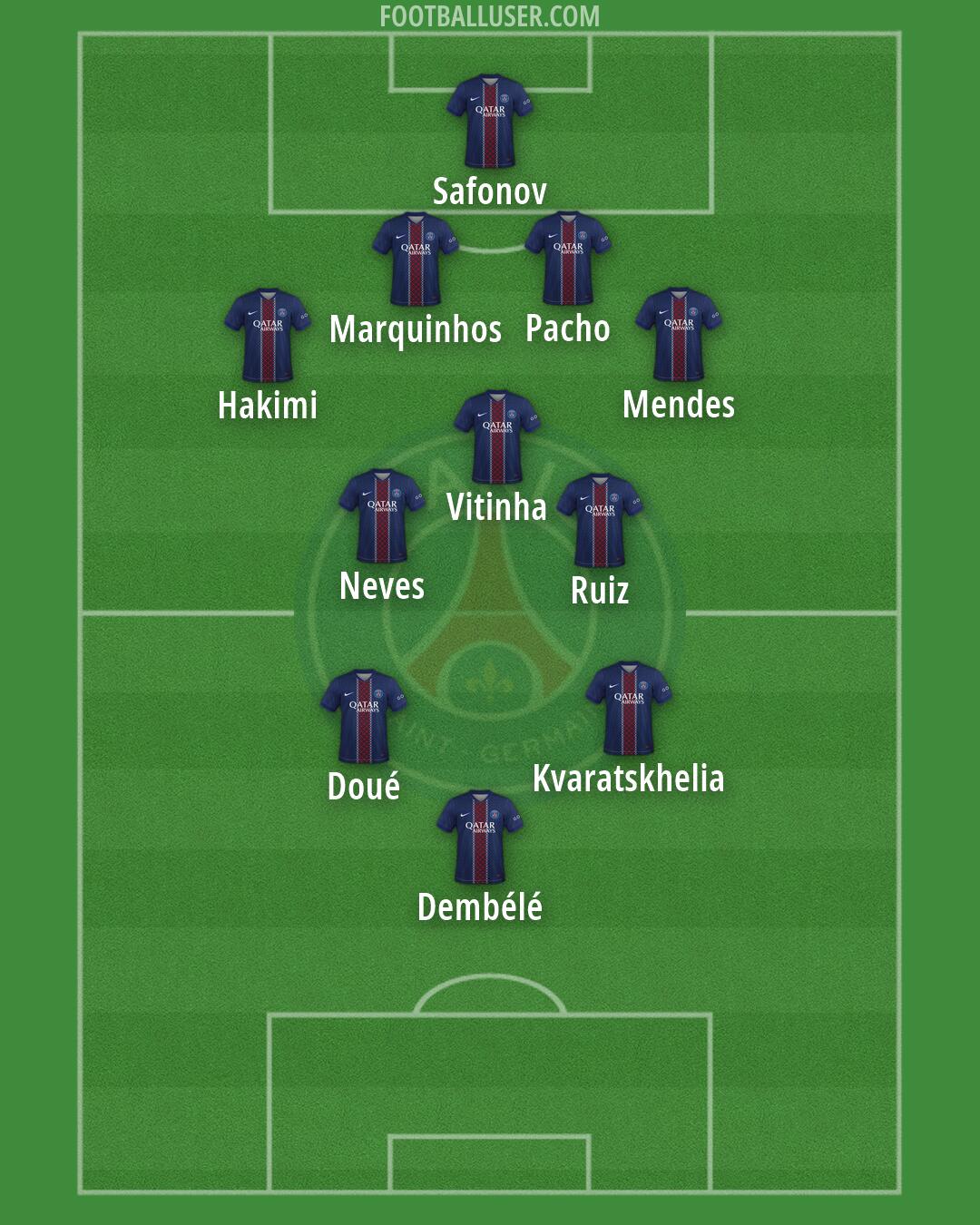
Safonov · Pacho · Mendes · Marquinhos · Hakimi · Neves · Vitinha · Ruiz · Kvaratskhelia · Dembélé · DouéPrioritizing heavy possession and verticality, PSG operates within a 4-3-3 formation. This lineup focuses on controlling the tempo of the game through high ball retention and aggressive pressing in the final third. The team seeks to dominate territory by moving the ball quickly between lines to catch opponents out of position.
Safonov guards the goal as the last line of defense. Ahead of him, the back four uses a high line to compress the pitch. Marquinhos acts as the captain (C) and leads the defense, using his aerial strength and reading of the game to cover space. He partners with Pacho to provide stability in the center. On the flanks, Hakimi pushes high to act as an extra attacker, while Mendes provides width on the left side. This unit functions by stepping up to intercept passes and squeezing the space between the defense and midfield.
The midfield relies on a single pivot system to dictate play. Vitinha sits in front of the defense to shield the back four and break lines with his passing range. To his sides, Neves and Ruiz provide the engine for the middle third. Neves works to recover possession and distribute the ball, while Ruiz drives forward to link the defensive unit with the attackers. This trio works to maintain control of the central areas and ensures the team stays compact when the ball is lost.
In the attacking phase, the front three create constant movement to pull defenders out of position. Dembélé leads the line as a central presence, often dropping deep to hold up the ball or making runs into the channels. Kvaratskhelia operates on the left wing, using his dribbling style to cut inside and create chances. On the right, Doué provides width and energy to stretch the opposition. The forwards press high in coordinated waves to force turnovers near the opponent's goal.
One major advantage for PSG is the ability to create wide overloads. When Hakimi and Mendes overlap, they force opposition wingers to track back, creating space for the midfielders to exploit. The team also benefits from high pressing intensity, which allows them to win the ball back quickly in dangerous areas. This creates immediate opportunities for quick transitions before the opposition can sit deep.
This formation is built to overwhelm opponents through ball dominance and territorial control. It is best suited for matches against teams that sit in a low block and require constant offensive pressure to break down.