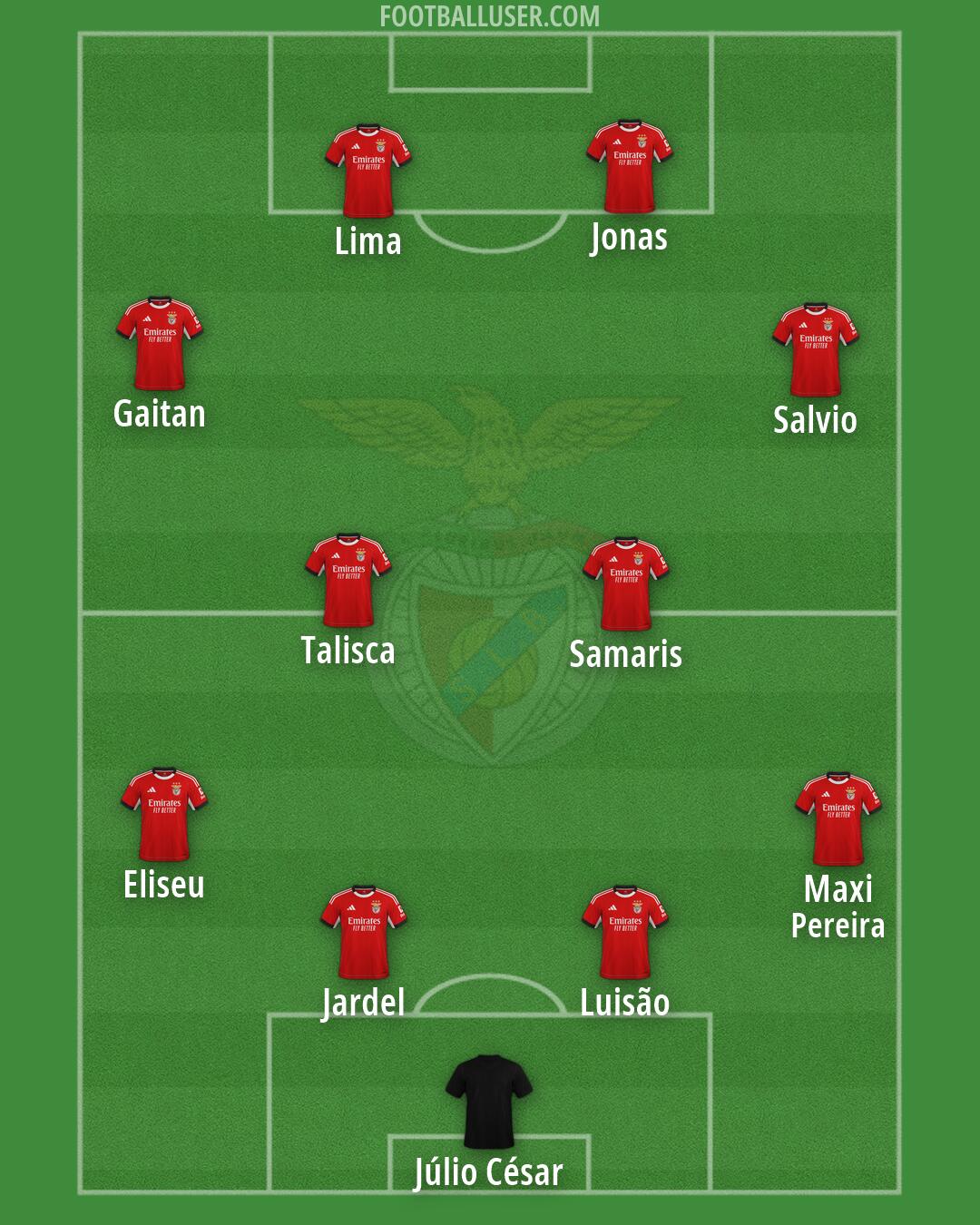

SL Benfica Football Formation
 May 31, 2026
 andremt


Starting Lineup
Júlio César · Jonas · Maxi (Pereira) · Jardel · Luisão · Salvio · Samaris · Lima · Eliseu · Talisca · GaitanPrioritizing aggressive verticality and high pressure, SL Benfica utilizes a 4-2-4 formation to overwhelm opponents. This lineup seeks to dominate the final third by committing many bodies forward to hunt the ball. The goal is to win possession high up the pitch and transition into attack with extreme speed.
Júlio César sits between the posts to organize the defensive line. The back four works as a unit to maintain a high line when the team pushes up. Luisão, the captain, uses his aerial strength and positional intelligence to lead the central pairing alongside Jardel. On the flanks, Maxi acts as an overlapping full back to provide width, while Eliseu works to cover the left side and track back when possession is lost.
A double pivot forms the heart of the midfield to bridge the gap between the defense and the front four. Samaris stays deeper to shield the back line and intercept passes, acting as the primary anchor. Talisca operates as a more advanced presence in the central area, looking to drive forward and break the line with his ball carrying. This pair must work hard to cover the ground left behind by the attacking players.
The attack is built around four dedicated forwards designed to stretch the opposition. Salvio and Gaitan operate as wide attackers, with Gaitan looking to cut inside to create chaos. In the center, Lima and Jonas work as a strike duo to pin the opposition defenders. Jonas uses his clever movement to find space between the lines, while Lima provides a physical presence to hold up the ball.
This formation offers significant advantages through its ability to create wide overloads and central pressure. By pushing the wingers and full backs high, Benfica can overwhelm the flanks. The presence of four attackers allows for intense pressing in coordinated waves, making it very difficult for the opposition to build play from the back.
SL Benfica relies on this high risk, high reward system to break down stubborn defenses. It is most effective against teams that play a low block and struggle to manage rapid transitions.