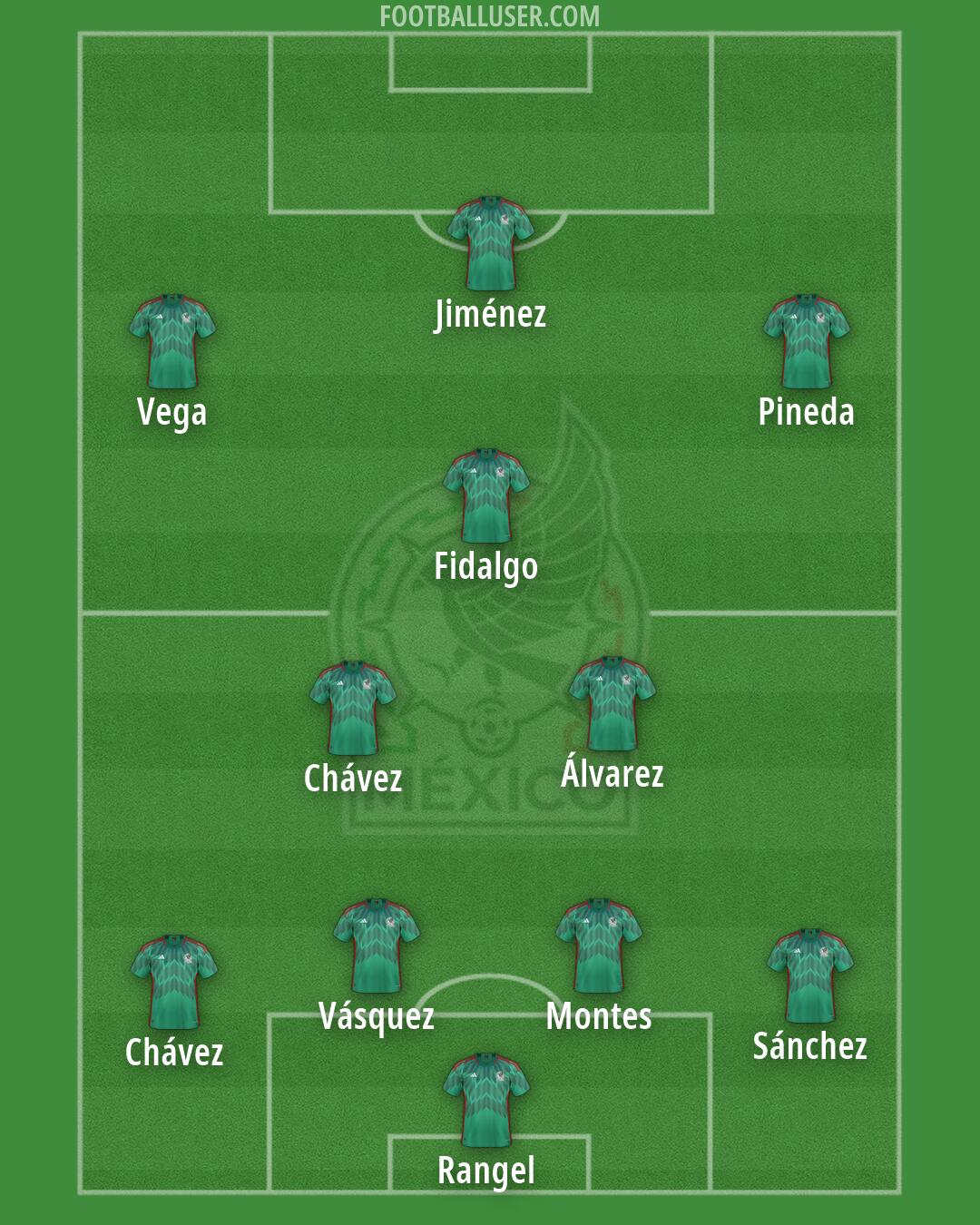

Mexico National Football Team Formation
 June 1, 2026


Starting Lineup
Rangel · Sánchez · Chávez · Vásquez · Montes · Álvarez · Fidalgo · Chávez · Vega · Pineda · JiménezMexico focuses on a high press and rapid verticality through a 4-3-3 formation. This lineup relies on winning the ball high up the pitch to catch opponents out of position. By using this setup, the squad looks to control the tempo through quick passing and aggressive movement in the final third.
Rangel sits between the posts to organize the back line. A flat back four consists of Sánchez on the right and Chávez on the left, while Montes and Vásquez occupy the central spots. Montes and Vásquez must step up to intercept passes and act as ball playing defenders to start attacks. Sánchez and Chávez are expected to overlap to provide width, while the central defenders cover the space behind them if the team plays a high line.
The midfield functions with a central trio that connects the defense to the attack. Chávez and Álvarez work in the middle to shield the back four and break the line with vertical passes. Fidalgo plays as the attacking ten, sitting just behind the strikers to create chances and find pockets of space. This midfield group must press hard to prevent opponents from building play through the center.
In the attacking third, Mexico uses three attackers to stretch the opposition. Jiménez leads the line as a lone striker, tasked to hold up the ball and bring others into play. Pineda and Vega operate as wide attackers, with Vega cutting inside from the left and Pineda looking to cross from the right. This front line pushes high to force mistakes and creates constant movement to pull defenders out of position.
One major strength of this Mexico lineup is the ability to press high in coordinated waves. The presence of Fidalgo in the advanced role allows the team to hunt the ball immediately after losing possession. Another advantage is the width provided by Sánchez and Chávez, which creates overloads on the flanks and forces the opposition to shift constantly.
This 4-3-3 formation is built for aggressive, attacking football that seeks to dominate through pressure. It is best suited for matches against teams that struggle to play out from the back under heavy duress.