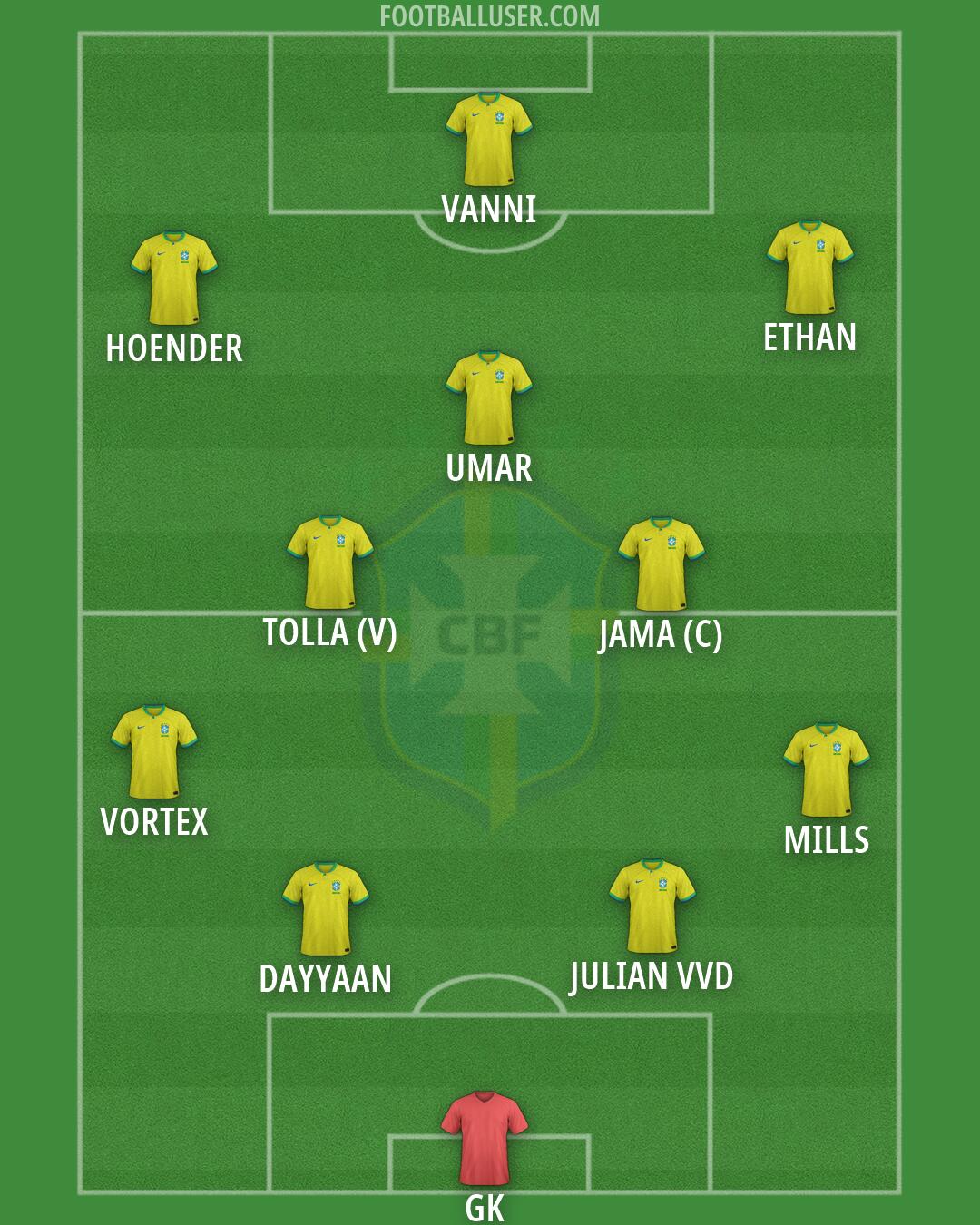

Brazil National Football Team Formation
 June 4, 2026


Starting Lineup
JAMA (C) · ETHAN · VORTEX · DAYYAAN · HOENDER · VANNI · TOLLA (V) · MILLS · JULIAN VVD · UMAR · GKBrazil looks to control the tempo through high pressing and quick transitions in a 4-3-3. This formation is built to play an aggressive brand of football that seeks to win the ball back high up the pitch and use the width of the field to stretch the opposition. The lineup aims to dominate through ball circulation and heavy vertical movement to catch the opponent out of position.
In goal, the goalkeeper acts as the first point of contact for building play. The defensive unit sits in a flat back four where MILLS operates as a right back to provide depth while VORTEX pushes up the left flank as an attacking wing back. In the middle of the defense, JULIAN VVD and DAYYAAN form the central pairing, with JULIAN VVD acting as a ball playing defender while DAYYAAN covers the space behind him. They work together to hold a high line and keep the distance between the lines short.
The midfield functions with a three man midfield with a carrier to drive the team forward. JAMA (C), serving as the captain, sits in the right central role to shield the defense and recycle possession. TOLLA (V) operates as the left central midfielder, helping to press in a mid-block and win the second ball. UMAR moves in the space ahead of them as an attacking ten behind the striker, looking to connect the midfield to the front line and arrive late into the box to create goal scoring chances.
The attack utilizes three attackers across the front to pin the last defender. VANNI acts as the pressing centre-forward to disrupt the opponent build up from the back. On the flanks, HOENDER and ETHAN play as inverted wingers who cut inside to create central overloads. These movements create space for the full backs to overlap and allow the team to attack in combinations through the half spaces. The front three work to find the feet of the striker or hit in behind on the transition.
Brazil offers several tactical advantages with this lineup. The presence of UMAR allows for numerical superiority in the attacking third, creating problems for single pivot systems. The ability to press high in coordinated waves from the front three and the midfield trio helps Brazil win it back high up the pitch. This creates immediate opportunities to counter at pace before the opposition can set their defensive block.
This 4-3-3 formation relies on intense pressing and quick ball movement to dominate games. It is best suited for matches against teams that struggle to play out from the back or those that lack width in their defensive transition.