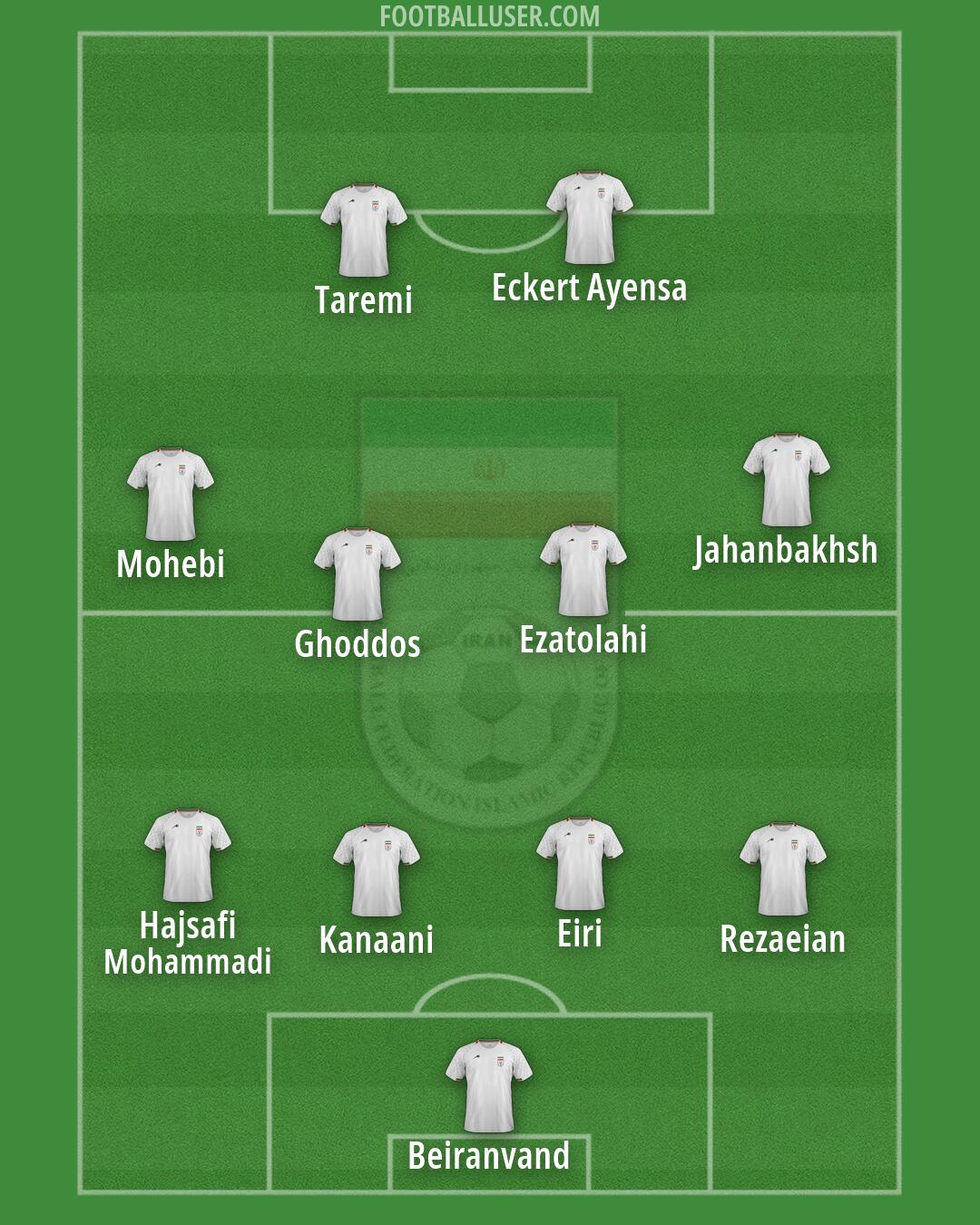

Iran National Football Team Formation
 June 4, 2026


Starting Lineup
Beiranvand · Hajsafi (Mohammadi) · Rezaeian · Kanaani · Eiri · Taremi · Jahanbakhsh · Ghoddos · Eckert Ayensa · Mohebi · EzatolahiIran looks to play a defensive, counter attacking game with a 5-4-1 formation. This lineup relies on a low block to absorb pressure before hitting the opponent on the transition. The goal is to stay compact and use the width of the pitch only when moving forward.
Eckert Ayensa stays on the line to protect the goal while the back five stays narrow. The central defenders consist of Taremi, Ezatolahi, and Ghoddos who work together to defend zonally and win the second ball. Ezatolahi and Ghoddos act as the main wall in the middle, while Taremi provides coverage. Mohebi operates as a defensive wing back on the right to keep the width, and Jahanbakhsh plays as an attacking wing back on the left to help with the buildup. The unit stays tight to ensure the opposition cannot play through the middle.
The midfield works as a flat four to protect the back line. Kanaani and Eiri form a central pairing where Kanaani seeks to intercept passes and Eiri connects the defensive and attacking lines. Hajsafi plays on the left to help Jahanbakhsh, while Rezaeian occupies the right side to support Mohebi. This midfield unit focuses on squeezing the space between the lines and ensuring they do not get bypassed too easily. They aim to win the ball and immediately look to find the striker.
Beiranvand operates as a lone striker, acting as a target man to hold up the ball under pressure. The attack relies on Beiranvand to receive long balls and wait for the wide players to join the run. Jahanbakhsh and Rezaeian provide the main outlets, looking to carry the ball forward into the final third. The team seeks to create runs in behind the opposition defense through quick transitions. By using Beiranvand to pin the last defender, the midfielders can arrive late into the box to support the attack.
Iran offers great compactness when defending in a low block. This formation creates wide overloads on the flanks when the wing backs push up during a break. The ability to hit in behind on the transition allows the team to punish teams that commit too many men forward.
This 5-4-1 formation provides a solid defensive base for Iran to exploit spaces on the break. It is a setup best suited for facing teams that dominate possession and leave gaps behind their high line.