United States National Soccer Team Formation
 June 7, 2026
 bau7o
bau7o


Starting Lineup
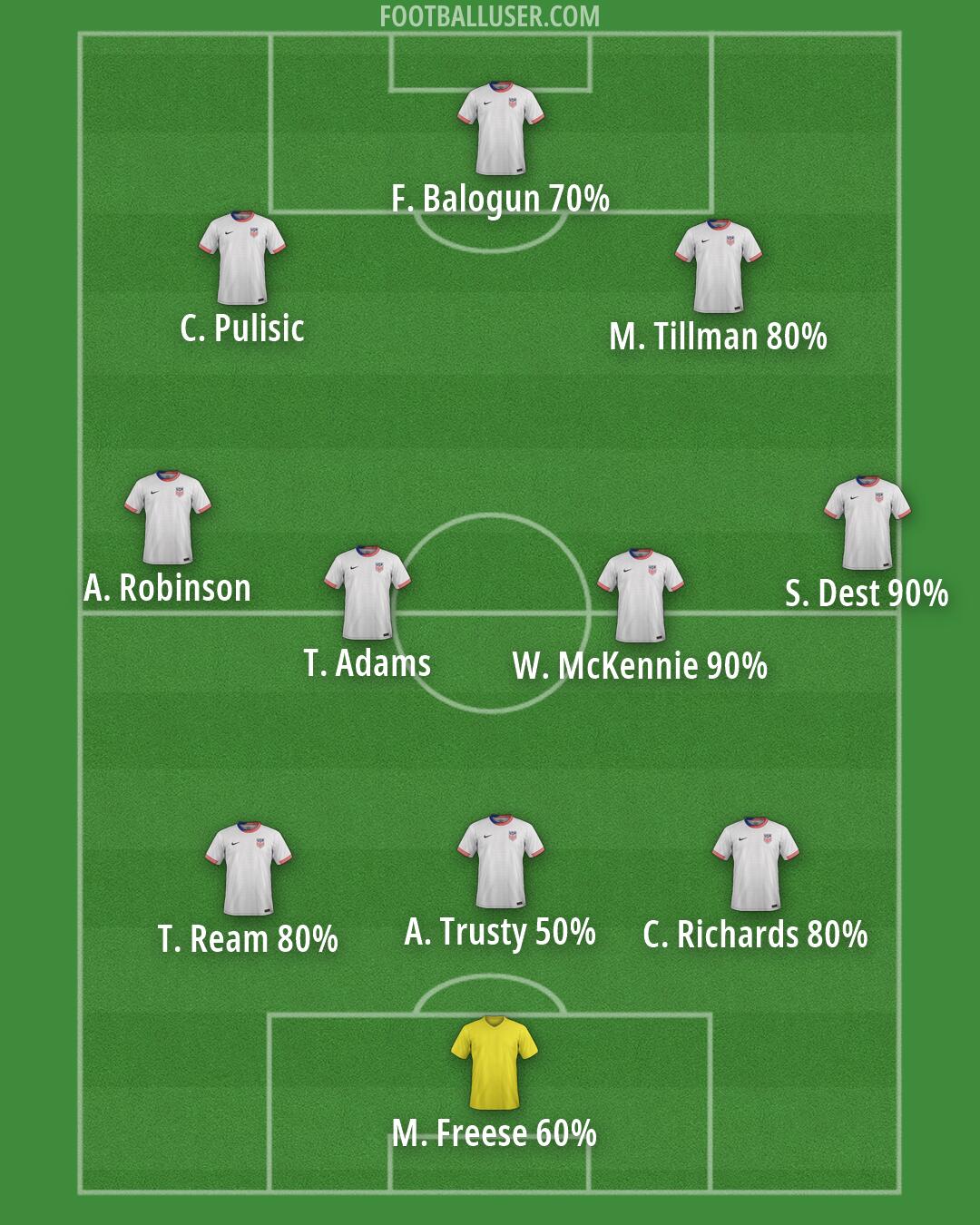
M. Freese 60% · T. Ream 80% · C. Richards 80% · A. Trusty 50% · C. Pulisic · F. Balogun 70% · M. Tillman 80% · T. Adams · W. McKennie 90% · A. Robinson · S. Dest 90%United States focuses on a direct and high energy way of playing through a 3-4-3 formation. This lineup is built to press hard and use the width of the pitch to stretch the opposition defense. The goal is to win the ball high up the pitch and quickly move it into the final third to catch teams out of position.
M. Freese starts between the posts to organize the back line. The United States defensive unit works with a back three consisting of A. Trusty in the center, flanked by T. Ream on the left and C. Richards on the right. T. Ream and C. Richards act as ball playing defenders who can spread the play wide. A. Trusty provides aerial strength and covers the space behind as the team pushes up. The unit defends zonally to maintain compactness when the opposition moves into the middle areas.
The midfield functions with two central players and two wide players to control the game. T. Adams and W. McKennie operate in a double pivot to control the middle. T. Adams provides a physical presence to shield the defense, while W. McKennie uses his passing range to drive the ball forward. S. Dest and A. Robinson play as wide midfielders who provide constant width. They act as attacking wing backs to overlap the front three and deliver crosses into the box.
In the attacking third, the team uses three players to pin the last defender. C. Pulisic and M. Tillman act as inverted wingers who cut inside to create scoring chances. C. Pulisic uses his dribbling style to beat markers on the flank. F. Balogun leads the line as a pressing centre-forward, making runs in behind to exploit space. This front line works in combinations to create chances through quick passing and movement.
One major advantage for United States is the ability to create wide overloads through the movement of S. Dest and A. Robinson. Their presence allows the wingers to move into central areas, creating numerical superiority in the half spaces. The team also benefits from the speed of transition when they win the ball back high up the pitch and launch direct attacks.
This 3-4-3 formation is built to overwhelm opponents with intensity and width. It is best suited for games where the team can exploit space behind an attacking opponent.