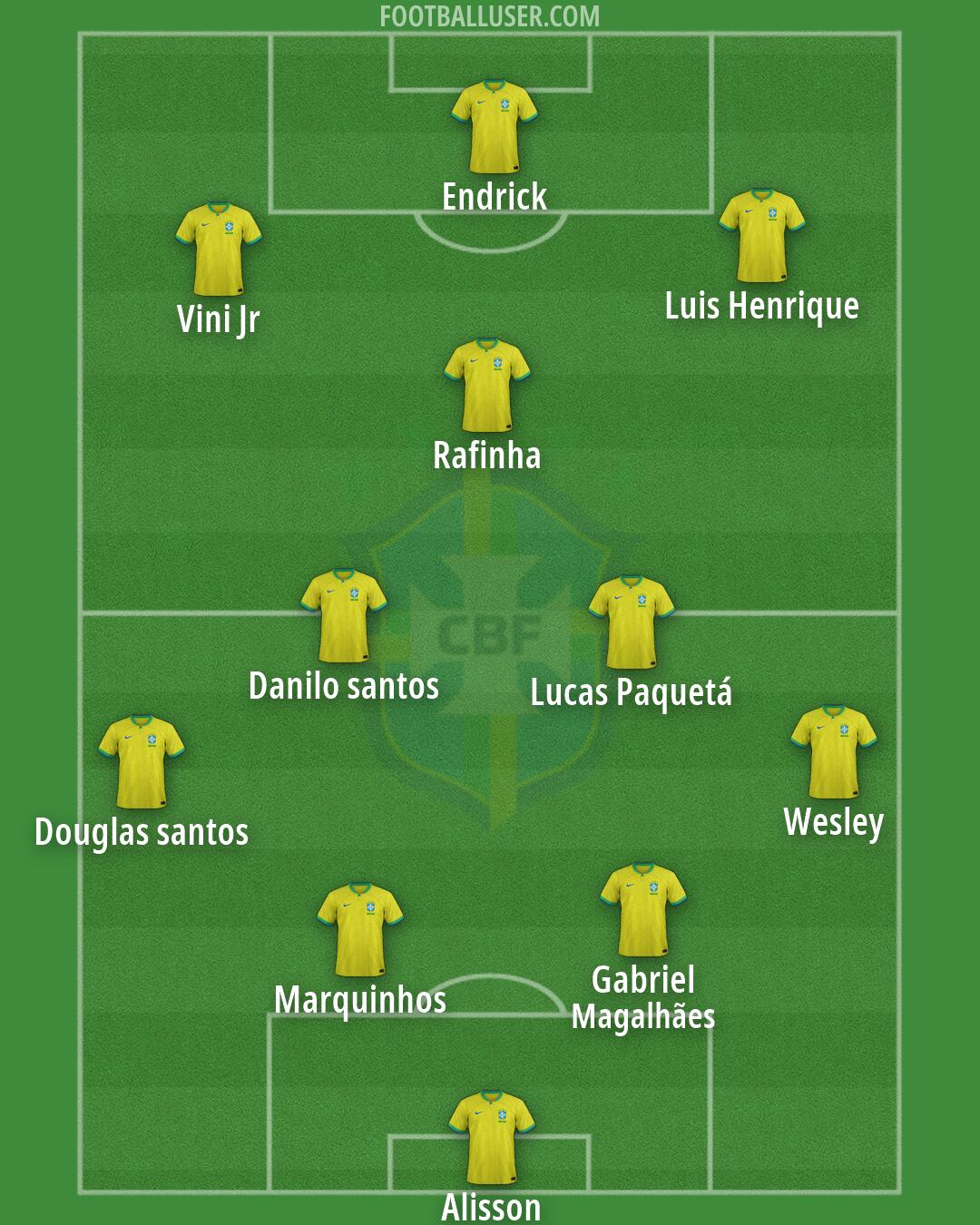

Brazil National Football Team Formation
 June 7, 2026


Starting Lineup
Alisson · Wesley · Marquinhos · Gabriel (Magalhães) · Rafinha · Vini Jr · Endrick · Douglas santos · Lucas Paquetá · Danilo santos · Luis HenriqueBrazil aims to dominate through heavy central congestion and high pressing in a 2-5-3. This formation relies on overwhelming the middle of the pitch to control tempo and force errors from the opposition. The goal is to use a massive midfield block to win the ball back high up the pitch and immediately look to exploit the verticality of the front three.
Alisson stays between the posts, often acting as a sweeper behind a very high line to cover the space left by the defenders. The back line consists of a pair of central defenders, Marquinhos and Gabriel, who must defend in much larger spaces than a traditional back four. Marquinhos uses his reading of the game to intercept passes, while Gabriel provides aerial strength to clear the lines during set pieces. Because there are only two defenders, they must stay compact to prevent being split by long balls and must be ready to step up to catch opponents offside.
The midfield acts as the engine room for Brazil, utilizing a five man unit to squeeze the space. Douglas Santos plays as a single pivot to shield the defense, while Wesley works alongside him to win the second ball. Lucas Paquetá operates in the half spaces to create from deep, using his passing range to find the attackers. Danilo Santos connects the defensive and attacking lines by carrying the ball forward, while Rafinha plays as an attacking ten to play through the lines. This heavy midfield presence allows the team to recycle possession and move the ball quickly from side to side.
The attacking trio focuses on stretching the defense and creating chaos in the final third. Vini Jr plays as an inverted winger on the left, frequently cutting inside to find space for shots or through balls. On the right, Luis Henrique stays wide to provide width and cross on the run. Endrick acts as a pressing centre-forward, working to pin the last defender and hold up the ball for the oncoming midfielders. The team builds attacks through quick combinations in the middle before looking to hit in behind on the transition.
This lineup offers significant numerical superiority in midfield, making it very hard for opponents to play through the center. The coordination of the five midfielders allows Brazil to press in waves, forcing long balls that the center backs can deal with. By crowding the middle, the team creates wide overloads when the wingers and central players combine to isolate defenders one on one.
Brazil utilizes a high risk high reward setup built on controlling the center of the pitch. This formation is best suited for games where the team needs to dominate possession against a side that sits deep in a low block.