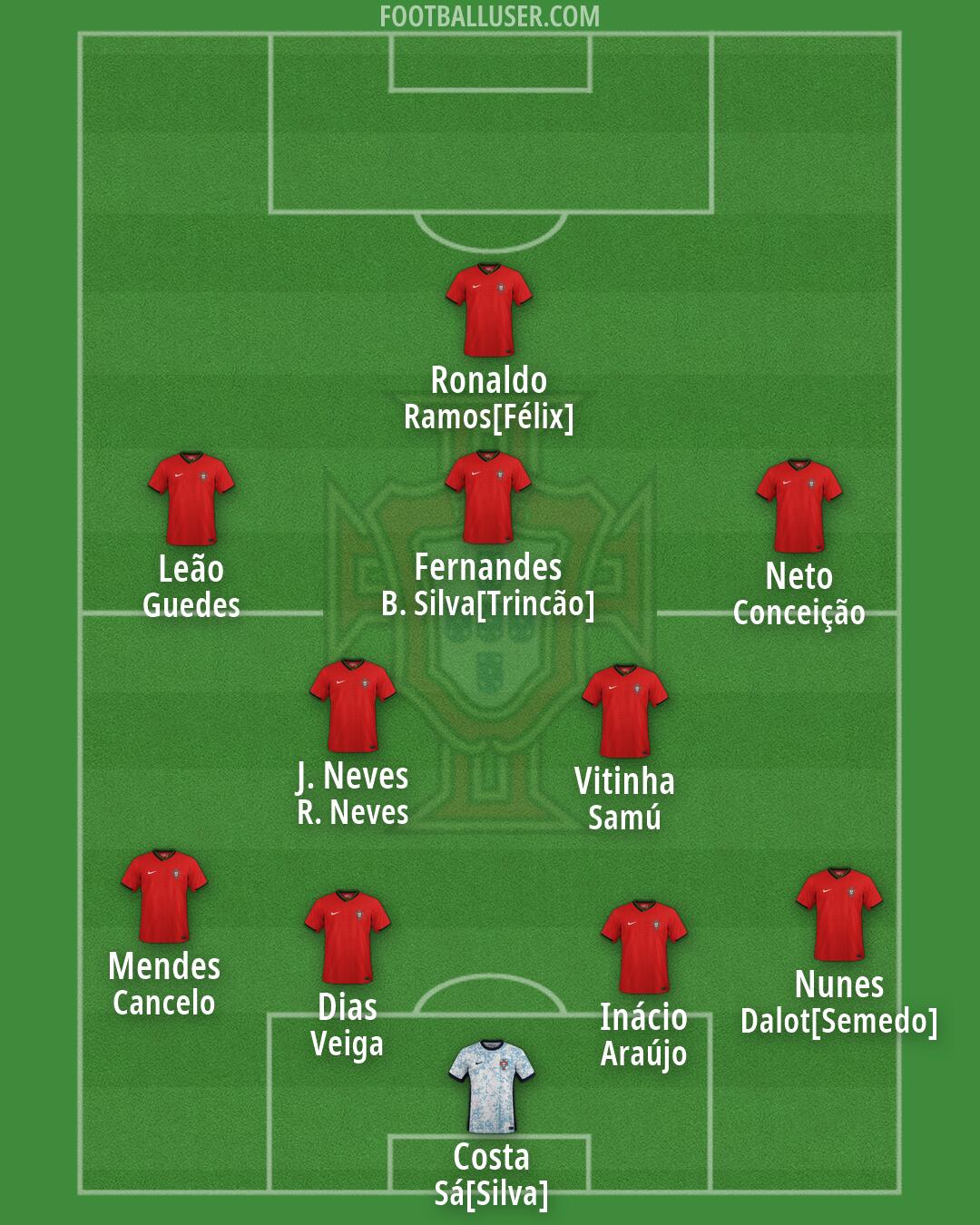

Portugal National Football Team Formation
 June 7, 2026
 Rebuild Master


Starting Lineup
Costa (Sá[Silva]) · Mendes (Cancelo) · Dias (Veiga) · Inácio (Araújo) · Nunes (Dalot[Semedo]) · J. Neves (R. Neves) · Vitinha (Samú) · Fernandes (B. Silva[Trincão]) · Leão (Guedes) · Neto (Conceição) · Ronaldo (Ramos[Félix])Portugal aims to win the ball high up the pitch and strike with massive speed in transition, using a 4-2-4 formation. This lineup focuses on stretching the defence and playing through the lines to exploit gaps behind the opponent. The team looks to pin the last defender and create high-intensity moments in the final third.
Diogo Costa plays between the posts, acting as a sweeping goalkeeper to cover the space behind the high line. The back four consists of Nunes at right back and Mendes at left back, both ready to push up and provide width. In the center, Inácio and Rúben Dias act as the primary defenders. Inácio provides composure when playing out from the back, while Dias is known for his aerial strength and ability to win the second ball. This unit works to keep a high line and squeeze the space to force a long ball from the opposition.
The midfield works as a double pivot to manage the transition between defence and attack. Vitinha operates as a carrier who can drive forward with the ball, using his passing range to find teammates. Alongside him, João Neves works to shield the defence and press aggressively to win the ball. This pair must hold a compact shape to prevent being bypassed in the middle, acting as the link that allows the front four to stay high.
The attack is built around four players who aim to attack the space behind the opposition back line. Diogo Neto and Rafael Leão act as wide wingers who look to cut inside and create chaos. Leão uses his dribbling style to beat men in one on one situations. In the center, Bruno Fernandes plays as a second striker in the hole, looking to deliver early passes or arrive late into the box. Cristiano Ronaldo acts as the main striker, using his movement to find space and his aerial strength to attack the far post.
One major advantage for Portugal is the ability to create wide overloads when the full backs join the attack. The team also benefits from the speed of transition, moving from a mid-block to an attacking wave in seconds. By playing with four attackers, they force the opposition to defend deep and can isolate wide players in one on one battles.
This 4-2-4 lineup is built for aggressive, vertical football that punishes teams for playing a high line. It is best suited for games where Portugal can win the ball high up the pitch and catch the opponent on the break.