
Iran National Football Team Formation
 June 8, 2026
 Rebuild Master


Starting Lineup
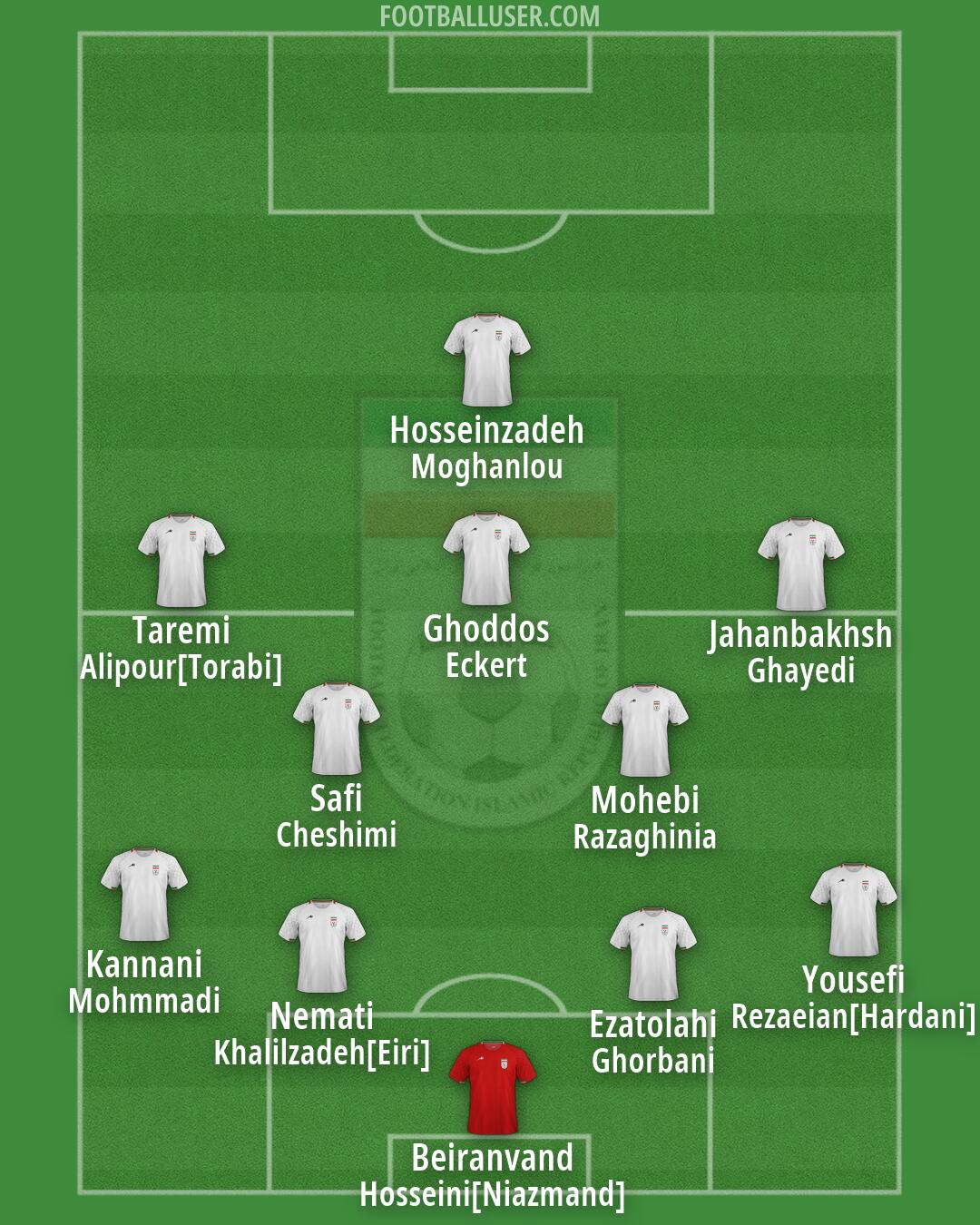
Beiranvand (Hosseini[Niazmand]) · Kannani (Mohmmadi) · Nemati (Khalilzadeh[Eiri]) · Ezatolahi (Ghorbani) · Yousefi (Rezaeian[Hardani]) · Safi (Cheshimi) · Mohebi (Razaghinia) · Ghoddos (Eckert) · Taremi (Alipour[Torabi]) · Jahanbakhsh (Ghayedi) · Hosseinzadeh (Moghanlou)Focusing on defensive solidity and quick transitions, Iran employs a 4-5-1 formation. This lineup is built to sit deep and absorb pressure before hitting the opposition on the break. The main goal is to remain compact and wait for the right moment to counter at pace.
Beiranvand stays between the posts to command the area. The back line functions as a flat back four that can shift across the pitch. Yousefi acts as a defensive wing back on the right to help the wide area, while Kannani plays as an attacking wing back on the left. Ezatolahi and Nemati form the central duo, with Ezatolahi looking to cover space while Nemati defends zonally. The whole unit works to squeeze the space and hold the line when the opponent pushes forward.
A dense midfield unit provides the core of this formation. Mohebi and Safi operate as a double pivot to shield the defence and win the second ball. Ghoddos and Taremi occupy the central areas to connect the defensive and attacking lines. Taremi uses his pressing intensity to win it back high up the pitch, while Ghoddos looks to carry the ball forward through the middle. Jahanbakhsh provides width on the flank but cuts inside to provide more central presence, helping the midfield win the battle in the center.
The attack is led by Hosseinzadeh acting as a lone striker. He must hold up the ball and find the feet of the incoming runners. Jahanbakhsh cuts inside from the flank to allow the team to build play in combinations. Taremi often drops deep to link-up play between the lines, creating room for Hosseinzadeh to make runs in behind. The forwards press from the front to force a long ball from the opposition.
Iran gains a massive advantage through numerical superiority in midfield, making it very difficult for opponents to play through the lines. The ability to press in a mid-block helps the team regain possession quickly. Another strength for Iran is the speed of transition once the ball is won, allowing the team to exploit space behind the opponent.
This 4-5-1 formation is a resilient way to defend and strike on the break. It is best suited for matches against teams that dominate possession and leave space in behind.