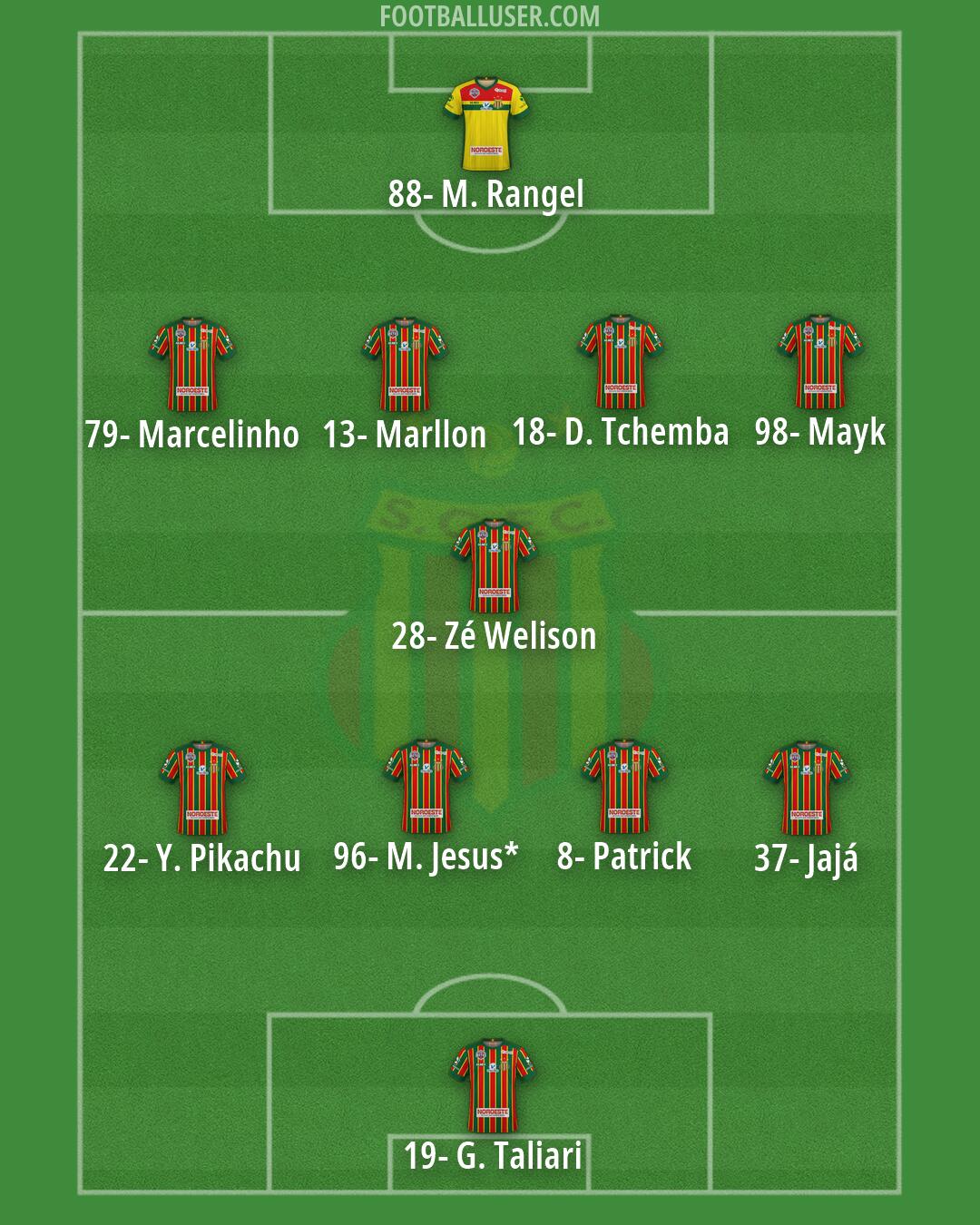

Sampaio Corrêa Football Formation
 June 8, 2026


Starting Lineup
88- M. Rangel79- Marcelinho
13- Marllon
18- D. Tchemba
98- Mayk
28- Zé Welison
96- M. Jesus*
8- Patrick
37- Jajá
22- Y. Pikachu
19- G. Taliari
Sampaio Corrêa looks to play a game built on a hard defensive block and rapid transitions using a 5-4-1 formation. This lineup is designed to sit deep and deny space between the lines, making the team difficult to break down. The goal is to stay compact and wait for the opposition to overcommit before launching attacks quickly.
M. Rangel guards the goal while the defensive unit holds a narrow defensive block. Zé Welison sits in the center of the back three to lead the line and win headers, while Marllon and D. Tchemba act as the wider center backs to cover the channels. Marcelinho and Mayk operate as attacking wing backs, tasked with providing width and tracking back to help the defenders. The unit works to stay close together to prevent through balls and force the opposition into wide areas.
The midfield functions as a flat four that sits in front of the back five to squeeze the space. Patrick and M. Jesus act as the central pairing, with Patrick tasked to shield the defense and M. Jesus looking to carry the ball forward. Jajá and Y. Pikachu occupy the wide areas to provide defensive cover and help recycle possession. This midfield unit works to stay compact and win the second ball to spark transitions.
G. Taliari acts as a lone striker tasked to hold up the ball and fight against the opposition center backs. The attack relies on the wingers, Jajá and Y. Pikachu, to push higher during transitions to support the front man. The team looks to exploit wide areas through Marcelinho and Mayk, who aim to deliver crosses into the box. Much of the attacking play comes from hitting in behind on the transition to catch the opposition defense out of position.
Sampaio Corrêa finds success through extreme compactness when defending in a low block. The formation allows for quick transitions to exploit space if the opponent loses control in the middle third. This setup also provides numerical superiority in the defensive third to handle heavy pressure.
This 5-4-1 formation is built to frustrate dominant sides by denying them any clear attacking lanes. It is best suited for matches where the team needs to defend a lead or play against superior technical opponents.