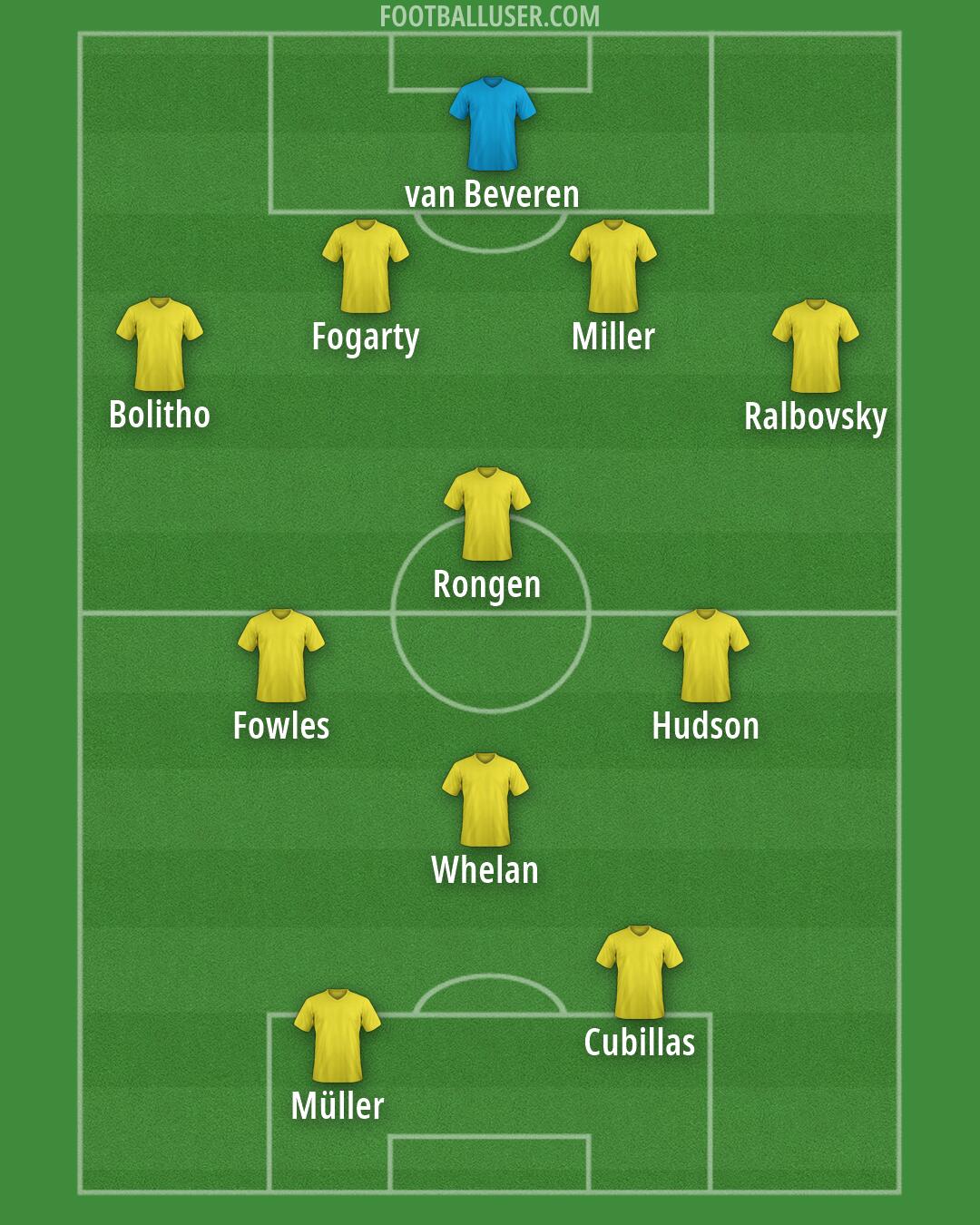
Custom Team Football Formation
 June 8, 2026


Starting Lineup
van Beveren · Fogarty · Miller · Bolitho · Ralbovsky · Rongen · Fowles · Hudson · Whelan · Müller · CubillasFocusing on direct play and quick transitions, this lineup utilizes a 4-4-2 formation. The team relies on verticality to move the ball from the back to the front as fast as possible. By spreading the pitch wide, they aim to stretch the opposition and create spaces in the middle. This system works well to bypass heavy midfields and exploit gaps left by advancing defenders.
In goal, van Beveren acts as the first line of defense to organize the unit. The defensive line consists of a flat back four featuring Bolitho at right back and Ralbovsky at left back. Both full backs are tasked to push up and provide width, while Fogarty and Miller form the central pairing. Fogarty and Miller must hold the line and stay compact to prevent runners from slipping through. The defensive unit functions by maintaining a consistent distance between the lines to avoid leaving too much space for the opponent to exploit.
The midfield is built around a four man block to control the central areas. Rongen plays as a single pivot to shield the defense and win the second ball. Alongside him, Fowles and Hudson operate in the half spaces to connect the defense to the attack. Hudson and Fowles must track back to help the full backs when the team is out of possession. Whelan plays in a more advanced role behind the two strikers, looking to arrive late into the box and find pockets of space. This group works to compress the midfield and deny the turn to opposition players.
Up front, the team employs two forwards in a partnership to pressure the opposition back line. Cubillas plays as the left striker, often looking to run in behind the defense to catch opponents off guard. Müller operates as the right striker, acting as a focal point to hold up the ball and lay it off to oncoming runners. These two forwards press in pairs from the front to force a long ball from the opponent. This duo creates constant movement, using one to pull a defender away while the other searches for a through ball.
One major tactical advantage of this formation is the ability to win the ball back high up the pitch through coordinated pressing. The proximity of the four midfielders to the two attackers makes it easier to squeeze the space in the final third. Another strength is the speed of transition, as the team can go direct to Müller and Cubillas immediately after an interception. This allows them to catch the opposition while they are moving forward.
This 4-4-2 formation is built to play a high intensity game centered on directness. It is best suited for matches against teams that play a high line and can be caught on the counter at pace.