
Real Madrid Football Formation
 June 12, 2026


Starting Lineup
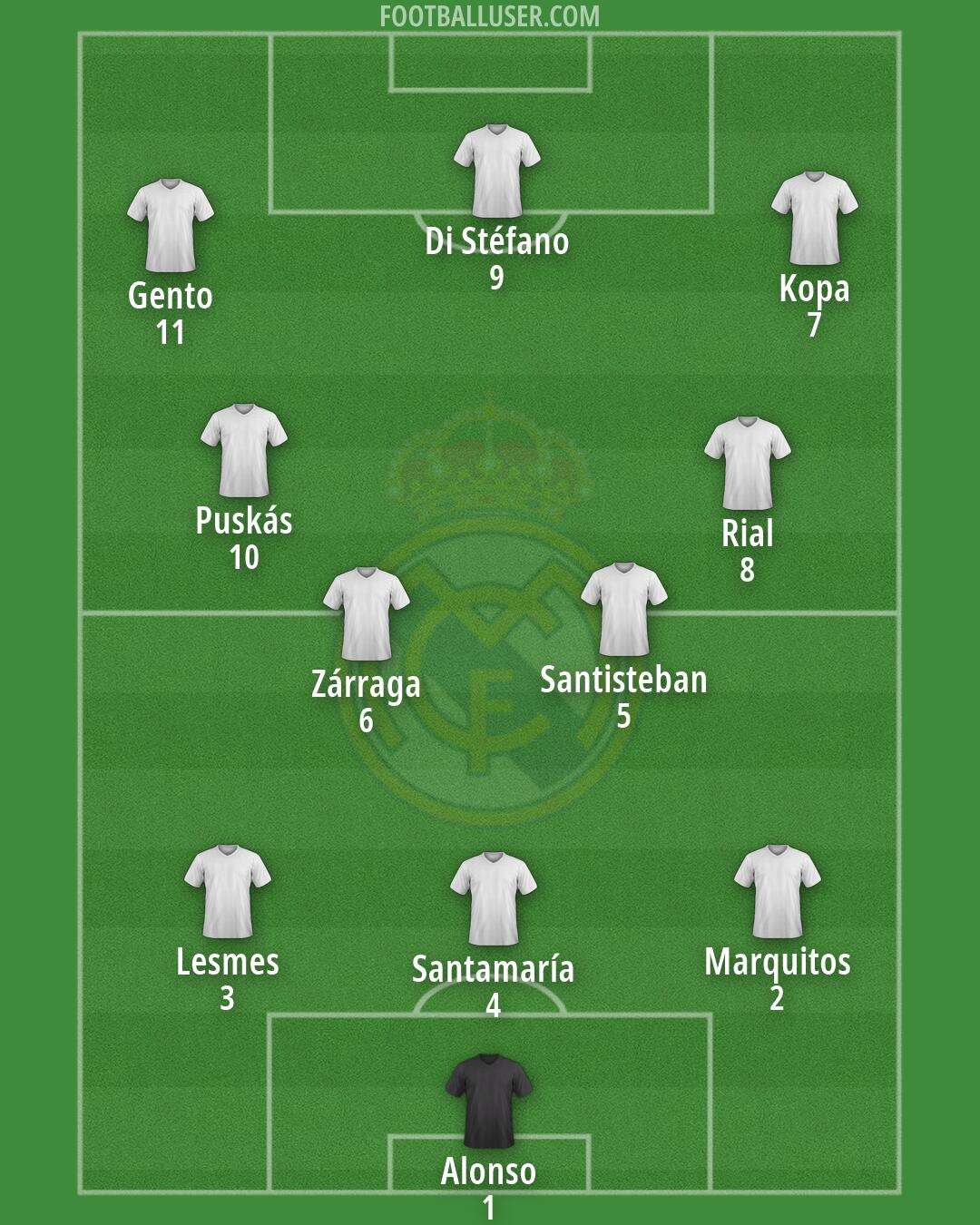
Alonso (1) · Marquitos (2) · Santisteban (5) · Zárraga (6) · Lesmes (3) · Santamaría (4) · Di Stéfano (9) · Gento (11) · Kopa (7) · Puskás (10) · Rial (8)Real Madrid plays an attacking brand of football using a 3-4-3 formation. This lineup focuses on high pressure and vertical play to overwhelm the opposition. The goal is to dominate the game through constant movement and heavy pressure in the final third, creating many chances in a short amount of time.
Alonso stands as the goalkeeper to protect the goal. The defensive unit works as a back three consisting of Santamaría, Lesmes, and Marquitos. Santamaría acts as the central defender, tasked with sweeping behind a high line and organizing the unit. Lesmes and Marquitos play as wide centre-backs who cover the wide spaces and win the header when the ball is delivered into the box. They work together to hold a compact defensive block and defend zonally to deny the turn to any attacking players.
The midfield unit is designed to control the center and link the defense to the attack. Zárraga acts as a single pivot to shield the defense and recycle possession. Santisteban and Rial operate as the driving force, carrying the ball forward and connecting the lines. Puskás plays in the hole as an attacking ten, using his clinical finishing to arrive late into the box and play through the lines. This midfield formation allows the team to win the second ball and quickly progress through the thirds.
In the attacking phase, Real Madrid uses three forwards to stretch the defence. Di Stéfano leads the line as a pressing centre-forward with exceptional link play, often dropping deep to find the feet of others. Gento plays as a wide winger who hugs the touchline and uses his extreme pace to spread wide, while Kopa operates as an inverted winger on the right to cut inside and create chances. This front line works to pin the last defender and create runs in behind, often using quick combinations to split the defence with a through ball.
One major advantage of this formation is the ability to create wide overloads when the midfield players push up. The team can also achieve numerical superiority in the attacking half by using Puskás to find pockets of space between the lines. Furthermore, the speed of transition allows the players to counter at pace, hitting in behind on the transition before the opponent can recover.
This 3-4-3 lineup is a potent attacking force designed to dominate possession. It is most effective against teams that sit deep in a low block and require constant pressure to break down.