
Real Madrid Football Formation
 June 12, 2026


Starting Lineup
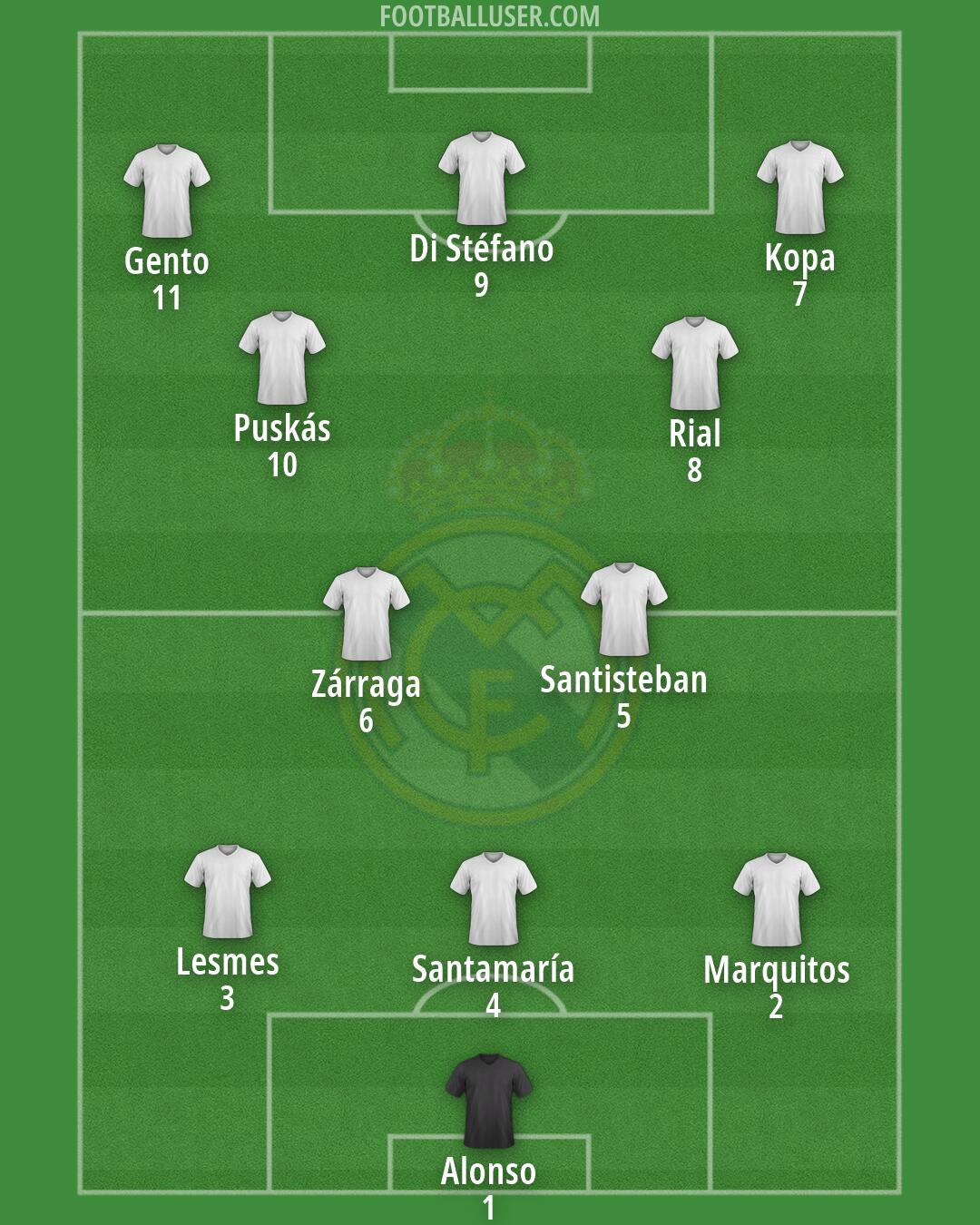
Alonso (1) · Marquitos (2) · Santisteban (5) · Zárraga (6) · Lesmes (3) · Santamaría (4) · Di Stéfano (9) · Gento (11) · Kopa (7) · Puskás (10) · Rial (8)Real Madrid plays a highly vertical game designed to hit the opposition with speed and intensity. This aggressive identity is built around a 3-4-3 formation. The team aims to win the ball high up the pitch and quickly transition into dangerous attacking movements to exploit space.
Alonso sits between the posts to manage the defense. In front of him, the back three consists of Marquitos, Santamaría, and Lesmes. Santamaría holds the central position to command the area and win headers. Marquitos and Lesmes act as wide centre-backs to cover the flanks and step into midfield when necessary. This defensive unit works to stay compact and squeeze the space between the lines.
The midfield operates with a double pivot to control the center of the pitch. Zárraga and Santisteban work as the deep-lying pairing to shield the defense and recycle possession. They are tasked to protect the back three and pick up runners in front of them. Ahead of them, Rial and Puskás play as two attacking midfielders in the half-spaces. Puskás is known for his goal scoring ability and clinical finishing, while Rial works to find the feet of the attackers and play through the lines to connect the units.
The attack features three players across the front line. Di Stéfano leads the line as the main striker, using his movement to pull defenders out of position and link up play. Gento and Kopa operate as wide attackers to provide width. Gento uses his pace to run in behind the opposition defense, while Kopa likes to cut inside to create chances. This lineup uses the width of the pitch to stretch the defense and create one on one situations for the forwards.
One major advantage of this Real Madrid lineup is the numerical superiority in the central areas during the transition. The ability of Rial and Puskás to operate in the half-spaces creates overloads that are hard to mark. Additionally, the front three can press in pairs to force a long ball from the opposition. The team is very strong when they can play quickly in transition to catch the opponent out of position and hit in behind.
This 3-4-3 formation is built for high intensity and rapid attacking play. It is best suited for games where the team needs to break down a deep block or exploit a high defensive line.