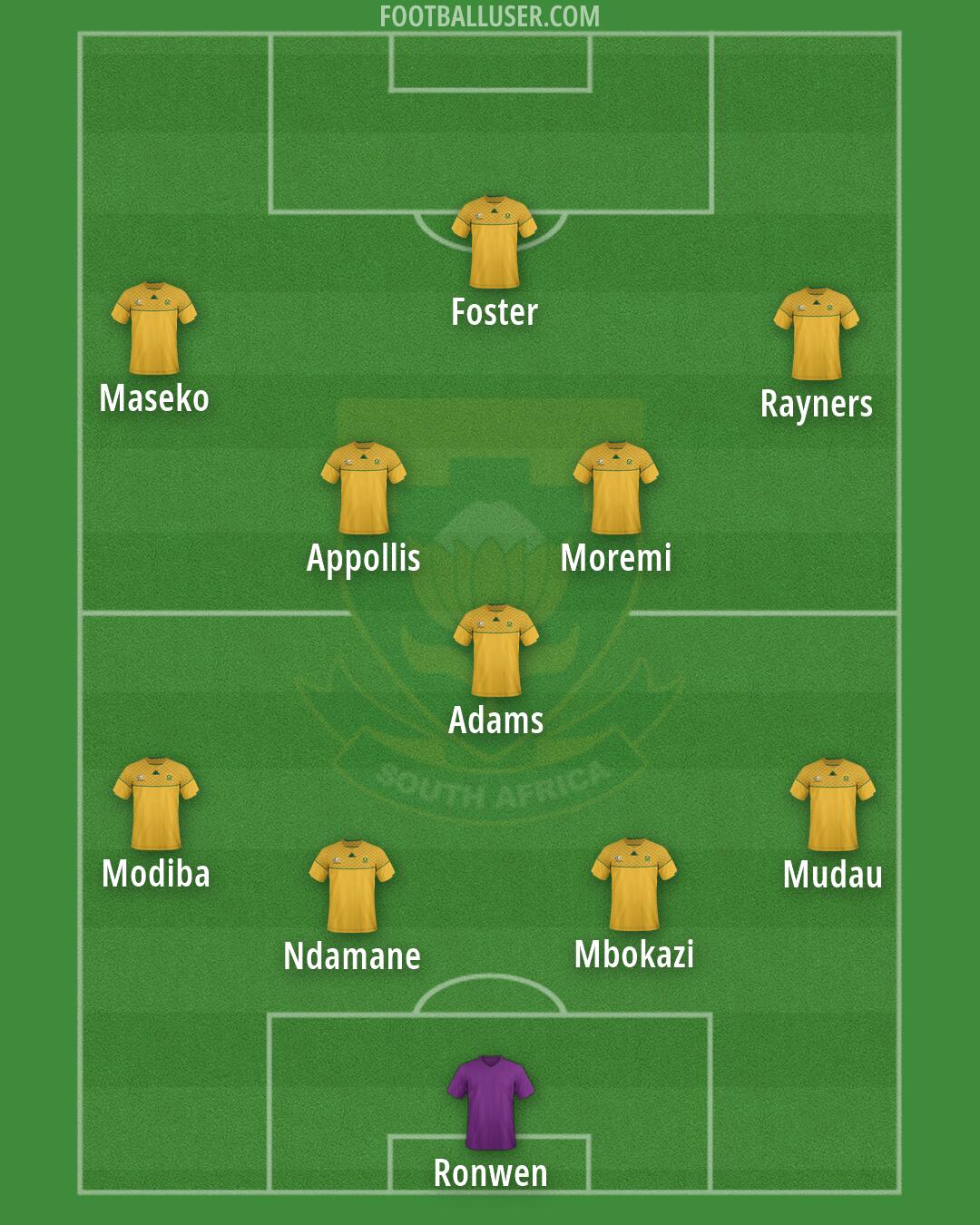

South Africa National Soccer Team Formation
 June 12, 2026


Starting Lineup
Ronwen · Modiba · Ndamane · Mudau · Mbokazi · Adams · Moremi · Maseko · Rayners · Foster · AppollisSouth Africa plays a game built on defensive stability and quick breaks, utilizing a 5-2-3 formation. The team looks to sit deep and wait for the opposition to overextend before hitting them in behind. This lineup is designed to remain hard to beat while staying ready to transition with speed and precision.
Ronwen sits in goal to organize the back five. Adams holds the center of a narrow defensive block alongside Ndamane and Mbokazi. The central trio works to cover the space and win the second ball. Mudau acts as an attacking wing back on the right to provide width, while Modiba plays as a defensive wing back on the left to ensure the team does not get stretched. This lineup allows the defenders to shift as a unit to block the runners and protect the middle.
The midfield relies on a pairing of two consisting of Moremi and Appollis. These players must cover a lot of ground to protect the defense and link the lines. Moremi works to shield the defense and win the ball back, while Appollis looks to carry the ball forward and find the attackers. They act as the connection between the defense and the attack, tasked with recycling possession and moving the ball through the thirds to the front three.
Up front, South Africa employs three attackers to stretch the opposition. Foster leads the line as a lone striker, looking to hold up the ball and find teammates. Maseko and Rayners act as wide wingers to provide width and the ability to cut inside. The wingers press the opposition back line, while the wing backs like Mudau overlap to create numbers in the final third. The team aims to move the ball quickly to the flanks to deliver crosses or play through the lines.
This formation offers significant tactical advantages, particularly in defensive compactness. Having three central defenders like Adams, Ndamane, and Mbokazi makes the team very hard to break down through the middle. Additionally, the presence of Mudau and Modiba allows for wide overloads when the team wins the ball back. The speed of transition through Rayners and Maseko allows the team to exploit gaps in a high line and hit the opposition in behind.
The 5-2-3 formation provides a solid foundation for a team that wants to defend deep and counter at pace. It is best suited for games against dominant sides that commit many players forward.