
Morocco National Football Team Formation
 June 14, 2026


Starting Lineup
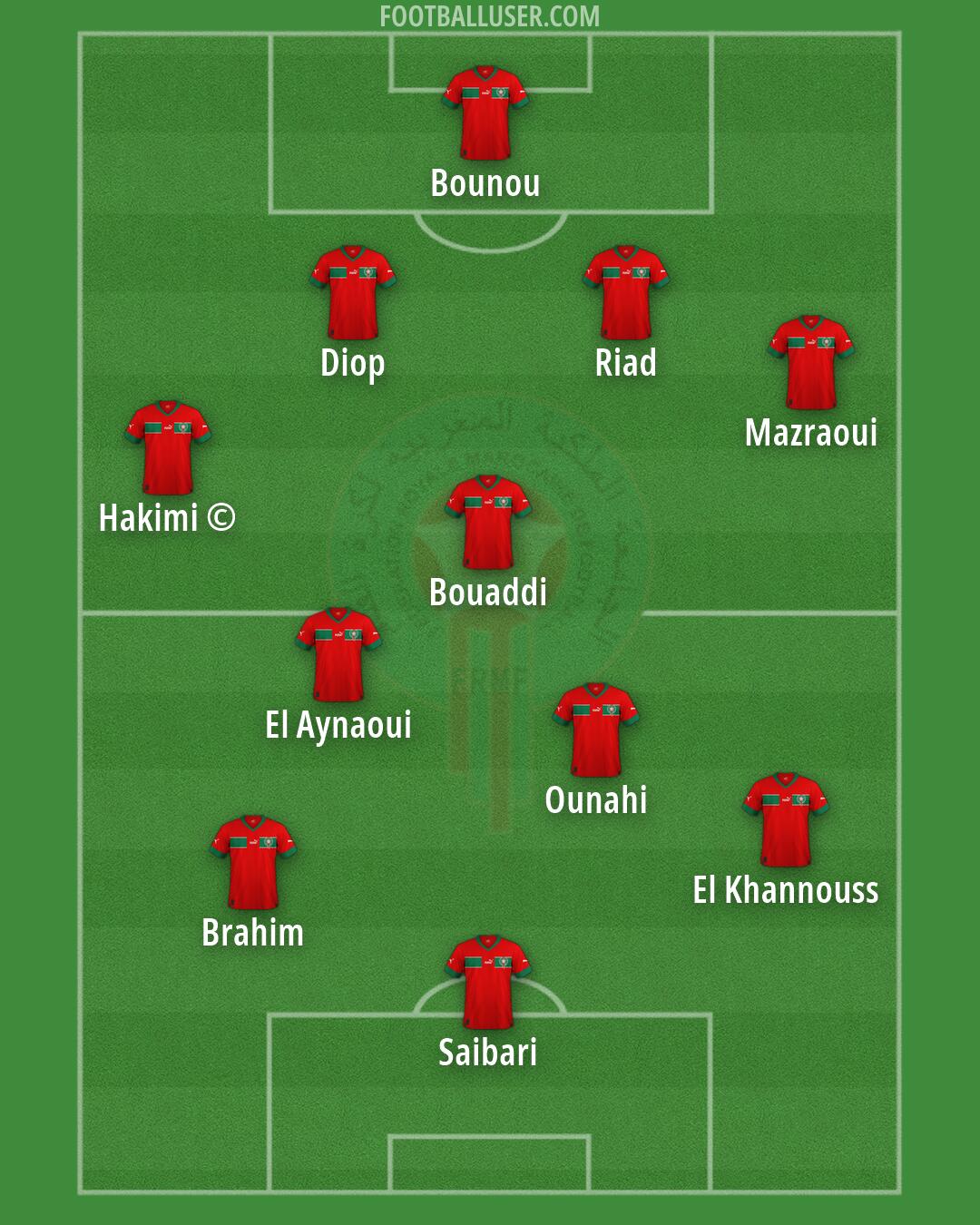
Bounou · Diop · Riad · Mazraoui · Hakimi © · Bouaddi · El Aynaoui · Ounahi · El Khannouss · Brahim · SaibariMorocco operates with a defensive identity built on solidity and quick transitions, employing a 5-4-1. This lineup is built to sit deep and hit opponents on the break, making them a difficult side to break down. The team looks to absorb pressure and then move forward quickly to catch the opposition out of position.
Bounou stays between the posts to guard the goal. The back line functions as a narrow defensive block with Diop, Bouaddi, and Riad occupying the central positions. Hakimi, the captain, and Mazraoui act as attacking wing backs who push up the pitch to provide width. The central defenders aim to be dominant in the air and cover space to ensure the team holds a compact formation. Diop and Riad work to mark the opposition attackers while Bouaddi acts as a covering defender sweeping behind the line.
The midfield relies on El Aynaoui to act as a single pivot who shields the defence. Ounahi and El Khannouss play as the central pair, where Ounahi uses his dribbling to drive forward and break the lines. Brahim plays as an attacking ten behind the striker to link the lines and connect the defence to the attack. This group works to trigger a press in a mid-block to win the ball back and quickly switch play to the wide areas.
Saibari leads the line as a lone striker, often acting as a pressing centre-forward to pin the last defender. The team builds attacks in transition, looking to exploit the runs of the wing backs. Brahim works to find the feet of the striker or play through the lines to find Saibari in behind. The movement is designed to create overlaps from wide and allow the team to deliver early crosses into the box.
A key advantage for Morocco is the compactness when defending in a low block, which makes it hard for opponents to play through the middle. The team also benefits from the speed of transition, especially when Hakimi can carry the ball forward. This allows the side to isolate wide players in one on one situations during a break. The numerical superiority in the back five ensures they win the second ball frequently.
This 5-4-1 formation is a resilient way to play that relies on discipline. It is ideally suited for facing high possession teams that need to be countered at pace.