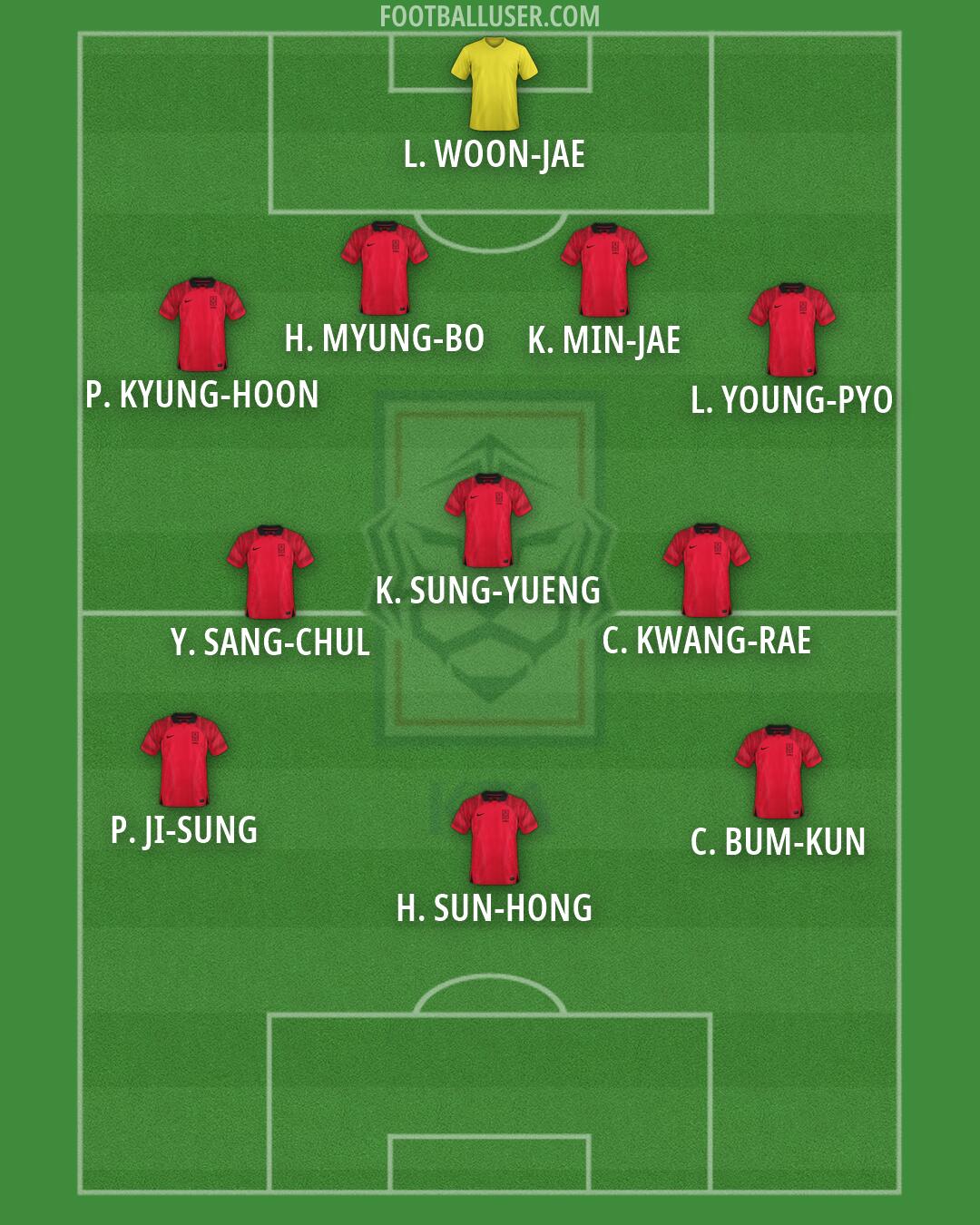

South Korea National Football Team Formation
 June 14, 2026


Starting Lineup
H. MYUNG-BO · K. MIN-JAE · P. KYUNG-HOON · L. YOUNG-PYO · K. SUNG-YUENG · Y. SANG-CHUL · C. KWANG-RAE · P. JI-SUNG · C. BUM-KUN · H. SUN-HONG · L. WOON-JAESouth Korea aims to control games through high intensity and verticality in a 4-3-3. The lineup is built to win the ball high up the pitch and move forward with speed. This formation allows the team to stretch the defence and create many chances in transition.
L. WOON-JAE starts in goal to manage the area behind the line. A flat back four sits in front of him, with P. KYUNG-HOON acting as a defensive wing back on the right. L. YOUNG-PYO plays as the left back to provide width. K. MIN-JAE operates as a ball playing centre back, using his strength and speed to cover space. H. MYUNG-BO joins him in the middle to defend zonally and win the second ball. The defensive unit works to keep a high line and squeeze the space.
A three man midfield provides the engine for South Korea. C. KWANG-RAE operates as the single pivot to shield the defence and recycle possession. Beside him, K. SUNG-YUENG and Y. SANG-CHUL act as inverted eights to connect the defensive and attacking lines. These midfielders are tasked to press aggressively to win the ball high up the pitch. They help to progress through the thirds by playing short from the back and then looking to break the line with a pass.
The attack uses three attackers across the front to pressure the opposition back line. H. SUN-HONG acts as a pressing centre forward to pin the last defender and fight for long balls. On the flanks, C. BUM-KUN and P. JI-SUNG play as wide wingers. P. JI-SUNG is known for his high pressing intensity and work rate, which helps him win the ball back quickly. The wingers often cut inside to create central presence or pull wide to deliver a cross. The forwards work to find the feet of the striker or run in behind.
The formation offers clear tactical advantages. South Korea can achieve numerical superiority in midfield when the eights push up. They also create wide overloads from the full backs when they overlap the winger. The ability to press in coordinated waves allows them to force a long ball from the opponent.
This 4-3-3 formation relies on high intensity and quick transitions to dominate games. It is best suited for facing teams that play a high line or struggle to play out from the back.