
Real Madrid Football Formation
 June 16, 2026
 Francesco Riva


Starting Lineup
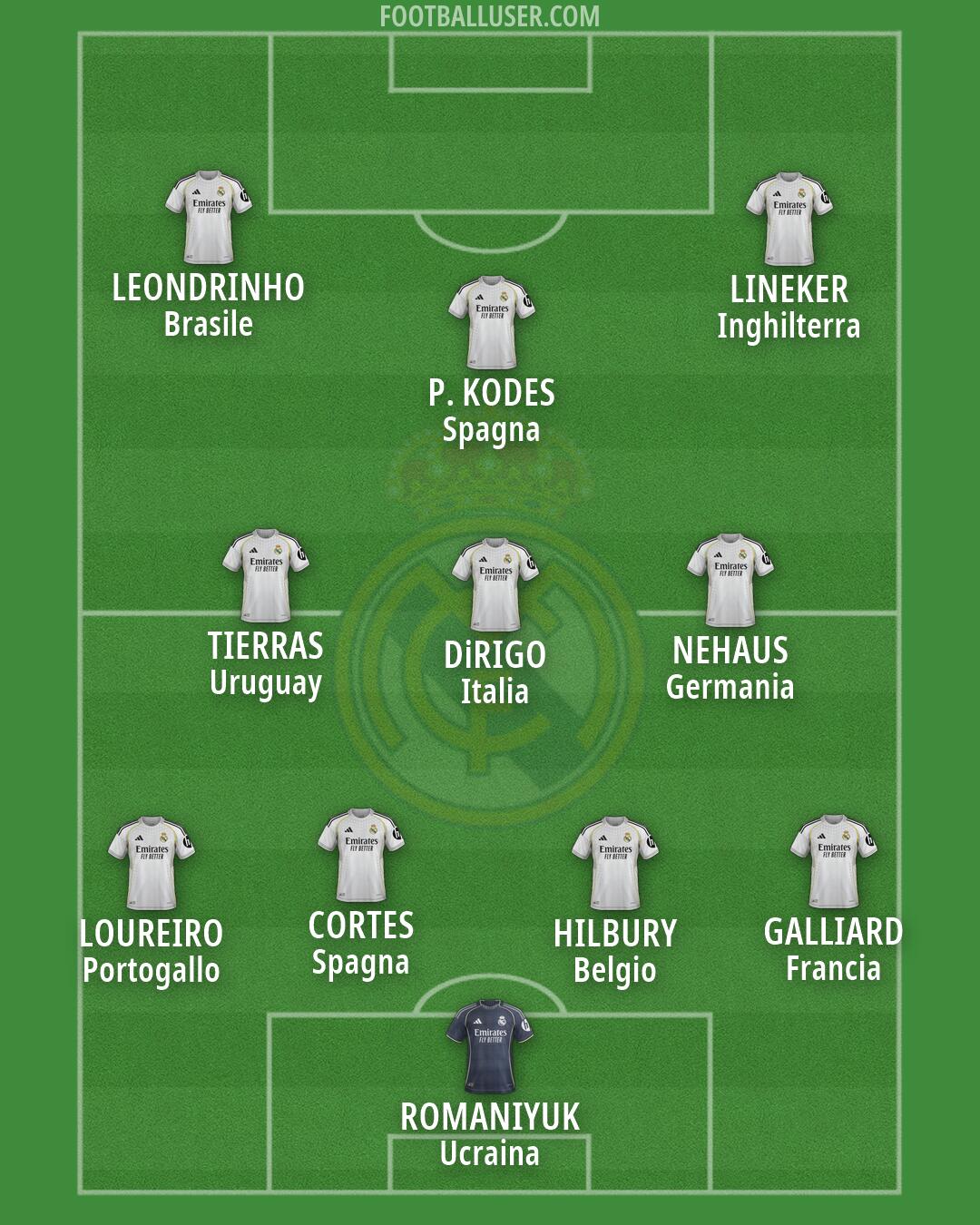
ROMANIYUK (Ucraina) · CORTES (Spagna) · HILBURY (Belgio) · LOUREIRO (Portogallo) · GALLIARD (Francia) · DiRIGO (Italia) · NEHAUS (Germania) · TIERRAS (Uruguay) · P. KODES (Spagna) · LEONDRINHO (Brasile) · LINEKER (Inghilterra)Real Madrid plays a direct and vertical brand of football using a 4-4-2 formation. This lineup is built to strike quickly once possession is won, looking to move the ball forward with purpose to catch the opposition off guard. By utilizing two strikers, the team aims to stretch the defence and create constant pressure on the opposing back line.
ROMANIYUK sits between the posts to command the area and organize the unit. The defensive unit operates as a flat back four to maintain a compact formation. GALLIARD plays as the right back to provide width, while LOUREIRO covers the left flank. In the center, CORTES and HILBURY form the heart of the defence, working to win the second ball and clear the lines. CORTES and HILBURY stay close to defend zonally and prevent runners from finding space in the box.
The midfield consists of four players tasked with controlling the center and linking the play. DiRIGO, NEHAUS, and TIERRAS work to shield the defence and win possession in the middle third. P. KODES operates as an attacking ten behind the striker to drive forward and create chances. This group must stay compact to squeeze the space and prevent the opposition from playing through the lines.
In the attacking phase, the team relies on a partnership of two forwards. LEONDRINHO acts as the left striker, while LINEKER occupies the right striker position. They work in combination to trouble defenders, either by making runs in behind or by dropping deep to find the feet of the strikers. The wide players help to spread wide, allowing the strikers to isolate defenders in one on one situations or receive the ball in the pockets of space.
A major advantage for Real Madrid is the speed of transition when they win the ball high up the pitch. The presence of two strikers alongside an advanced P. KODES allows the team to create numerical superiority in the final third. This formation allows for quick combinations to break the lines and catch defenders before they can recover.
This 4-4-2 formation is designed for quick counter attacks and high intensity. It is best suited for games where the team can sit deep and exploit an opponent that plays with a high defensive line.