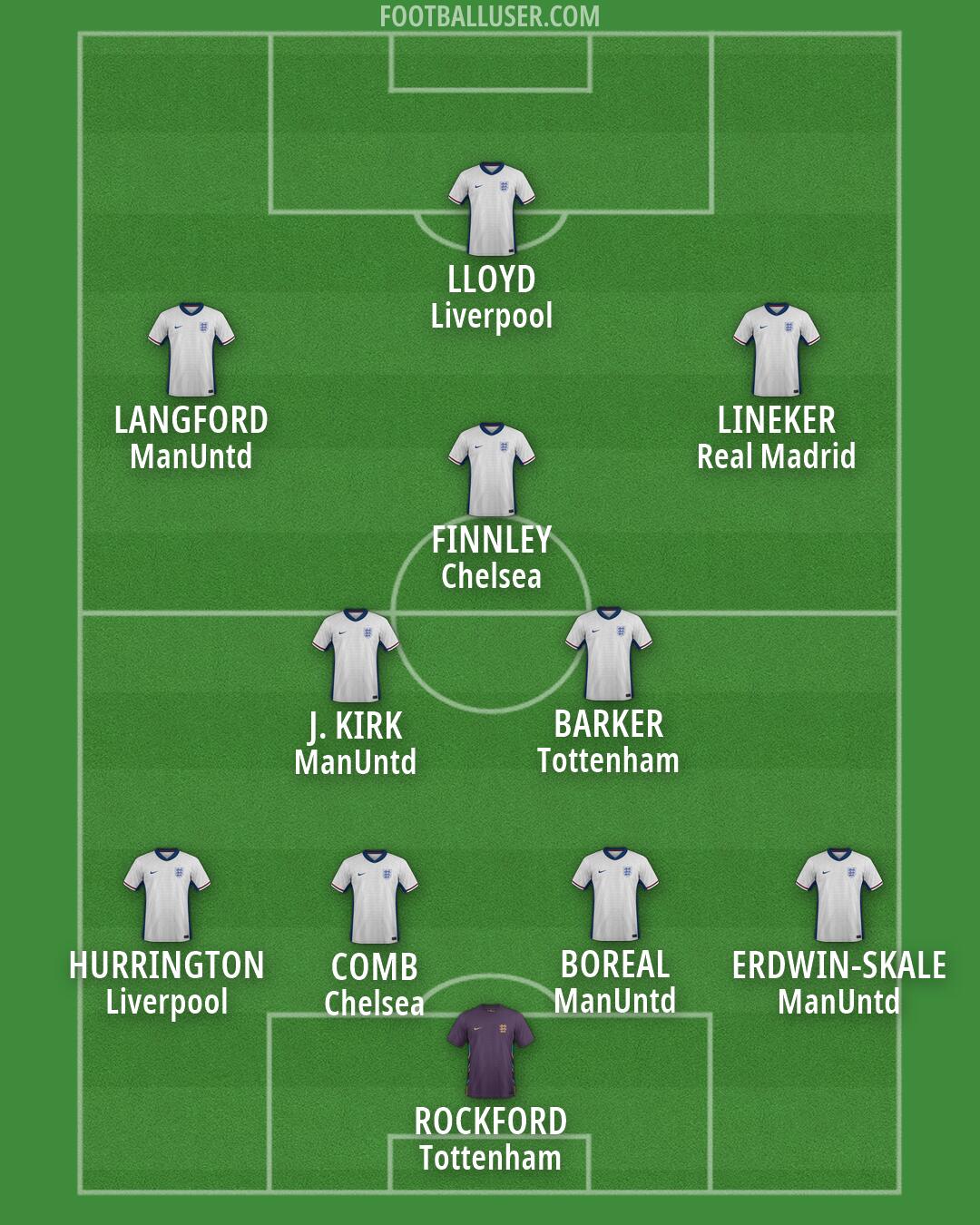
England National Football Team Formation
 June 16, 2026
 Francesco Riva


Starting Lineup
ROCKFORD (Tottenham) · BOREAL (ManUntd) · COMB (Chelsea) · HURRINGTON (Liverpool) · ERDWIN-SKALE (ManUntd) · J. KIRK (ManUntd) · BARKER (Tottenham) · FINNLEY (Chelsea) · LLOYD (Liverpool) · LINEKER (Real Madrid) · LANGFORD (ManUntd)England focuses on a high press and quick vertical play within a 4-3-3 formation. This lineup is built to win the ball high up the pitch and strike before the opposition can settle. Such football requires intense movement to play through the thirds with speed.
ROCKFORD sits between the posts to command the area. The back four consists of BOREAL and COMB acting as the central pair, while ERDWIN-SKALE and HURRINGTON occupy the wide positions. BOREAL and COMB work to cover for each other, with one often stepping into midfield to provide an extra passing option. ERDWIN-SKALE and HURRINGTON push up to provide width, while remaining ready to track back when the team loses possession. That defensive unit aims to hold a high line to squeeze the space.
A three-man midfield is used to control the center of the pitch. J. KIRK and BARKER operate in the deeper roles to shield the defense and recycle possession. BARKER often drives forward with the ball to link the lines, while J. KIRK stays more central to deny the turn of opposing attackers. FINNLEY plays as an attacking ten behind the striker, looking to find pockets of space and arrive late into the box. This midfield trio works to compress the midfield and win the second ball.
In the final third, England utilizes three attackers to stretch the defense. LLOYD acts as a pressing centre-forward, working to pin the last defender and harass the back line. LINEKER plays as an inverted winger on the right, known for his clinical finishing and intelligent movement in the box, while LANGFORD operates on the left. LINEKER and LANGFORD often cut inside to create central overloads, allowing for overlaps from the full backs. Attackers focus on breaking the line with through balls and finding the feet of the striker.
Two specific tactical advantages arise from this formation, particularly the speed of transition. When England wins the ball, the immediate movement of LINEKER and LANGFORD creates chances to hit in behind on the transition. The ability to press in coordinated waves allows the team to win it back high up the pitch frequently. Furthermore, the movement of FINNLEY between the lines creates numerical superiority in the attacking third.
This 4-3-3 formation defines a team that wants to dominate through intensity and quick vertical play. It is best suited for games against teams that play a high line or struggle to manage pressure in their own defensive third.