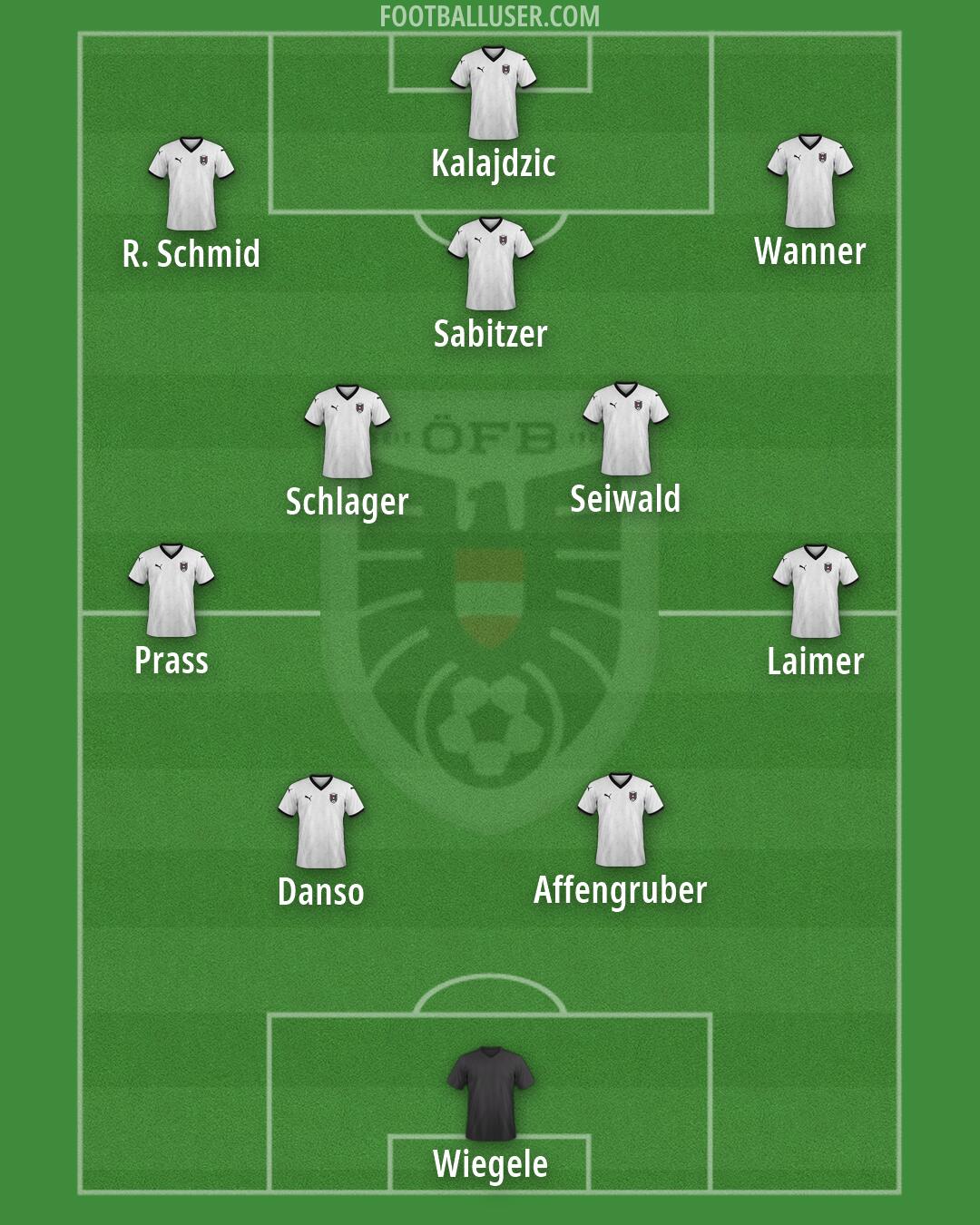

Austria National Football Team Formation
 June 17, 2026


Starting Lineup
Prass · Laimer · Danso · Affengruber · Kalajdzic · Schlager · Seiwald · Sabitzer · R. Schmid · Wanner · WiegeleAustria aims to play a vertical and high pressing game with a 2-4-4. This lineup is built to overwhelm the opposition and hunt for the ball quickly after losing it. The team looks to transition fast and attack the box with plenty of numbers to exploit any gaps in the opponent's defence.
Wiegele stays between the posts to lead the defence. A back two of Danso and Affengruber forms the base of the lineup. Danso works as a ball playing defender to start attacks, while Affengruber provides the coverage needed when the team pushes up. They often play a high line to squeeze the space in the middle of the pitch. These two must stay compact to prevent runners from getting between them and must work to clear the lines when under pressure.
A central block featuring a double pivot and two advanced midfielders controls the middle. Laimer and Prass act as the central pair where Laimer uses his high pressing intensity to win the ball back high up the pitch. They shield the two defenders and look to recycle possession to keep the pressure on. Schlager and Seiwald play in the half spaces to link the play. Seiwald carries the ball forward to break the line, while Schlager drops into pockets of space to connect the defensive and attacking lines.
Four players sit across the front to pin the last defender. Sabitzer and Kalajdzic lead the line as a strike partnership. Kalajdzic uses his aerial strength to win the header and find the feet of his teammates, while Sabitzer uses his passing range to spray balls wide or play through the lines. R. Schmid and Wanner provide the width. R. Schmid stays wide to stretch the defence, whereas Wanner will often cut inside to find space in the box. This formation creates constant movement for runs in behind and cutbacks from the byline.
One main advantage for Austria is the ability to press high in coordinated waves. Having four players in the front line allows them to trigger a press very effectively. Another strength is the capacity to create wide overloads and exploit the space between the opposition's lines. The team is built to win the second ball and break quickly when they regain control.
This formation is a brave way to play that relies on heavy aggression. It is best suited for matches where the team needs to pin the opponent back and force mistakes through constant pressure.