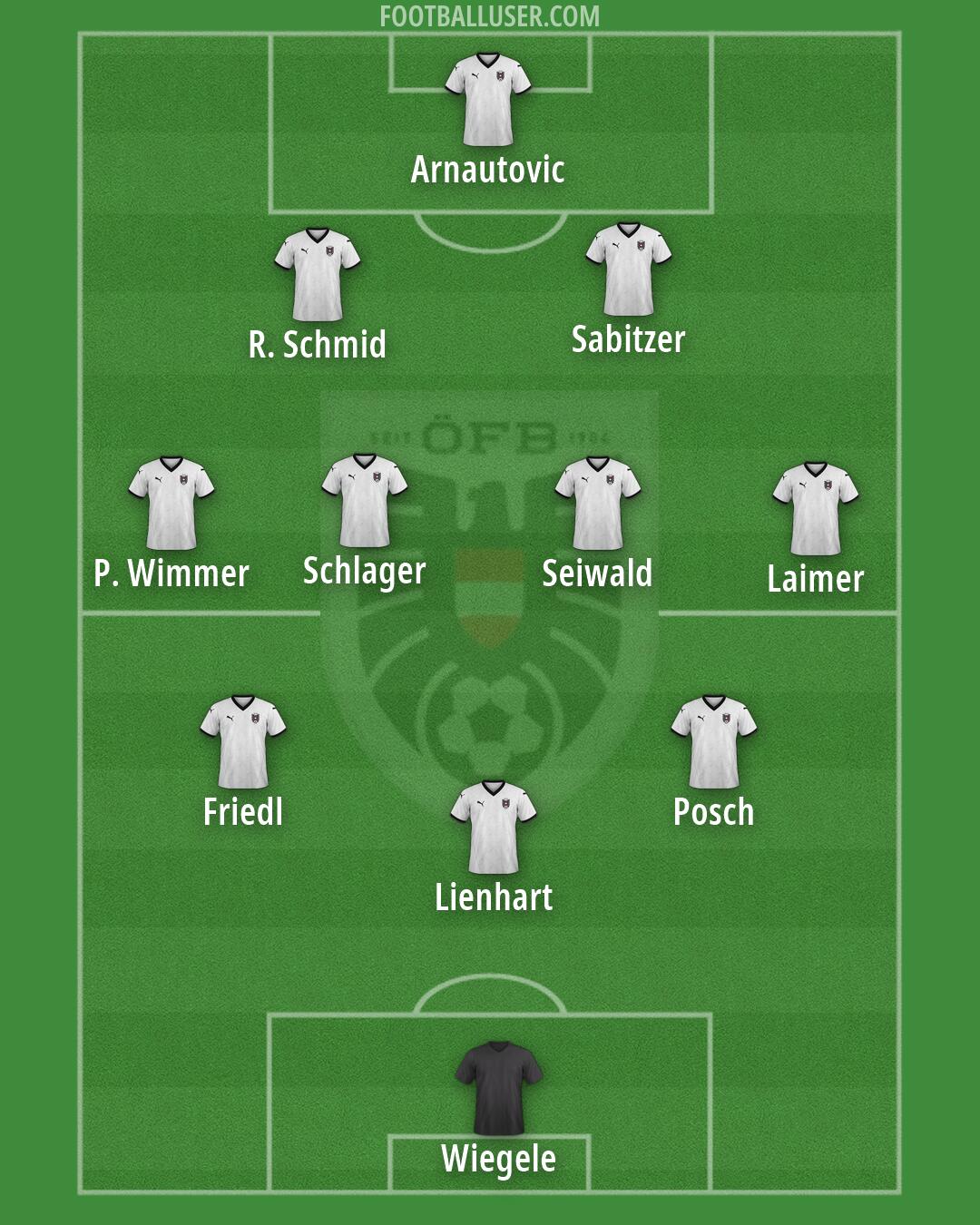

Austria National Football Team Formation
 June 17, 2026


Starting Lineup
Friedl · Lienhart · Posch · Laimer · P. Wimmer · Schlager · Seiwald · R. Schmid · Arnautovic · Sabitzer · WiegeleAustria plays with high intensity to win the ball back high up the pitch and strike through vertical passing. This aggressive identity is built around a 3-4-3 formation. The team looks to squeeze the space in the opposition half and use a high press to force errors. By playing this way, Austria seeks to control the game through directness and rapid movements.
Wiegele sits in goal to act as a sweeping goalkeeper. The defensive unit functions as a back three with Lienhart, Friedl, and Posch. Lienhart acts as the central ball playing defender who can play out from the back to start attacks. Friedl and Posch provide cover and defend zonally to stop runs in behind. This back three holds a compact block to ensure the team is rarely caught out during a transition.
In the center of the pitch, Seiwald and Schlager form a double pivot to control the middle. Seiwald works to shield the defence and intercept passes, while Schlager is able to carry the ball forward into the attacking third. To provide width and support the middle, Laimer and P. Wimmer operate on the flanks. They press aggressively to win it back high up the pitch, which allows the team to connect the defensive and attacking lines quickly.
The attacking front three features R. Schmid, Sabitzer, and Arnautovic. Arnautovic acts as a target man who can hold up the ball and win the header to bring others into play. Sabitzer and R. Schmid function as inverted wingers who cut inside to create goal scoring chances. This movement allows Laimer and P. Wimmer to overlap the wingers and provide width. The team often looks to hit in behind on the transition, using the speed of the wide players to stretch the defence.
A primary advantage for Austria is the ability to press high in coordinated waves. This creates pressure that forces a long ball from the opposition. The formation also offers speed of transition, moving the ball from the defensive block to the strikers in seconds. By using the double pivot of Seiwald and Schlager, the team maintains compactness when defending while still having the ability to bypass the midfield with quick passes.
This 3-4-3 formation is designed for a high pressing game that relies on rapid ball recovery and verticality. It is best suited for matches against teams that struggle to play out from the back under heavy pressure.