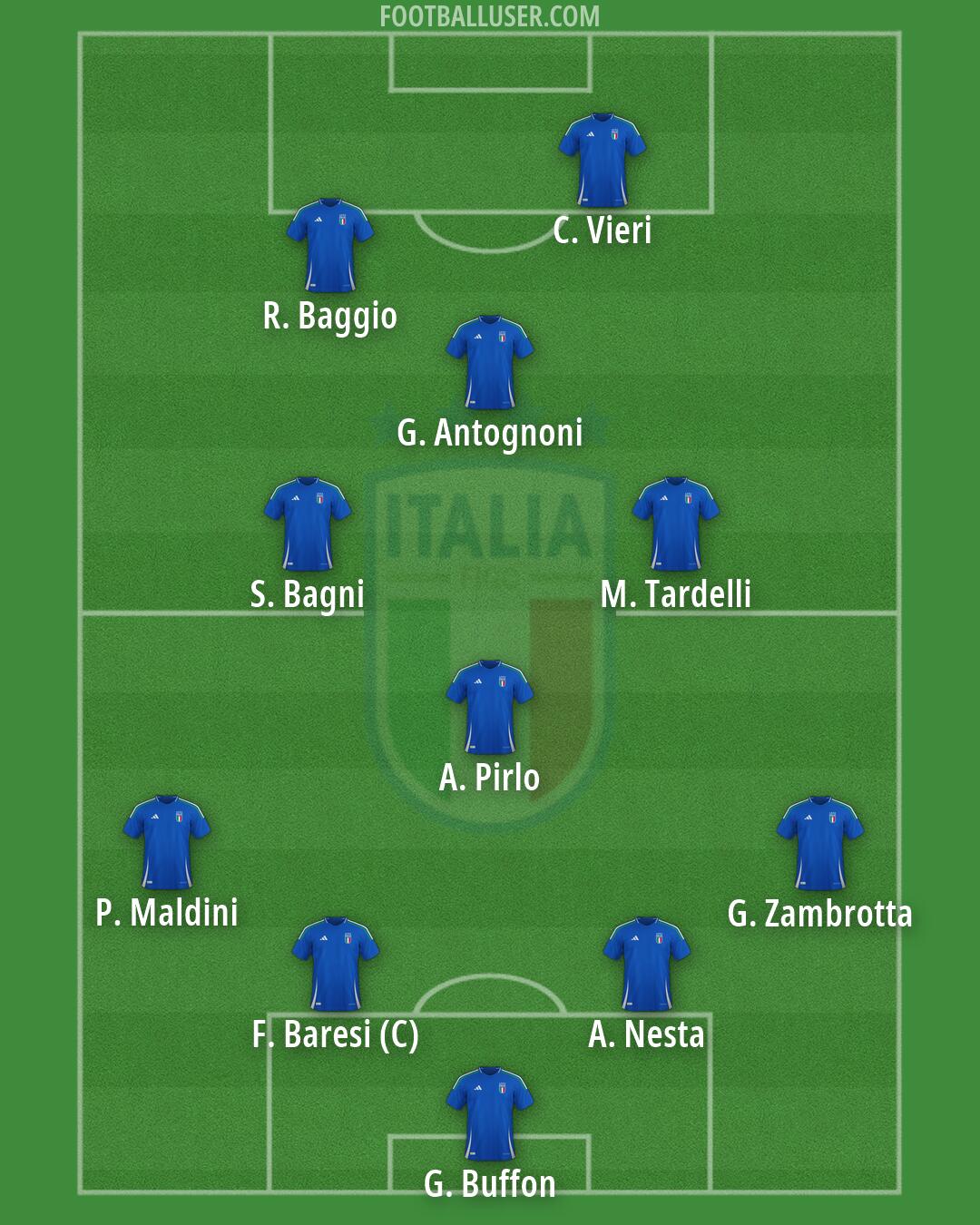

Italy National Football Team Formation
 Today, June 17, 2026


Starting Lineup
G. Buffon · A. Nesta · F. Baresi (C) · G. Zambrotta · P. Maldini · A. Pirlo · M. Tardelli · S. Bagni · G. Antognoni · R. Baggio · C. VieriItaly relies on a heavy defensive presence and quick transitions using a 5-4-1 formation. This lineup is built to sit deep and deny space in the middle before launching direct attacks. The team looks to remain compact and difficult to break down, prioritizing defensive solidity over high possession.
G. Buffon guards the goal as the last line of defense. The back five uses a staggered approach with A. Nesta and F. Baresi (C) acting as the central defensive core. F. Baresi (C) leads the line with his reading of the game and ability to sweep behind the defense. A. Pirlo operates as a ball playing defender to help play out from the back. On the flanks, P. Maldini plays as a left wing back with his positional intelligence and ability to cover wide areas, while G. Zambrotta acts as an attacking wing back to provide width.
The midfield operates in a flat four to protect the central zones. M. Tardelli and S. Bagni form a double pivot to shield the defense and win the second ball. M. Tardelli uses his engine to drive forward with the ball while S. Bagni focuses on cutting off the passing lane to the opposition attackers. Ahead of them, G. Antognoni and R. Baggio occupy the half spaces. R. Baggio plays as an attacking ten to connect the midfield and the attack, using his dribbling style to carry the ball forward. G. Antognoni helps to recycle possession and find the feet of the striker.
In the attacking phase, C. Vieri acts as a lone target man. He is tasked to hold up the ball and fight for headers to allow the midfielders to push up. The attack is built through quick transitions where R. Baggio and G. Antognoni look to split the defense with a through ball. The width comes from G. Zambrotta and P. Maldini pushing high to overlap the wingers. C. Vieri works to pin the last defender, creating space for late runs into the box from the attacking midfielders.
This formation provides significant defensive compactness when sitting in a low block. Italy gains a numerical superiority in the defensive third to make it hard for opponents to find gaps. The speed of transition is a major advantage, as the team can move from a defensive stance to an attacking one very quickly once the ball is won.
Italy utilizes this formation to frustrate superior technical sides by staying hard to beat. It is best suited for games where the team needs to defend a lead or counter at pace against a high line.