
Austria National Football Team Formation
 June 17, 2026


Starting Lineup
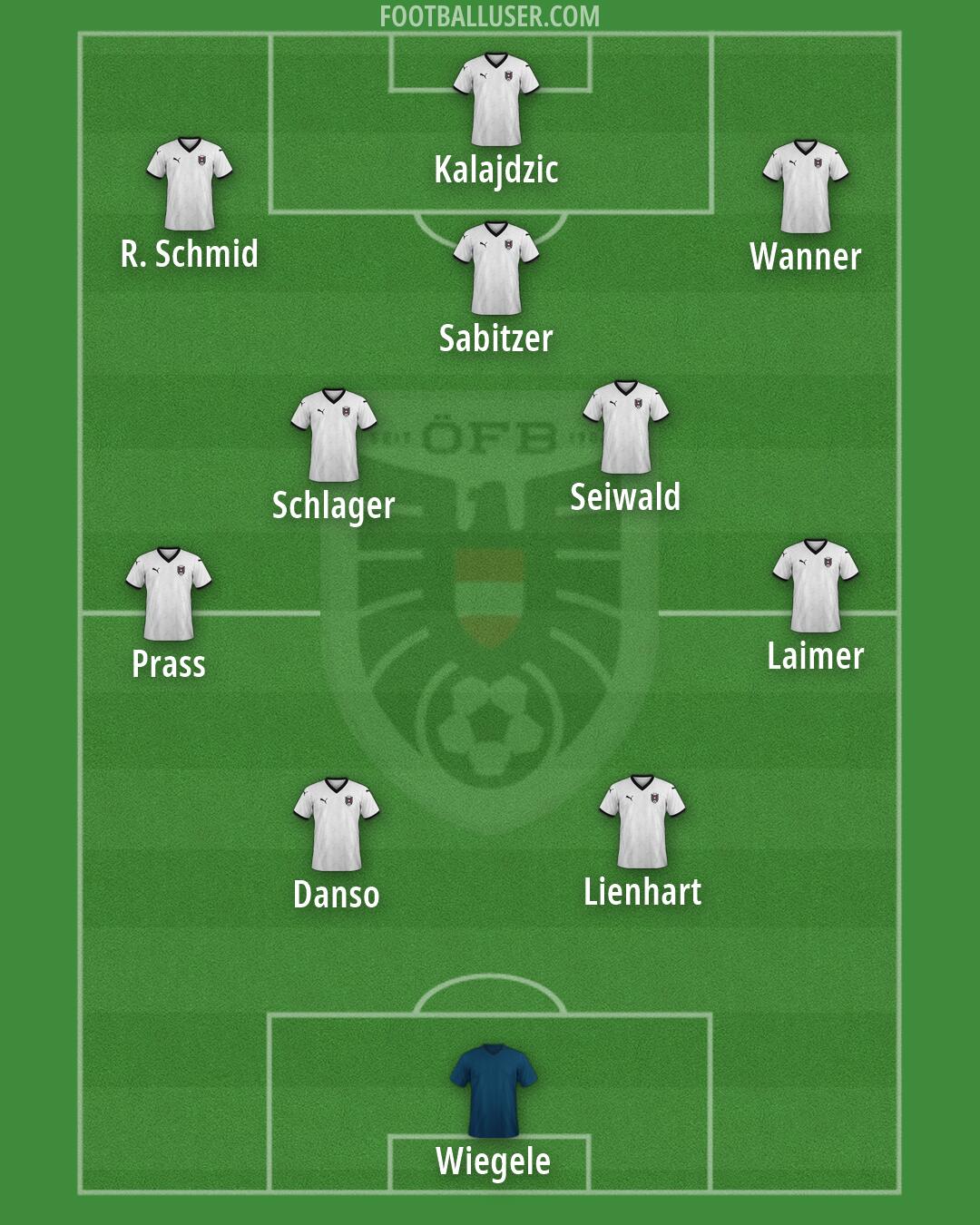
Prass · Danso · Lienhart · Laimer · Kalajdzic · R. Schmid · Seiwald · Sabitzer · Wanner · Schlager · WiegeleAustria employs a high pressing style of play using a 2-5-3 formation. This lineup is built to overwhelm the opposition in the central areas and win the ball back high up the pitch. The team seeks to control the tempo by crowding the middle and forcing the opponent into mistakes under heavy pressure.
Wiegele stays between the posts to manage the defense. The defensive unit consists of a narrow duo of Danso and Lienhart. Danso uses his aerial strength to win headers and clear the lines when the opposition goes direct. Lienhart acts as a covering defender to pick up runners and step up to squeeze the space. Because there are only two central defenders, they must defend zonally and be ready to set the offside trap to prevent being hit in behind.
The midfield is a massive engine room that controls the center of the pitch. Prass and Laimer form a double pivot to shield the defense and win the second ball. Ahead of them, Schlager and Seiwald operate as two tens in the half spaces to press aggressively and carry the ball forward. Sabitzer plays as an attacking ten behind the striker, using his passing range to receive on the half turn and play through the lines. This unit works to compress the midfield and connect the defensive and attacking lines through quick passing.
The front line utilizes three forwards to pin the last defender. Kalajdzic acts as a target man to hold up the ball and find the feet of his teammates. On the wings, Wanner and R. Schmid provide width and stretch the defence. Wanner looks to isolate a one on one wide, while R. Schmid can cut inside to create more central options. The forwards press from the front to force a long ball, allowing the team to break quickly and hit in behind on the transition.
A major tactical advantage of this lineup is the numerical superiority in midfield. This allows the team to dominate possession and intercept passing lanes. The ability to press high in coordinated waves also makes it very difficult for the opposition to build play from the back. Additionally, the speed of transition allows the team to exploit gaps the moment they win the ball.
This formation relies on intense pressing and central congestion to suffocate the opponent. It is best suited for matches against teams that attempt to play out from the back in tight spaces.