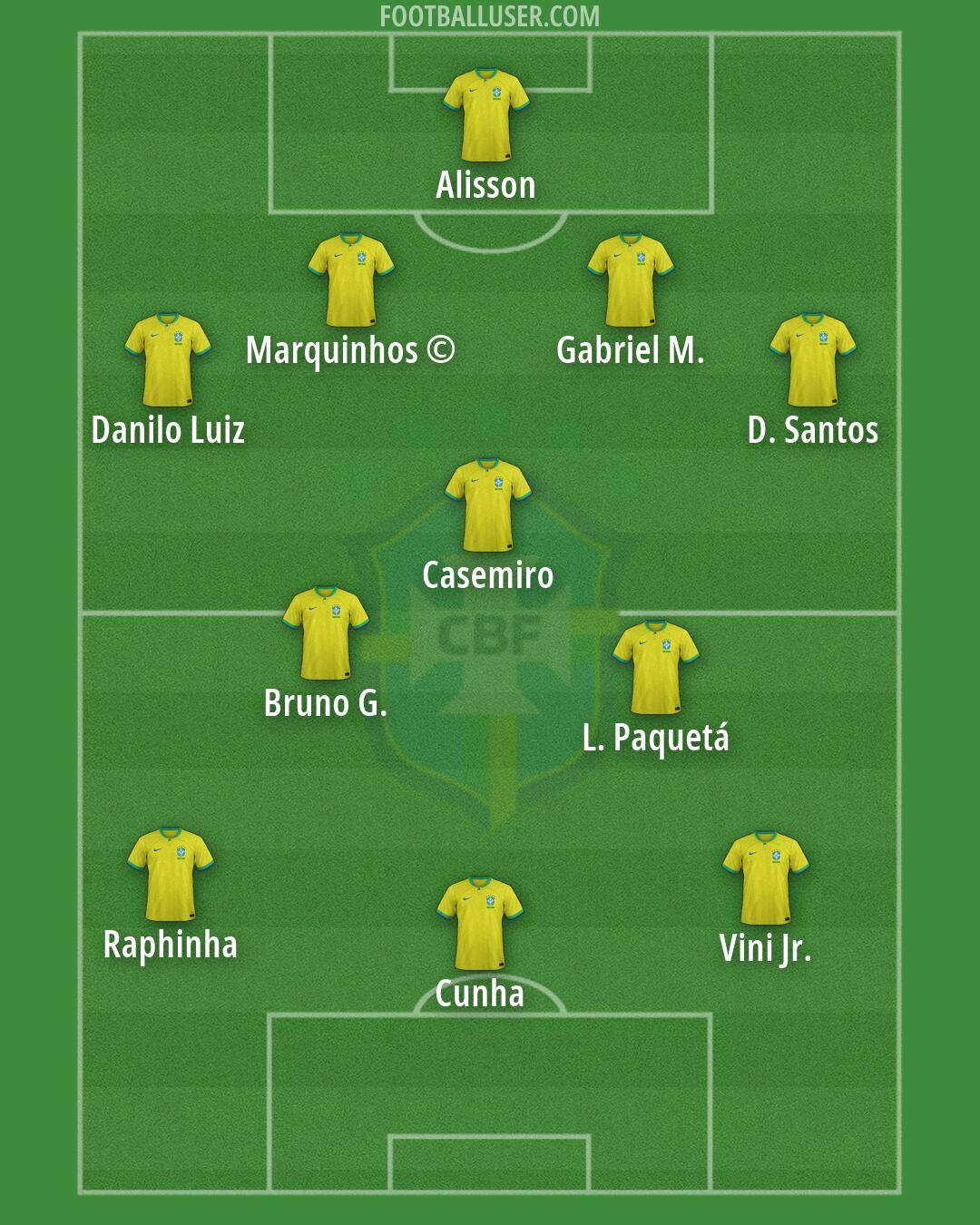

Brazil National Football Team Formation
 June 20, 2026


Starting Lineup
Alisson · Marquinhos © · Gabriel M. · D. Santos · Danilo Luiz · Bruno G. · Casemiro · L. Paquetá · Cunha · Vini Jr. · RaphinhaControl of the ball and a heavy press define the Brazil lineup. The Seleção uses a 4-3-3 formation to dominate territory and force turnovers in the opposition half. This system is built to play a high tempo game where the team wins it back high up the pitch and attacks with verticality.
Alisson stays between the posts to command his area and act as a sweeper when the team plays a high line. The back four operates as a zonal line, with Marquinhos © acting as a ball playing defender on the right. As captain, Marquinhos © uses his reading of the game to cover for Gabriel M. Danilo Luiz stays more disciplined to hold the line on the right, while D. Santos acts as an attacking full back to provide width. The defensive unit works together to squeeze the space and protect the central lanes.
A single pivot system sits at the heart of the midfield to manage the tempo. Casemiro plays as the defensive anchor, using his strength to intercept passes and shield the back four. Bruno G. acts as a carrier who drives forward with the ball to connect the defensive and attacking lines. L. Paquetá works in the half spaces to create from deep and move between the lines. This trio helps the team recycle possession to control the match.
The front three uses width and direct runs to break the opposition back line. Vini Jr. plays on the left as an inverted winger, using his dribbling and pace to cut inside and attack the far post. Raphinha stays wide on the right, often looking to get to the byline or deliver a cross on the run. Cunha leads the line as a pressing centre forward, working to hold up the ball and find the feet of the midfielders while pressing the opposition back line.
The Brazil formation offers the ability to press high in coordinated waves, making it difficult for opponents to build from the back. Wide overloads can also be created when D. Santos pushes forward to overlap the winger. The speed of transition is a key advantage when the team wins the second ball. This formation allows the team to switch play quickly to isolate wide players in one on one situations.
This 4-3-3 identity is best suited for teams that want to pin the last defender and dominate the ball. It is highly effective against opponents that sit deep and struggle to deal with rapid transitions and wide attackers.