
Brazil National Football Team Formation
 June 21, 2026


Starting Lineup
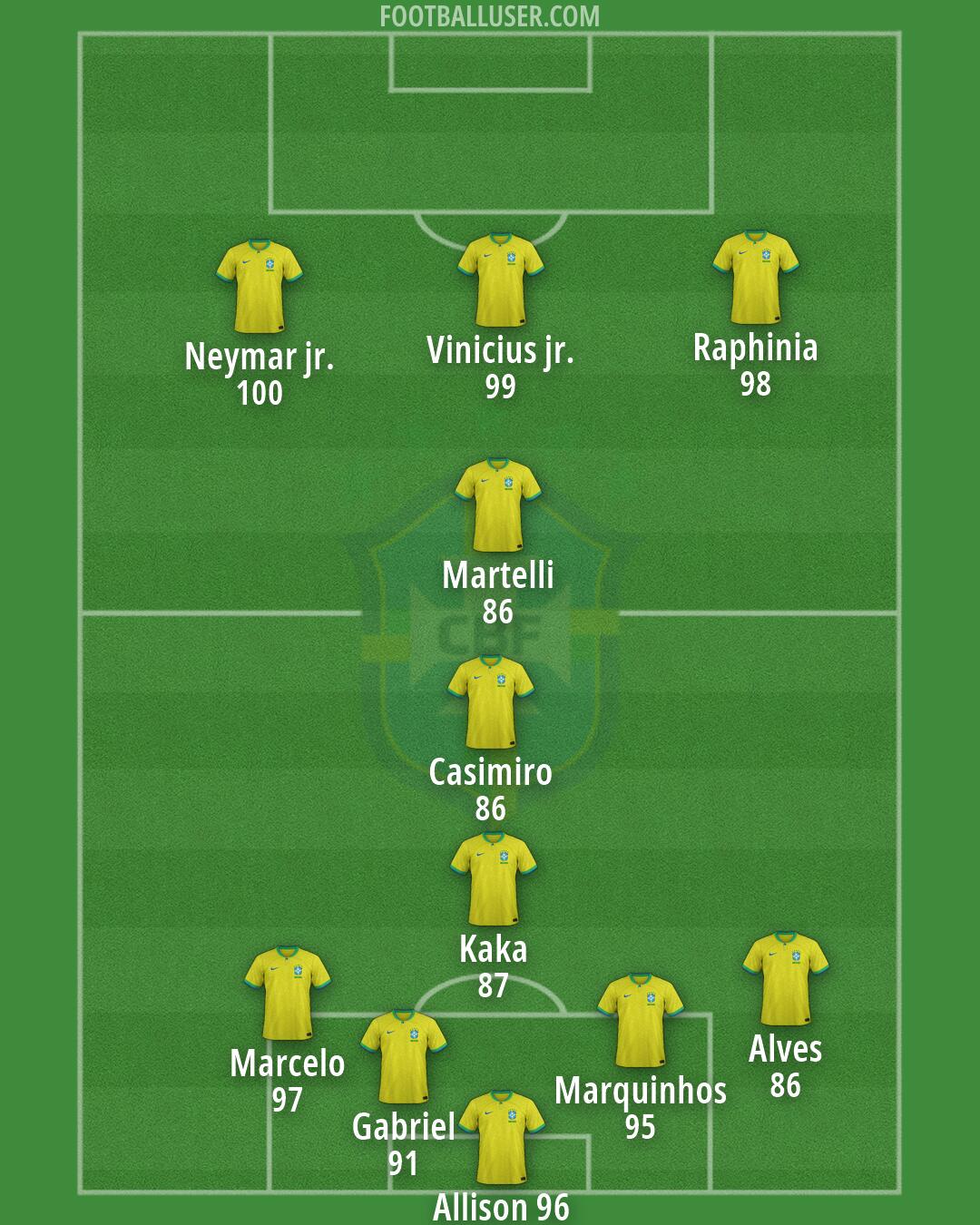
Vinicius jr. (99) · Neymar jr. (100) · Raphinia (98) · Casimiro (86) · Kaka (87) · Martelli (86) · Marcelo (97) · Gabriel (91) · Alves (86) · Allison 96 · Marquinhos (95)Brazil aims to control matches through quick transitions and wide attacking presence in a 5-2-3 formation. This lineup works to use width to stretch the opposition before finding ways to break the line with individual skill. The Seleção relies on a setup that can sit in a mid-block or push forward to win the ball back high up the pitch.
Allison acts as the last line of defense, providing security from the goal line. The defensive unit functions with a back three consisting of Gabriel, Marquinhos, and Kaka, who must defend zonally and stay compact. Gabriel and Marquinhos are tasked to cover the space behind the wing backs while Kaka holds the center. Alves and Marcelo operate as attacking wing backs, providing width and expected to push high up the pitch to support the attack. This system requires the back three to be dominant in the air and quick to shift across the pitch to handle runners.
In the middle of the pitch, Casimiro operates as a single pivot to shield the defense and recycle possession. He works to intercept passes and protect the center backs when the team is under pressure. Martelli plays as an attacking ten, looking to connect the defensive and attacking lines by finding pockets of space. This midfielder must carry the ball forward and find ways to play through the lines to reach the front three. The midfield acts as the engine to bridge the gap between the back five and the attacking unit.
The attack utilizes three attackers across the front to pin the last defender. Vinicius jr. plays as a pressing centre-forward, using his speed to run in behind. Neymar jr. acts as an inverted winger on the left, looking to cut inside and create chances. Raphinia operates on the right side to provide width and support the overlap from Alves. These forwards work to press the opposition back line to force a long ball. The goal is to create chances through combinations in tight spaces or by finding the feet of the striker.
Brazil gains a massive advantage through the attacking width provided by Marcelo and Alves, which creates wide overloads. This formation allows for great speed of transition when the team wins the ball in the middle third. The presence of Casimiro provides a reliable way to protect against counter attacks while the rest of the team pushes forward. The ability to shift between a defensive five and a heavy attacking front makes them difficult to mark.
This 5-2-3 formation focuses on utilizing wing backs to create numerical superiority on the flanks. It is a setup best suited for games where the team needs to absorb pressure before hitting the opponent on the transition.