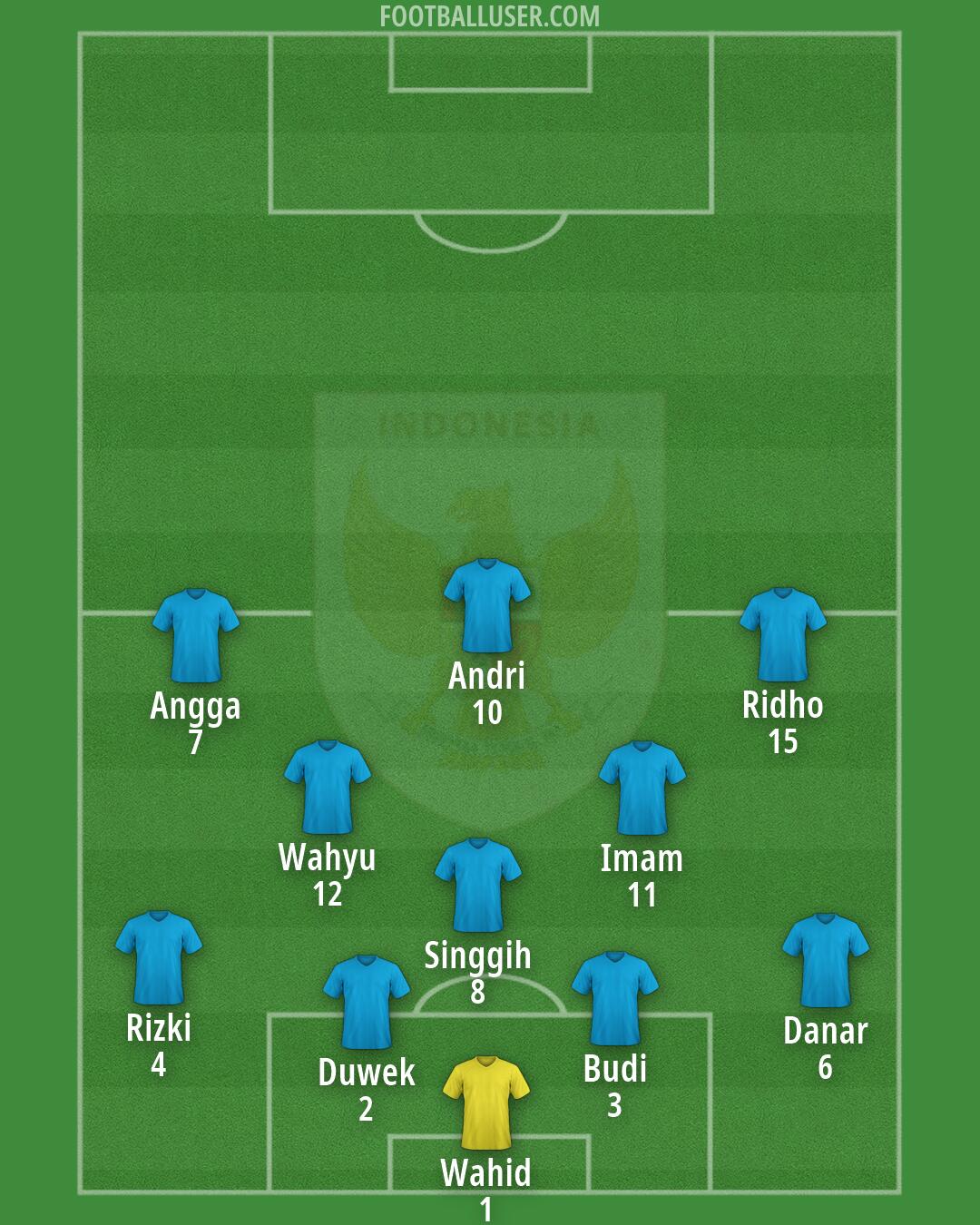

Indonesia National Football Team Formation
 June 24, 2026


Starting Lineup
Wahid (1) · Duwek (2) · Budi (3) · Rizki (4) · Danar (6) · Singgih (8) · Wahyu (12) · Imam (11) · Andri (10) · Angga (7) · Ridho (15)Indonesia seeks to win the ball high up the pitch and strike on the break using a 5-2-3. This formation relies on a heavy defensive block and quick transitions to exploit spaces left by the opposition. The lineup is built to absorb pressure and then launch direct attacks through wide areas.
Wahid sits between the posts to command his area. In front of him, the defense operates with a back five. Singgih acts as the central defender to hold the line, while Duwek and Budi play as the wide centre-backs to cover the channels. The wing backs, Danar and Rizki, are tasked to provide width and track back when the team loses possession. This unit works to squeeze the space between the lines and force a long ball from the opponent.
The midfield functions as a double pivot with Imam and Wahyu. These two players must work hard to shield the defence and intercept passes in the middle third. Imam and Wahyu act as the connection between the back five and the front three. They need to win the second ball to start the counter attack. One of them often drops deeper to help build play from the back while the other looks to carry the ball forward into the half spaces.
Up front, Indonesia uses three attackers to stretch the defence. Andri plays as a lone striker to hold up the ball and link play. On the flanks, Angga and Ridho act as wide wingers who hug the touchline to pull the opposition defenders apart. This front line is designed to press from the front and force errors. They look to run in behind the defence or receive cutbacks from the wing backs to create scoring chances.
One major advantage of this lineup is the ability to create wide overloads when Danar and Rizki step up to join the attack. The team also benefits from compactness when defending in a low block. This makes it very difficult for opponents to find gaps in the central areas. The speed of transition allows the forwards to exploit the opposition once the ball is won back.
Indonesia relies on a heavy defensive block and rapid forward movements to catch teams off guard. This formation is best suited for games against technically superior sides where sitting deep and defending zonally is necessary.