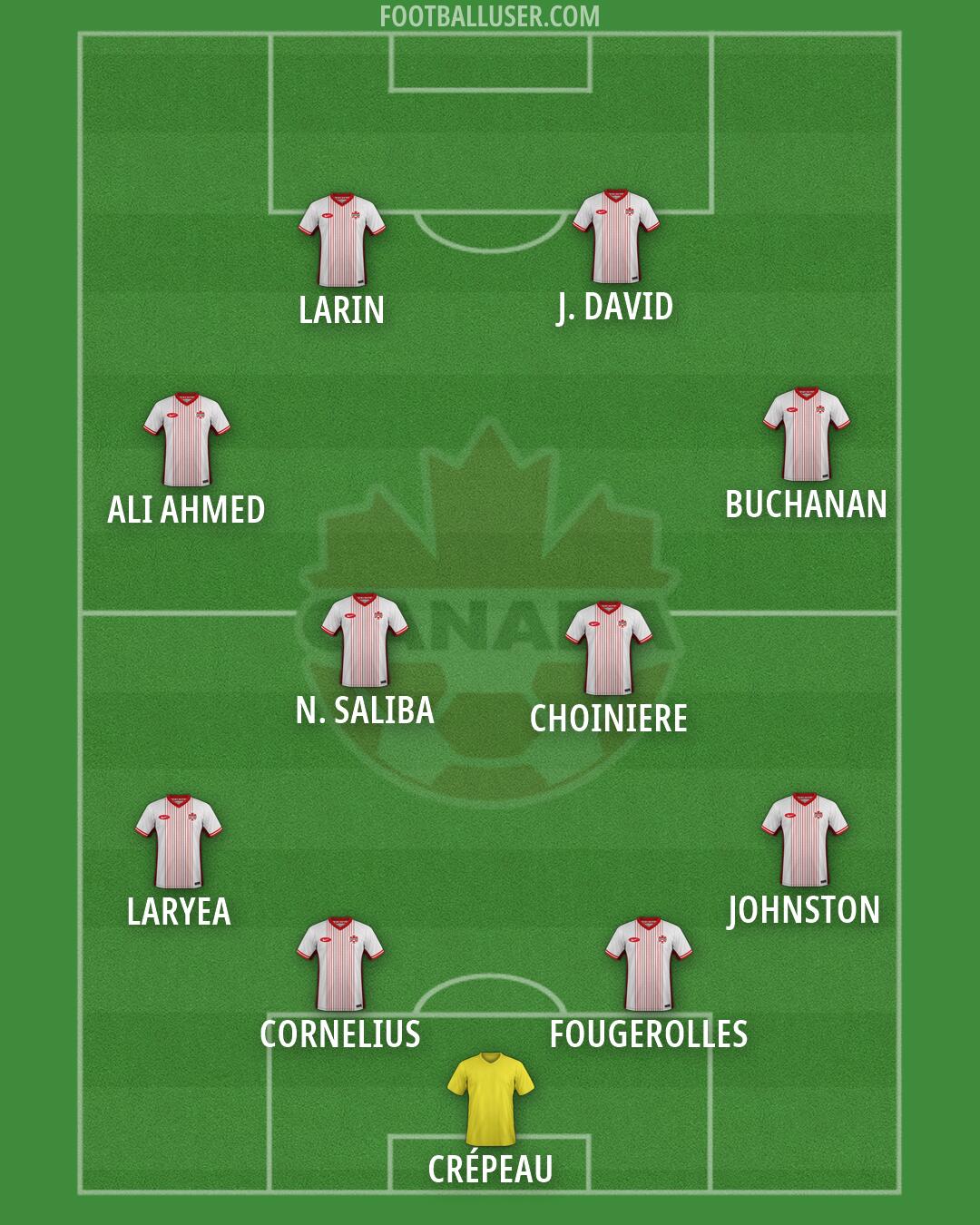

Canada National Soccer Team Formation
 June 24, 2026


Starting Lineup
JOHNSTON · FOUGEROLLES · CORNELIUS · LARYEA · BUCHANAN · CHOINIERE · N. SALIBA · ALI AHMED · J. DAVID · LARIN · CRÉPEAUCanada seeks to overwhelm opponents with a heavy attacking presence through a 4-2-4 formation. This lineup is designed to play a vertical game that targets the opposition defense quickly. The goal is to win the ball high up the pitch and move forward with pace to catch the opponent out of position.
CRÉPEAU acts as the last line of defense in goal. The defensive unit works in a flat back four to hold a compact line when the team drops into a mid-block. JOHNSTON plays as the right back to provide cover, while LARYEA operates on the left. FOUGEROLLES and CORNELIUS form the central pairing, where they must stay close together to defend zonally and win headers. They need to be ready to step up to set the offside trap or drop back to cover runners.
A double pivot forms the heart of the midfield. N. SALIBA and CHOINIERE are responsible for controlling the middle of the pitch. N. SALIBA uses his passing range and composure to receive the ball from the defenders and play through the lines. CHOINIERE must work hard to shield the defense and win the second ball in contested areas. This pairing is vital to link the back four with the four players ahead of them to progress through the thirds.
The attacking unit is built around two central strikers and two wide players. LARIN and J. DAVID work as a forward partnership to stretch the defense and find space between the lines. BUCHANAN plays on the right to spread the play wide, while ALI AHMED stays on the left to look for opportunities to cut inside. The team looks to play short from the back before looking to hit in behind on the transition. They want to create situations where they can deliver early crosses or find the feet of the strikers.
One major advantage for Canada is the ability to press high in coordinated waves. By having four players in the attacking third, the team can trigger a press immediately after losing possession. The formation also allows for wide overloads when the full backs move up to support the wingers. This creates space for the central attackers to make runs into the box or pull wide to create more room.
This 4-2-4 formation is a high-risk way to play that focuses on heavy offensive pressure. It is most effective when facing teams that play a low block and struggle with the speed of transitions.