
Brazil National Football Team Formation
 June 24, 2026


Starting Lineup
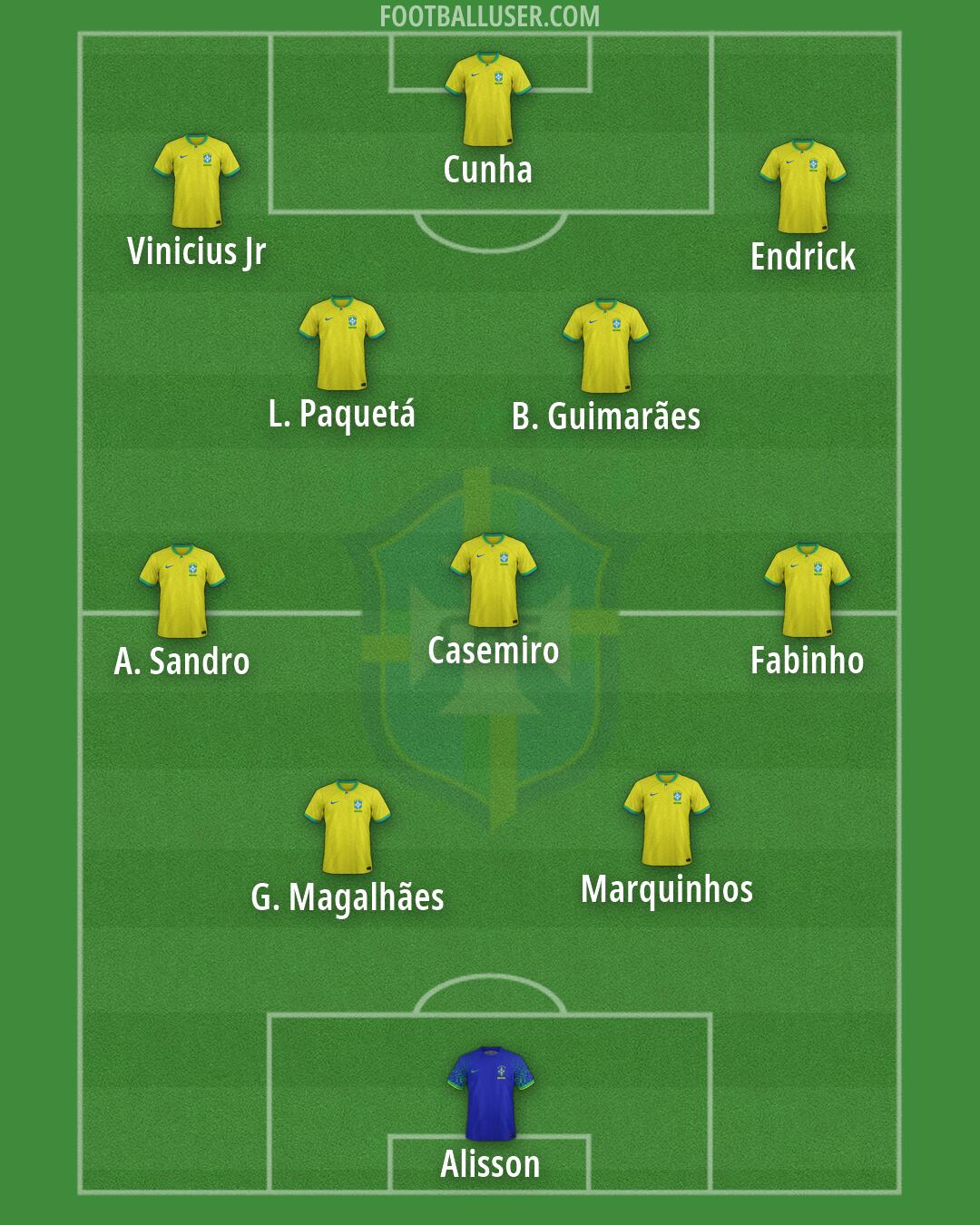
A. Sandro · Fabinho · G. Magalhães · Marquinhos · Cunha · Vinicius Jr · Endrick · L. Paquetá · B. Guimarães · Casemiro · AlissonBrazil focuses on a high press and rapid transitions using a 5-2-3 formation. This lineup is built to win the ball high up the pitch and move the play forward with speed. The team looks to exploit wide areas while maintaining a heavy presence in the final third.
Alisson starts in goal to organize the back line and sweep behind the defense. The defensive unit consists of a back three of Casemiro, Marquinhos, and G. Magalhães. Casemiro acts as the central anchor, while Marquinhos provides covering and G. Magalhães defends zonally. The wing backs, A. Sandro and Fabinho, provide the width and must track back to form a five man line when defending deep. This defensive unit works to squeeze the space and force the opposition to play wide.
The midfield operates with a two man unit of B. Guimarães and L. Paquetá. These players function as a central pairing that must cover large areas of the pitch. B. Guimarães works to win the second ball and drive the ball forward, while L. Paquetá connects the defensive and attacking lines. They are tasked to press aggressively to win the ball back high up the pitch and prevent the opposition from playing through the middle.
In the attacking phase, Brazil uses three attackers across the front. Vinicius Jr operates as an inverted winger on the left to cut inside, while Endrick plays on the right to stretch the defense. Cunha leads the line as a pressing centre-forward to pin the last defender. The wing backs, A. Sandro and Fabinho, provide constant width by overlapping the wingers. This creates many combinations to hit in behind the opposition defense during transitions.
Brazil gains a major advantage from the ability to press high in coordinated waves. The team can also create wide overloads when A. Sandro and Fabinho push up to join the wingers. This formation allows for great speed of transition, as the front three can immediately target space behind the opposition back line.
This 5-2-3 formation provides a heavy attacking presence while remaining solid in the wide areas. It is best suited for matches where the team needs to play against a side that sits deep and defends in a compact block.