Arsenal Football Formation
 June 24, 2026


Starting Lineup
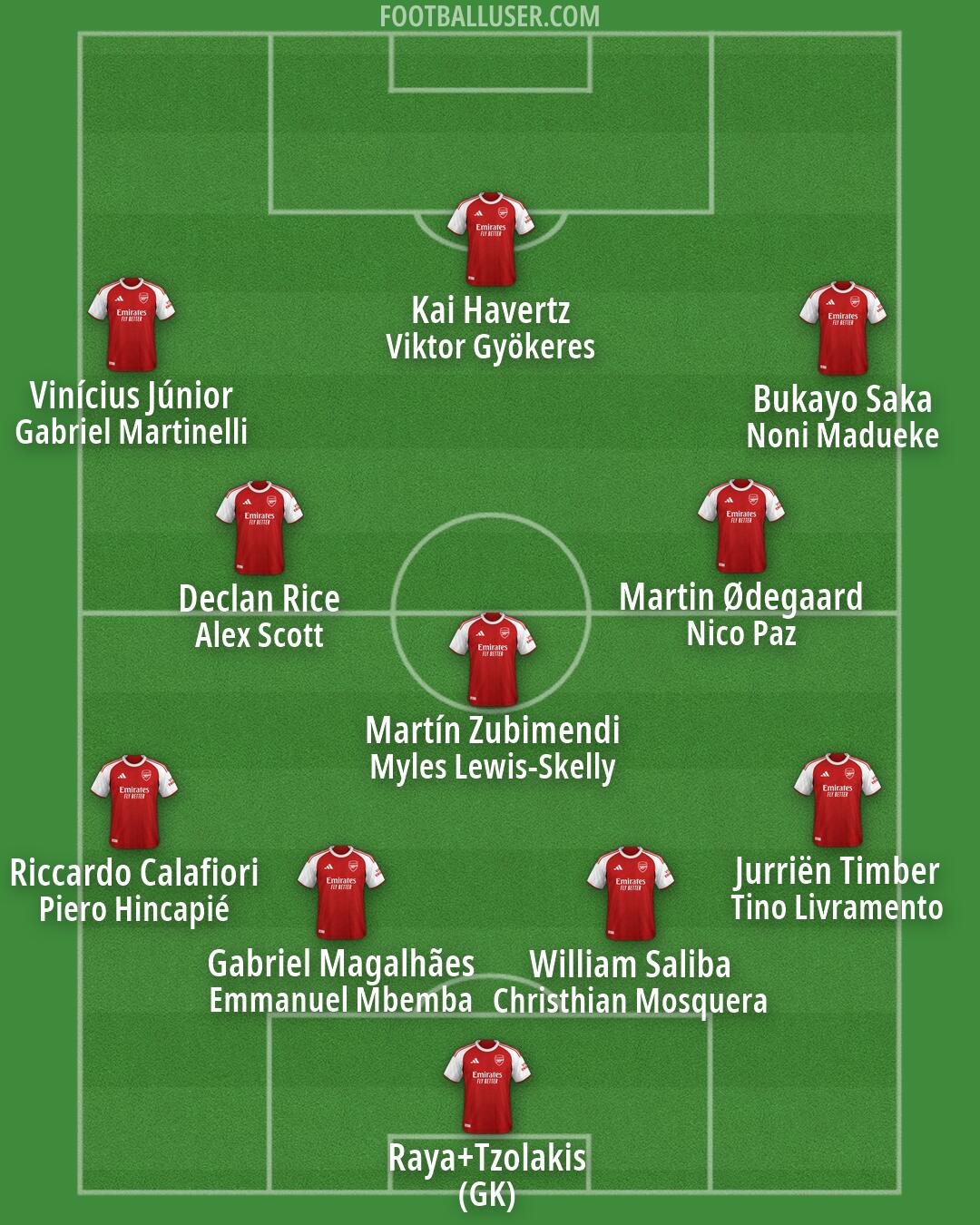
Raya+Tzolakis (GK) · Riccardo Calafiori (Piero Hincapié) · Gabriel Magalhães (Emmanuel Mbemba) · Jurriën Timber (Tino Livramento) · Martín Zubimendi (Myles Lewis-Skelly) · Declan Rice (Alex Scott) · Martin Ødegaard (Nico Paz) · Bukayo Saka (Noni Madueke) · Vinícius Júnior (Gabriel Martinelli) · Kai Havertz (Viktor Gyökeres) · William Saliba (Christhian Mosquera)Arsenal focuses on controlling the tempo through high pressing and rapid ball movement in a 4-3-3 formation. This lineup is built to dominate possession and squeeze the space in the opposition half. By maintaining a high line, Arsenal look to win the ball back high up the pitch and immediately move into attacking positions to catch opponents out of position.
David Raya acts as the goalkeeper, playing out from the back to start the build up. The back four consists of Jurriën Timber at right back and Riccardo Calafiori at left back, both capable of pushing high to provide width. In the center, William Saliba and Gabriel Magalhães form a strong pairing where Saliba provides recovery speed and Gabriel offers aerial strength. This defensive unit functions by maintaining a high line to compress the pitch while the defenders step up to intercept passes.
The midfield operates with a single pivot role played by Martín Zubimendi, who sits deep to shield the defense and recycle possession. Declan Rice plays as a carrier in the left central midfield role, driving forward with the ball to break the lines. Martin Ødegaard acts as the creative engine from the right side, looking to find pockets of space and play through the lines to the attackers. This trio links the defense to the attack by shifting between a compact block and an expansive attacking unit.
Arsenal uses a front three consisting of Vinícius Júnior on the left and Bukayo Saka on the right, both acting as inverted wingers who cut inside to challenge the defense. Kai Havertz leads the line as a pressing centre forward, making runs in behind and dropping into space to link up with the midfielders. The attack relies on quick combinations and the ability of the wingers to isolate defenders one on one. When the team wins the ball, they look to hit in behind on the transition to exploit the space left by the opposition.
One major advantage of this formation is the ability to press high in coordinated waves, with the front three and midfield trio working together to force mistakes. The presence of Rice and Zubimendi allows for numerical superiority in the center of the pitch during build up phases. Additionally, the overlapping movement from Calafiori and Timber creates wide overloads that stretch the opposition defense.
This 4-3-3 formation provides a heavy pressing presence and strong central control. It is best suited for matches against teams that play a high line or struggle to bypass a compact midfield.