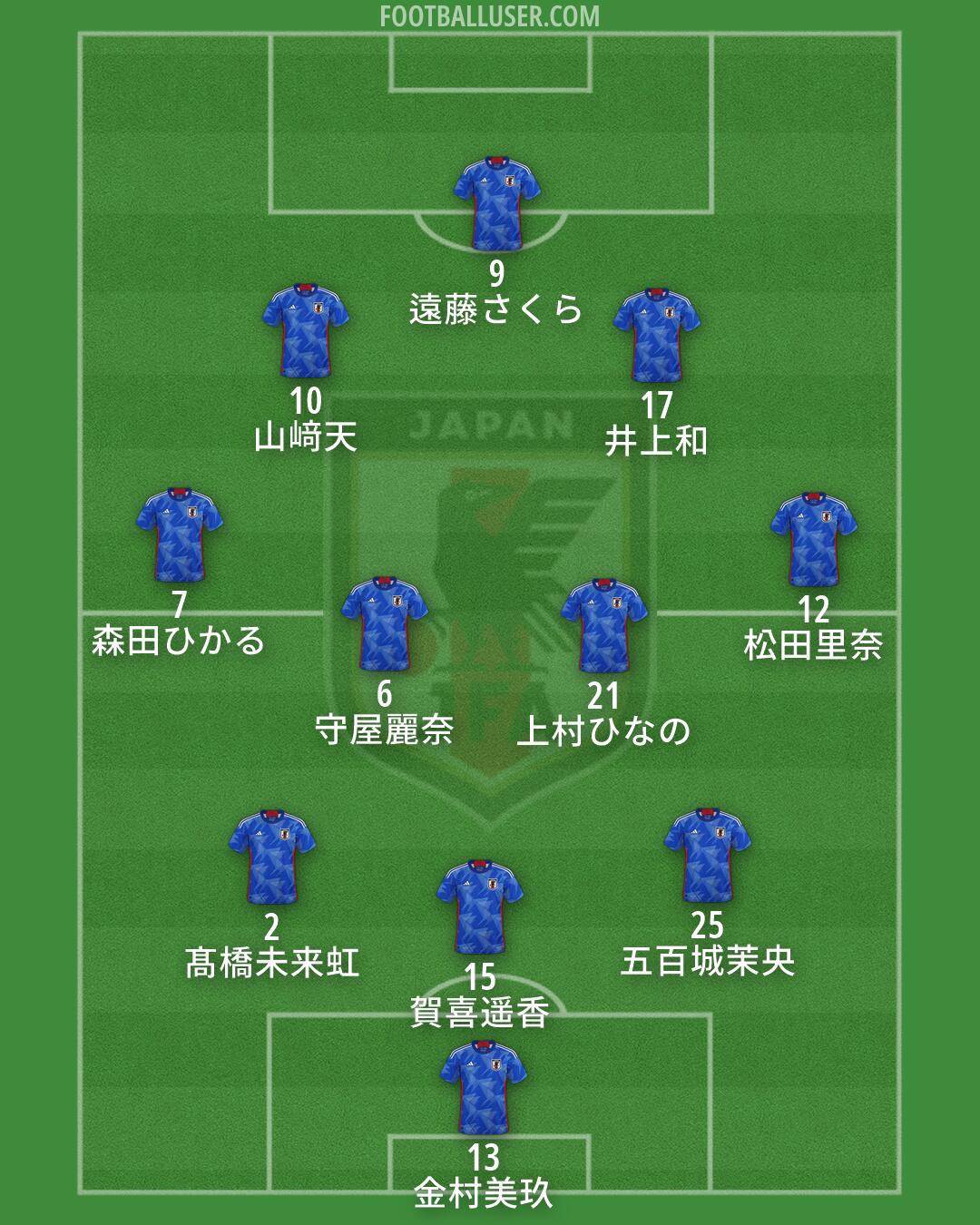

Japan National Football Team Formation
 June 26, 2026


Starting Lineup
9 (遠藤さくら)10 (山﨑天)
17 (井上和)
7 (森田ひかる)
6 (守屋麗奈)
21 (上村ひなの)
12 (松田里奈)
2 (髙橋未来虹)
15 (賀喜遥香)
25 (五百城茉央)
13 (金村美玖)
Japan plays with a high press identity using a 3-4-3 formation. The lineup is designed to win the ball high up the pitch and progress through the thirds with speed. This system works to stretch the defence by using the full width of the pitch and creating constant pressure on the opposition.
The goalkeeper 13 oversees a back three that maintains a high line to squeeze the space. Player 15 sits in the middle of the defence to hold the line, while 2 and 25 act as the left and right centre-backs. These three defenders focus on defending zonally and making sure they cover the space behind the midfield. When the opposition tries to play out from the back, the unit steps up to trigger a press and force a long ball.
The midfield features a central pair of 21 and 6 who act to connect the defensive and attacking lines. 21 is a player who can carry the ball forward to break the line, while 6 works to shield the defence and win the second ball. To provide width, 12 and 7 play as wide midfielders who push up to support the attack. They are responsible to track back when needed and help the back three defend the flanks.
Up front, Japan uses three attackers across the front to pin the last defender. Player 9 acts as a pressing centre-forward to lead the attack and hold up the ball. The wide players 17 and 10 operate as inverted wingers who look to cut inside and create goalscoring chances. This movement allows 12 and 7 to overlap the winger and deliver crosses into the box. These attackers work to make runs in behind and play one-two combinations to split the defence with a through ball.
A key strength of this Japan lineup is the ability to create wide overloads. By having 12 and 7 push high, they can double up on opposition full backs and find space to whip it in. Another advantage is the speed of transition, as the team can move from a mid-block to an attacking phase very quickly. This allows them to hit in behind on the transition before the opposition can get organised.
This 3-4-3 formation relies on high intensity and coordinated pressing to dominate the game. It is best suited for matches where the team needs to break down a compact low block through wide play.