
France National Football Team Formation
 June 26, 2026


Starting Lineup
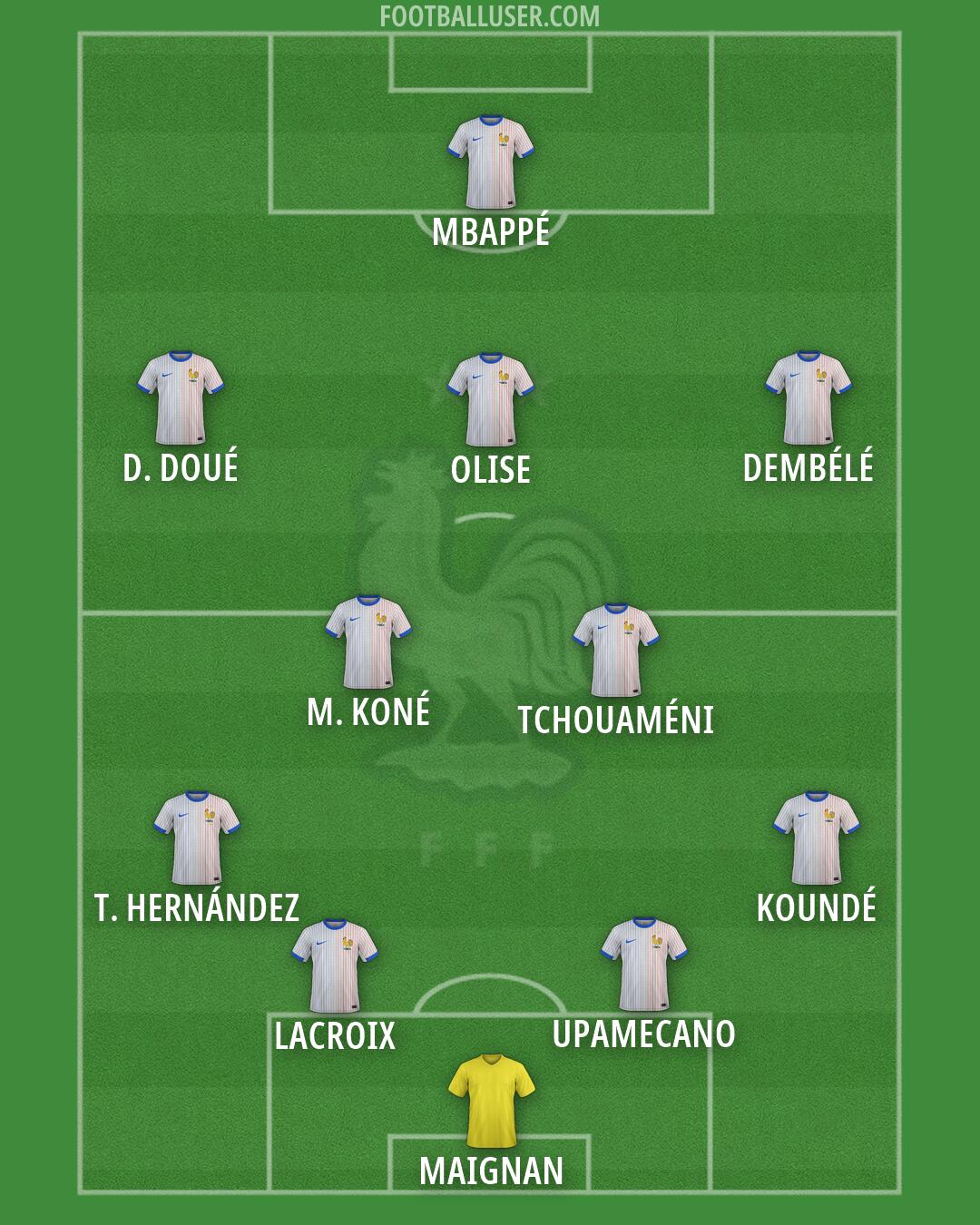
MAIGNAN · KOUNDÉ · UPAMECANO · LACROIX · T. HERNÁNDEZ · TCHOUAMÉNI · M. KONÉ · DEMBÉLÉ · OLISE · D. DOUÉ · MBAPPÉFrance aims to dominate through a high press and rapid verticality using a 4-2-4. This lineup is built to stretch the opposition and win the ball high up the pitch to catch teams out of position. By committing many players forward, the team seeks to overwhelm the defensive lines with speed and directness.
MAIGNAN acts as the last line of defense, often playing as a sweeper behind a high line to catch long balls. The back four relies on KOUNDÉ and T. HERNÁNDEZ to provide width, with T. HERNÁNDEZ pushing high to overlap the winger. In the center, UPAMECANO provides aerial strength and physical presence, while LACROIX covers space and steps up to intercept passes. This unit maintains a high line to keep the team compact and reduce the space between the defense and the midfield.
The midfield functions as a double pivot to provide a screen for the back four. TCHOUAMÉNI acts as the primary anchor, shielding the defense and breaking up play. M. KONÉ works alongside him to carry the ball forward and connect the defensive unit to the attacking quartet. Together, they must control the center of the park and cover the ground left vacant by the advancing full backs to prevent counter attacks.
The attacking front line is designed to pin the last defender and create chaos in the final third. MBAPPÉ and OLISE operate as two central forwards, with MBAPPÉ using his blistering pace to run in behind the defense. DEMBÉLÉ and D. DOUÉ act as wide wingers who stay high to provide width. DEMBÉLÉ often cuts inside to create goal threats, while D. DOUÉ looks to find space in the channels. This front four presses the opposition back line aggressively to force errors and transition quickly.
France gains a significant advantage through their ability to press in coordinated waves, making it difficult for opponents to build from the back. The formation creates numerical superiority in the attacking third, often isolating wide players in one on one situations. This setup also allows for extreme speed of transition once the ball is won in the midfield.
This 4-2-4 formation is built for high intensity and direct attacking play. It is most effective against teams that play a high defensive line or struggle to manage rapid transitions.