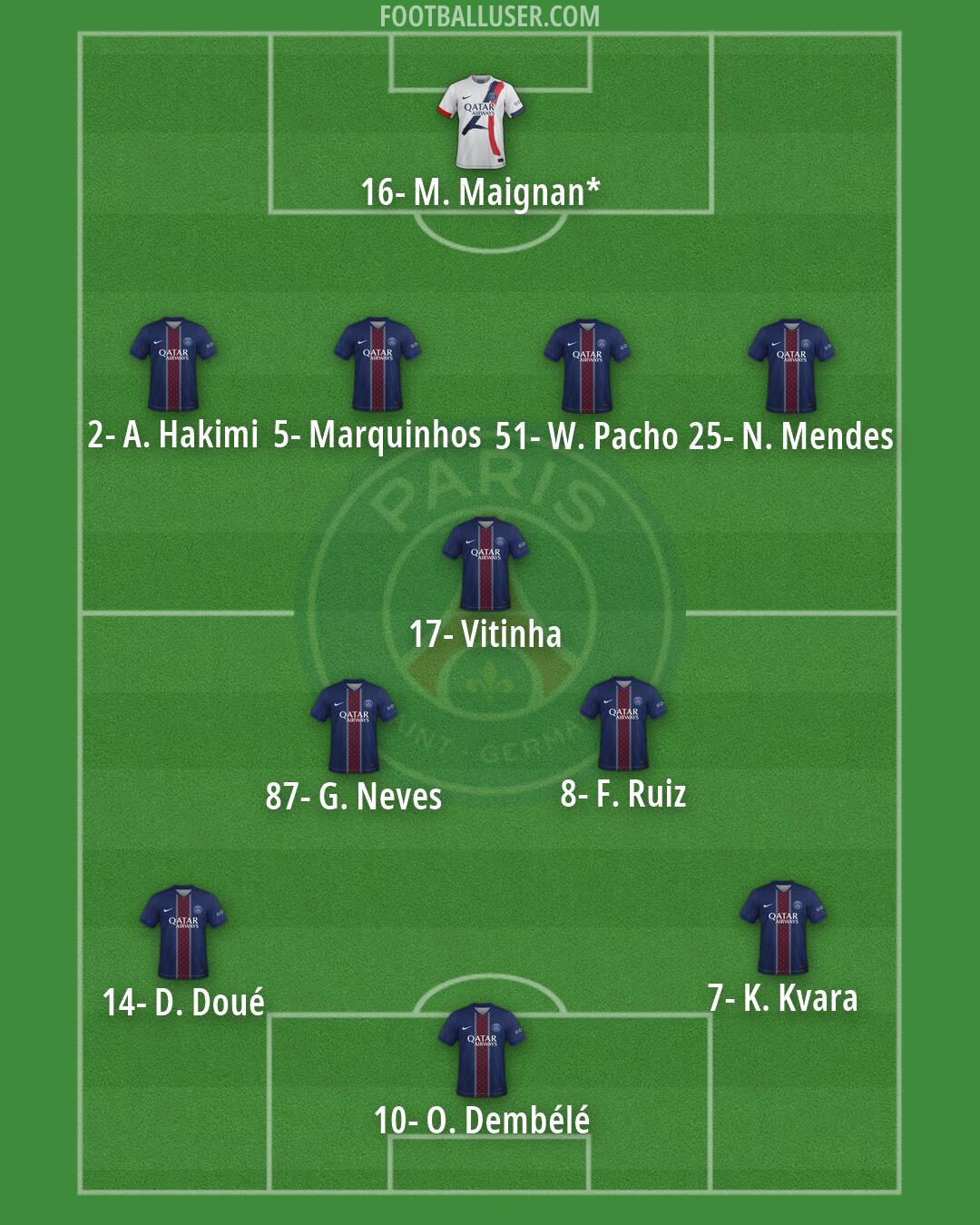

PSG Football Formation
 June 27, 2026


Starting Lineup
16- M. Maignan*2- A. Hakimi
5- Marquinhos
51- W. Pacho
25- N. Mendes
17- Vitinha
87- G. Neves
8- F. Ruiz
14- D. Doué
7- K. Kvara
10- O. Dembélé
PSG plays a high press game built around a 4-3-3 formation. This lineup focuses on winning the ball high up the pitch to launch immediate attacks. The goal is to dominate through ball control and quick vertical movements once the ball is regained.
M. Maignan acts as the last line of defense in goal. The back line operates as a flat back four with Marquinhos and W. Pacho as the central defenders. Marquinhos uses his reading of the game to cover space, while W. Pacho provides physical strength in the middle. A. Hakimi acts as an attacking full back to provide width on the right, whereas N. Mendes pushes up to support the left side. This defensive unit works to squeeze the space between the lines and keep the opposition pushed back.
The midfield consists of a single pivot with Vitinha sitting in front of the defense. Vitinha works to recycle possession and shield the back four. Beside him, F. Ruiz and G. Neves operate as two central midfielders who connect the lines. F. Ruiz carries the ball forward to drive the play, while G. Neves looks to play through the lines with his passing range. They work to control the tempo and ensure the team maintains a compact shape when the ball is lost.
The attacking unit uses three attackers to stretch the opposition. O. Dembélé plays as a central striker, often looking to hold up the ball and link play with the midfielders. On the wings, K. Kvara and D. Doué act as inverted wingers who cut inside to create goal scoring chances. K. Kvara uses his dribbling style to beat markers on the flank, while D. Doué makes runs in behind to exploit the space. This front three presses the opposition back line hard to force errors.
PSG creates several tactical advantages with this lineup. The presence of A. Hakimi and N. Mendes allows for wide overloads when they overlap the wingers. The midfield trio provides numerical superiority in the center of the pitch to dominate ball retention. Additionally, the team can transition at pace, using the speed of the front three to hit in behind on the transition.
This 4-3-3 formation is built for teams that want to control games through high intensity pressing. It is best suited for matches against opponents that struggle to play out from the back under pressure.