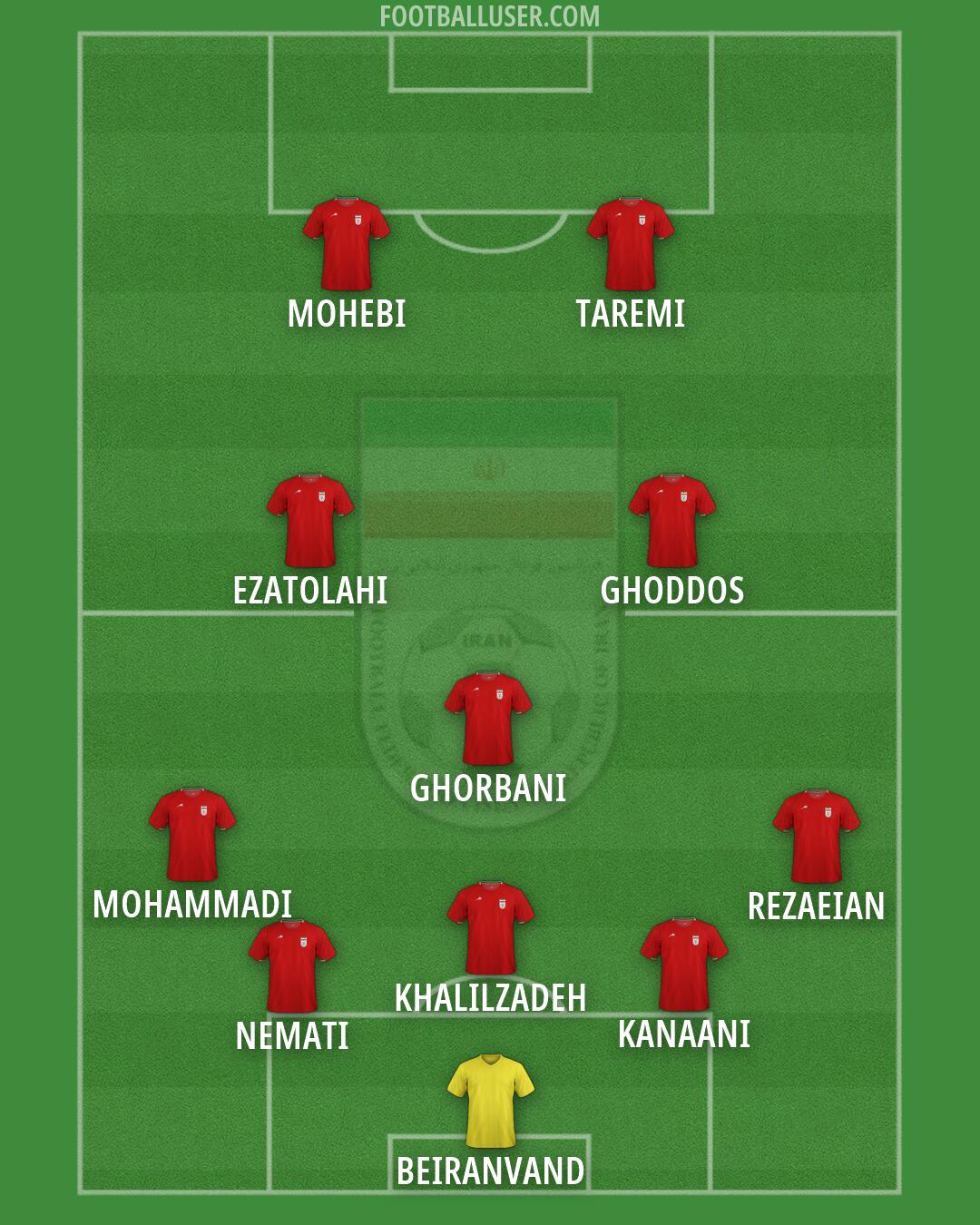

Iran National Football Team Formation
 June 27, 2026


Starting Lineup
BEIRANVAND · REZAEIAN · KANAANI · KHALILZADEH · NEMATI · MOHAMMADI · GHODDOS · GHORBANI · EZATOLAHI · TAREMI · MOHEBIIran aims to be defensively solid and rely on quick transitions using a 5-3-2 formation. This lineup is built to sit deep and absorb pressure before hitting teams on the break. By using a heavy defensive presence, Iran looks to stay compact and frustrate the opposition.
BEIRANVAND operates between the posts to command his area. The defensive unit uses a back five that functions as a narrow defensive block. KHALILZADEH holds the center as the primary central defender, while NEMATI and KANAANI act as the wide centre-backs to cover the channels. REZAEIAN and MOHAMMADI act as attacking wing backs, tasked with providing the width and tracking back to support the central three. The unit works together to squeeze the space and force the opponent to play wide.
The midfield operates as a three-man midfield with a carrier and a sitting player. GHORBANI sits in front of the back five to shield the defense and intercept passes. EZATOLAHI acts as a runner to connect the lines and drive forward with the ball, while GHODDOS looks to create from deep and recycle possession in the middle third. This trio works to compress the midfield and win the second ball when the team recovers it.
Up front, Iran employs two forwards in a partnership. TAREMI acts as a pressing centre-forward who can hold up the ball and play with his back to goal. MOHEBI works alongside him to make runs in behind and stretch the defense. The attack is built through direct play or long balls to the strikers, who then look to link up play between the lines or find the wing backs when they overlap.
One major tactical advantage of this formation is the ability to defend in a compact shape, making it very difficult for opponents to play through the middle. The presence of REZAEIAN and MOHAMMADI also allows for wide overloads when the team transitions into attack. This setup provides stability against teams that dominate possession.
Iran uses this formation to maintain a strong defensive foundation and exploit spaces on the break. It is best suited for matches against superior technical sides where controlling the defensive zone is the priority.